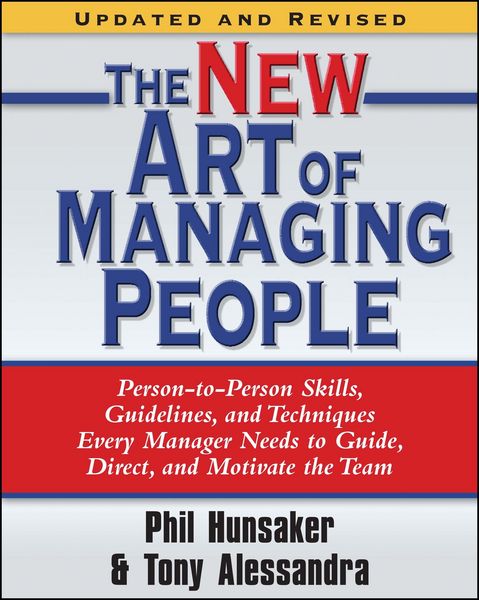
Produktbild: The New Art of Managing People, Updated and Revised

The New Art of Managing People, Updated and Revised Person-To-Person Skills, Guidelines, and Techniques Every Manager Needs to Guide, Direct, and Motivate the Team

Fr. 33.90

inkl. gesetzl. MwSt., Versandkostenfrei


Beschreibung

Produktdetails

Einband

Taschenbuch

Erscheinungsdatum

23.12.2008

Verlag

Free Press

Seitenzahl

368

Maße (L/B/H)

23.1/18.5/2.8 cm

Gewicht

499 g

Sprache

Englisch

ISBN

978-1-4165-5062-4

Beschreibung

Produktdetails

Einband

Taschenbuch

Erscheinungsdatum

23.12.2008

Verlag

Free Press

Seitenzahl

368

Maße (L/B/H)

23.1/18.5/2.8 cm

Gewicht

499 g

Sprache

Englisch

ISBN

978-1-4165-5062-4

Herstelleradresse

Libri GmbH
Europaallee 1
36244 Bad Hersfeld
DE

Email: gpsr@libri.de

Kundinnen und Kunden meinen

0 Bewertungen

Informationen zu Bewertungen

Zur Abgabe einer Bewertung ist eine Anmeldung im Konto notwendig. Die Authentizität der Bewertungen wird von uns nicht überprüft. Wir behalten uns vor, Bewertungstexte, die unseren Richtlinien widersprechen, entsprechend zu kürzen oder zu löschen.

Die Bewertungen sind nach Format, Anzahl Sterne und Datum sortiert.

Verfassen Sie die erste Bewertung zu diesem Artikel

Helfen Sie anderen Kund*innen durch Ihre Meinung

Kundinnen und Kunden meinen

0 Bewertungen filtern

Die Leseprobe wird geladen.
  • Produktbild: The New Art of Managing People, Updated and Revised

  • Contents

    Preface

    1 Building Productive Managerial Relationships

    The Interactive Approach to Managing People

    Principles of Interactive Management

    Increasing Employees' On-The-Job Effectiveness

    Understanding People

    Interactive Communication Skills

    Constructive Manipulation

    What to Expect

    ADJUSTING EFFECTIVELY TO PERSONAL STYLE DIFFERENCES

    2 Learning How to Learn


    The Learning Model

    Dimensions of Learning

    Individual Learning Styles

    Learning Modes

    Learning Style Types

    Characteristics of Learning Style Types

    Learning Styles and Problem Solving

    Guidelines for Managing the Learning Process

    3 Doing Unto Others

    Behavioral Styles and Interpersonal Problems

    Unproductive Behavior

    Identifying Behavioral Styles

    Behavioral Flexibility

    Behavioral Styles and Interactive Management

    4 Deciding How to Decide

    The Dimensions of Decision Style

    Four Basic Decision Styles

    Back-Up Styles

    Mixed Styles

    Characteristics of Each Decision Style

    Is There a "Best" Decision Style?

    Advantages of Each Style

    Problems of Each Style

    Coping Productively with Other Styles

    Applications to Integrative Management

    5 Analyzing Transactional Styles

    Ego States

    Transactions

    Strokes

    Life Positions

    Trading Stamps

    Use of Time

    Games

    Stopping Games

    Interventions

    TA and Interactive Management

    INTERACTIVE COMMUNICATION SKILLS

    6 The Art of Questioning


    Why People Ask Questions

    Types of Questions

    Questioning Strategies and Techniques

    7 The Power of Listening

    Gripes about Managers

    Categories of Listeners

    Barriers to Effective Listening

    The Nineteen Commandments of Power Listening

    Exercises to Improve Your Listening Skills

    Listening and Interactive Management

    8 Projecting the Appropriate Image

    Components of Image

    Image and Interactive Management

    9 Communicating Through Voice Tones

    10 Using Body Language Effectively


    Interpreting Body Language Gestures

    Interpreting Gesture Clusters

    Using Body Language

    11 Spatial Arrangements Say Things

    Territory

    Environment

    Things

    Using Territory and Environment to Facilitate Communication

    Personal Space

    Interpersonal Space

    Interpersonal Space Strategies

    Special Arrangement Determinants

    Implications for Interactive Management

    12 How Your Use of Time Talks

    Accuracy

    Scarcity

    Repetition

    13 Making Sure with Feedback

    Types of Feedback

    Using Feedback Effectively

    INTERACTIVE PROBLEM-SOLVING

    14 Problem-Solving Together


    Problem Definition

    Action Planning

    Implementation

    Follow-Through

    15 Defining the Problem

    Step 1: Establish Trust Bond

    Step 2: Clarify Objectives

    Step 3: Assess Current Situation

    Step 4: Identify Problems

    Step 5: Define and Analyze Problems

    Step 6: Agree on Problems to be Solved

    16 Developing Action Plans

    Step 1: Check the Trust Bond

    Step 2: Establish Decision-Making Criteria

    Step 3: Develop Action Alternatives

    Step 4: Evaluate Action Alternatives

    Step 5: Decide on an Action Plan

    17 Implementing Action

    Step 1: Check the Trust Bond

    Step 2: Assign Tasks and Responsibilities

    Step 3: Set Up an Implementation Schedule

    Step 4: Reinforce Commitment and Activate

    18 Following Through

    Step 1: Check the Trust Bond

    Step 2: Establish Criteria for Success

    Step 3: Determine How to Measure Performance

    Step 4: Monitor Results

    Step 5: Take Corrective Action

    19 What Do You Do with What You've Learned?

    Use the Interactive Management Problem-Solving Process to Improve Your Interactive Management Skills

    Index