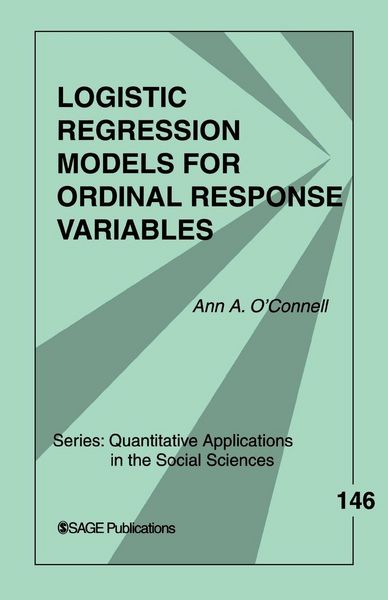
• Produktbild: Logistic Regression Models for Ordinal Response Variables
  • Produktbild: Logistic Regression Models for Ordinal Response Variables

Logistic Regression Models for Ordinal Response Variables

Fr. 71.90

inkl. gesetzl. MwSt., Versandkostenfrei


Beschreibung

Produktdetails

Einband

Taschenbuch

Erscheinungsdatum

01.11.2005

Verlag

Sage Publications

Seitenzahl

120

Maße (L/B/H)

21.6/14/0.7 cm

Gewicht

170 g

Sprache

Englisch

ISBN

978-0-7619-2989-5

Beschreibung

Produktdetails

Einband

Taschenbuch

Erscheinungsdatum

01.11.2005

Verlag

Sage Publications

Seitenzahl

120

Maße (L/B/H)

21.6/14/0.7 cm

Gewicht

170 g

Sprache

Englisch

ISBN

978-0-7619-2989-5

Noch keine Bewertungen vorhanden

Verfassen Sie die erste Bewertung zu diesem Artikel

Helfen Sie anderen Kundinnen und Kunden durch Ihre Meinung.

Kundinnen und Kunden meinen

Bewertungen (0)

Weitere Artikel finden Sie in

  • Produktbild: Logistic Regression Models for Ordinal Response Variables
  • Produktbild: Logistic Regression Models for Ordinal Response Variables
  • List of Tables and Figures
    Series Editor's Introduction
    Acknowledgments
    1. Introduction
    Purpose of This Book
    Software and Syntax
    Organization of the Chapters
    2. Context: Early Childhood Longitudinal Study
    Overview of the Early Childhood Longitudinal Study
    Practical Relevance of Ordinal Outcomes
    Variables in the Models
    3. Background: Logistic Regression
    Overview of Logistic Regression
    Assessing Model Fit
    Interpreting the Model
    Measures of Association
    EXAMPLE 3.1: Logistic Regression
    Comparing Results Across Statistical Programs
    4. The Cumulative (Proportional) Odds Model for Ordinal Outcomes
    Overview of the Cumulative Odds Model
    EXAMPLE 4.1: Cumulative Odds Model With a Single Explanatory Variable
    EXAMPLE 4.2: Full-Model Analysis of Cumulative Odds
    Assumption of Proportional Odds and Linearity in the Logit
    Alternatives to the Cumulative Odds Model
    EXAMPLE 4.3: Partial Proportional Odds
    5. The Continuation Ratio Model
    Overview of the Continuation Ratio Model
    Link Functions
    Probabilities of Interest
    Directionality of Responses and Formation of the Continuation Ratios
    EXAMPLE 5.1: Continuation Ratio Model With Logit Link and Restructuring the Data
    EXAMPLE 5.2: Continuation Ratio Model With Complementary Log-Log Link
    Choice of Link and Equivalence of Two Clog-Log Models
    Choice of Approach for Continuation Ratio Models
    EXAMPLE 5.3: Full-Model Continuation Ratio Analyses for the ECLS-K Data
    6. The Adjacent Categories Model
    Overview of the Adjacent Categories Model
    EXAMPLE 6.1: Gender-Only Model
    EXAMPLE 6.2: Adjacent Categories Model With Two Explanatory Variables
    EXAMPLE 6.3: Full Adjacent Categories Model Analysis
    7. Conclusion
    Considerations for Further Study
    Notes
    Appendix A: Chapter 3
    Appendix B: Chapter 4
    Appendix C: Chapter 5
    Appendix D: Chapter 6
    References
    Index
    About the Author