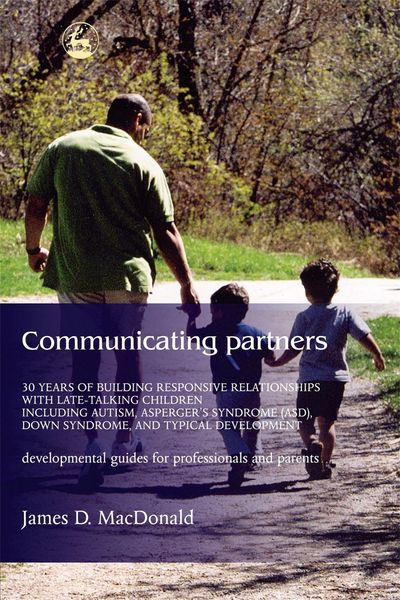
Communicating Partners 30 Years of Building Responsive Relationships with Late Talking Children Including Autism, Asperger's Syndrome (Asd), Down Syndrome, and Typical Devel
-
- Taschenbuch ausgewählt
- eBook
-
Sprache:Englisch
-
Verlag:Jessica Kingsley Publishers Ltd
Fr. 51.90
inkl. gesetzl. MwSt.,
Beschreibung
Produktdetails
Einband
Taschenbuch
Erscheinungsdatum
15.05.2004
Verlag
Jessica Kingsley Publishers LtdSeitenzahl
336
Maße (L/B/H)
23.1/15.6/2.2 cm
Gewicht
501 g
Sprache
Englisch
ISBN
978-1-84310-758-3
Communicating Partners, the result of over thirty years of clinical practice and research work with pre-verbal and verbal children with language delays, offers an innovative approach to working with late talking children that focuses on developing relationships through mutual understanding. Providing detailed maps of what children and their life partners need to do to ensure effective social relationships, the program focuses on five key stages of communication development - interactive play, nonverbal communication, social language, conversation, and civil behavior - and five life-long responsive strategies to use every day to build relationships within the child's own world. Communicating Partners addresses issues such as:
* What does a child need to do before language?
* What are effective ways to help a child socialize and communicate from early play through civil conversations?
* How have parents successfully helped children learn to communicate at home?
* How can a child develop socially effective language and conversation skills?
* How can a child with an autistic spectrum disorder, Down Syndrome or other significant delays develop rich social relationships?
* What have families done to build warm social relationships with their children?
* What is developmentally effective therapy and education when social and communicative delays are of major concern?
Illustrated with personal stories and research findings, and containing a wealth of practical suggestions to help parents, teachers, and professionals understand their child's world, Communicating Partners is an invaluable resource for all those interacting and working with late talking children.
Kundinnen und Kunden meinen
Verfassen Sie die erste Bewertung zu diesem Artikel
Helfen Sie anderen Kund*innen durch Ihre Meinung