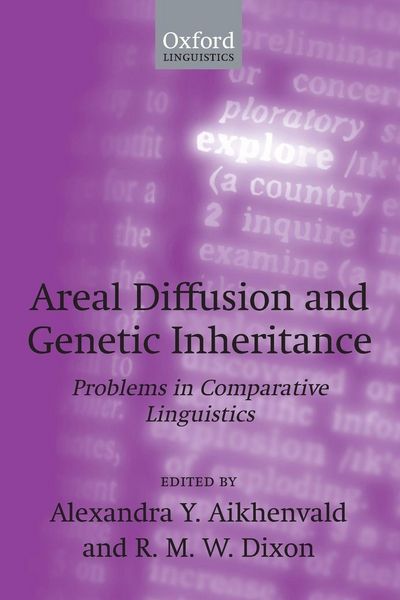
Areal Diffusion and Genetic Inheritance Problems in Comparative Linguistics
-
- Hardcover
- Taschenbuch ausgewählt
-
Sprache:Englisch
Fr. 112.00
inkl. gesetzl. MwSt.,
Beschreibung
Produktdetails
Einband
Taschenbuch
Erscheinungsdatum
01.04.2006
Abbildungen
Numerous maps, tables and line drawings
Herausgeber
Aikhenvald Alexandra Y. + weitereVerlag
Oxford University PressSeitenzahl
470
Maße (L/B/H)
23.4/15.6/2.5 cm
Gewicht
708 g
Sprache
Englisch
ISBN
978-0-19-928308-8
Two languages can resemble each other in the categories, constructions, and types of meaning they use; and in the forms they employ to express these. Such resemblances may be the consequence of universal characteristics of language, of chance or coincidence, of the borrowing by one language of another's words, or of the diffusion of grammatical, phonetic, and phonological characteristics that takes place when languages come into contact. Languages sometimes show likeness because they have borrowed not from each other but from a third language. Languages that come from the same ancestor may have similar grammatical categories and meanings expressed by similar forms: such languages are said to be genetically affiliated. This book considers how and why forms and meanings of different languages at different times may resemble one another. Its editors and authors aim (a) to explain and identify the relationship between areal diffusion and the genetic development of languages, and (b) to discover the means of distinguishing what may cause one language to share the characteristics of another. The introduction outlines the issues that underlie these aims, introduces the chapters which follow, and comments on recurrent conclusions by the contributors. The problems are formidable and the pitfalls numerous: for example, several of the authors draw attention to the inadequacy of the family tree diagram as the main metaphor for language relationship. The authors range over Ancient Anatolia, Modern Anatolia, Australia, Amazonia, Oceania, Southeast and East Asia, and Sub-Saharan Africa. The book includes an archaeologist's view on what material evidence offers to explain cultural and linguistic change, and a general discussion of which kinds of linguistic feature can and cannot be borrowed. The chapters are accessibly-written and illustrated by twenty maps. The book will interest all students of the causes and consequences of language change and evolution.
Noch keine Bewertungen vorhanden
Verfassen Sie die erste Bewertung zu diesem Artikel
Helfen Sie anderen Kundinnen und Kunden durch Ihre Meinung.