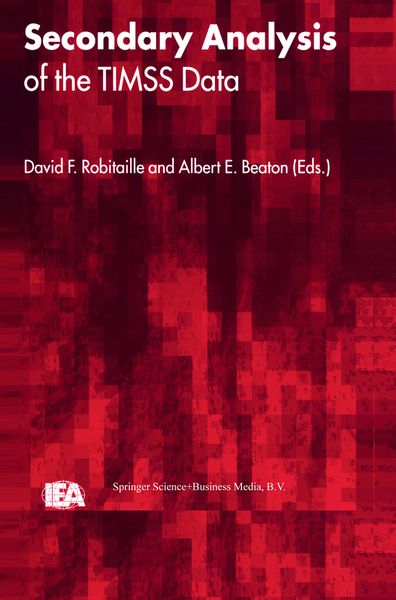
Secondary Analysis of the TIMSS Data
-
- Hardcover ausgewählt
- Taschenbuch
-
Sprache:Englisch
Fr. 138.00
inkl. gesetzl. MwSt.,
Beschreibung
Produktdetails
Einband
Gebundene Ausgabe
Erscheinungsdatum
30.09.2002
Herausgeber
David F. Robitaille + weitereVerlag
Springer NetherlandSeitenzahl
429
Maße (L/B/H)
24.1/16/2.9 cm
Gewicht
818 g
Auflage
2002
Sprache
Englisch
ISBN
978-1-4020-0859-7
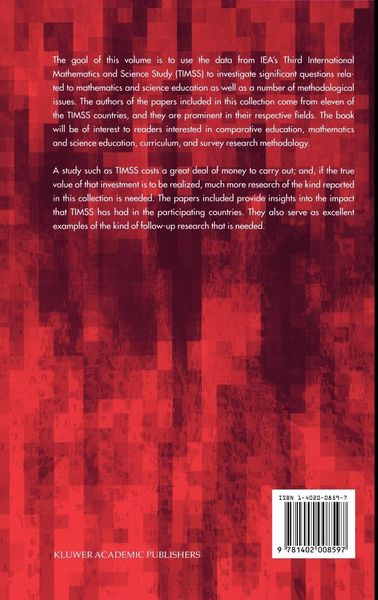
Researchers who participate in IEA studies have a unique opportunity to work collaboratively with their counterparts from many different countries and disciplinary backgrounds over a period of several years on questions of shared academic interest. Once the data for a given study have been collected and the first round of international reports published, however, opportunities for that kind of collaboration tend to be much less frequent. A major strength of IEA studies compared to other large-scale, international studies is that they are classroom based, thereby making it possible for researchers and policy makers to investigate linkages between students’ achievement and a wide range of variables. Those variables could be related to instructional practices, to students’ and teachers’ background and attitudes, to school organizational patterns, or to opportunity to learn, to name a few. The research questions that TIMSS was designed to address make it clear that these kinds of relational, multi-variate analyses were among the major goals of the project. The international reports of the TIMSS–95 results that were published by the International Study Center at Boston College between 1996 and 1999 were intended to provide comprehensive coverage of the basic findings of the study. They were not intended to provide in-depth analyses of research and policy issues; instead, their main purpose was to make the basic findings of the study widely available in a timely manner. This they certainly did.
Noch keine Bewertungen vorhanden
Verfassen Sie die erste Bewertung zu diesem Artikel
Helfen Sie anderen Kundinnen und Kunden durch Ihre Meinung.