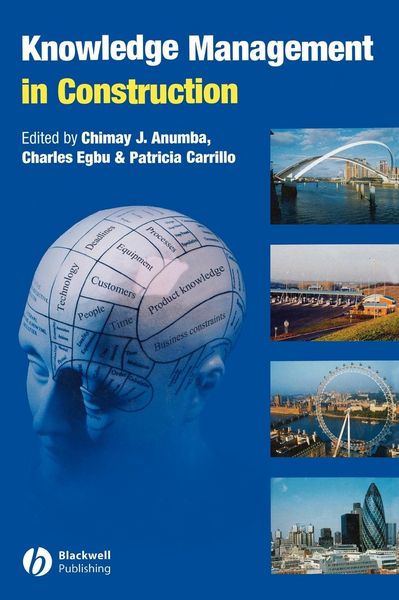
Produktbild: Knowledge Management Construction

Knowledge Management Construction

Fr. 183.00

inkl. gesetzl. MwSt., Versandkostenfrei


Beschreibung

Produktdetails

Einband

Gebundene Ausgabe

Erscheinungsdatum

27.05.2005

Herausgeber

Anumba Chimay J. + weitere

Verlag

Wiley

Seitenzahl

244

Maße (L/B/H)

26/18.3/1.8 cm

Gewicht

662 g

Sprache

Englisch

ISBN

978-1-4051-2972-5

Beschreibung

Produktdetails

Einband

Gebundene Ausgabe

Erscheinungsdatum

27.05.2005

Herausgeber

Verlag

Wiley

Seitenzahl

244

Maße (L/B/H)

26/18.3/1.8 cm

Gewicht

662 g

Sprache

Englisch

ISBN

978-1-4051-2972-5

Kundinnen und Kunden meinen

0 Bewertungen

Informationen zu Bewertungen

Zur Abgabe einer Bewertung ist eine Anmeldung im Konto notwendig. Die Authentizität der Bewertungen wird von uns nicht überprüft. Wir behalten uns vor, Bewertungstexte, die unseren Richtlinien widersprechen, entsprechend zu kürzen oder zu löschen.

Die Bewertungen sind nach Format, Anzahl Sterne und Datum sortiert.

Verfassen Sie die erste Bewertung zu diesem Artikel

Helfen Sie anderen Kund*innen durch Ihre Meinung

Kundinnen und Kunden meinen

0 Bewertungen filtern

  • Produktbild: Knowledge Management Construction
  • Chapter 1 INTRODUCTION.

    Chapter 2 NATURE AND DIMENSIONS OF KNOWLEDGE MANAGEMENT.

    2.1 Introduction; 2.2 Why knowledge management now? The Drivers; 2.3 Nature of knowledge; 2.4 Extra organisational knowledge and absorptive capacity; 2.5 Key knowledge processes; 2.6 Conclusions.

    Chapter 3 CONSTRUCTION AS A KNOWLEDGE-BASED INDUSTRY.

    3.1 Introduction; 3.2 Construction industry and knowledge intensive products and services; 3.3 Knowledge production in Construction; 3.4 Communicating and sharing knowledge; 3.5 Creating and sustaining a knowledge culture; 3.6 Conclusions.

    Chapter 4 THE BUSINESS CASE FOR KNOWLEDGE MANAGEMENT.

    4.1 Introduction; 4.2 What does Knowledge Management mean to Construction?; 4.3 What Knowledge Management strategy should be adopted?; 4.4 Delivering Knowledge Management in practice; 4.5 A business case for Knowledge Management; 4.6 The Future.

    Chapter 5 ORGANISATIONAL READINESS FOR KNOWLEDGE MANAGEMENT.

    5.1 Introduction; 5.2 Importance of knowledge lifecycle management (KLM); 5.3 Preparing the organisational context for KLM; 5.4 Conclusions.

    Chapter 6 TOOLS AND TECHNIQUES FOR KNOWLEDGE MANAGEMENT.

    6.1 Introduction; 6.2 Knowledge management tools; 6.3 Selecting Knowledge management tools; 6.4 The SeLEKT approach; 6.5 Conclusions.

    Chapter 7 CROSS-PROJECT KNOWLEDGE MANAGEMENT.

    7.1 Introduction; 7.2 Nature of projects; 7.3 Construction projects; 7.4 Cross project knowledge transfer; 7.5 Live capture and re-use of project knowledge; 7.6 Conclusions.

    Chapter 8 KNOWLEDGE MANAGEMENT AS A DRIVER FOR INNOVATION.

    8.1 Introduction; 8.2 Knowledge management and innovations - building and maintaining capabilities; 8.3 Knowledge management and improved innovations: Issues of strategy, process, structure, culture and technology; 8.4 Managing knowledge for exploitations: Implications for managers; 8.5 Conclusions.

    Chapter 9 PERFORMANCE MEASUREMENT IN KNOWLEDGE MANAGEMENT.

    9.1 Introduction; 9.2 Why measure the performance of knowledge management and knowledge assets; 9.3 Types of performance measures; 9.4 Measurement approaches; 9.5 Application tools; 9.6 Conclusions.

    Chapter 10 KM STATEGY DEVELOPMENT: A CLEVER APPROACH.

    10.1 Introduction; 10.2 The CLEVER project; 10.3 The Clever Framework; 10.4 Utilisation and Evaluation of the Framework; 10.5 Conclusions;.

    Chapter 11 CORPORATE MEMORY.

    11.1 Introduction; 11.2 Research Methodology; 11.3 Related Research; 11.4 Tacit knowledge, capture, sharing and reuse; 11.5 Tacit and explicit knowledge capture, sharing and reuse; 11.6 Conclusions.

    Chapter 12 BUILDING A KNOWLEDGE SHARING CULTURE IN CONSTRUCTION PROJECT TEAMS.

    12.1 Introduction; 12.2 Case study; 12.3 Discussion; 12.4 Conclusions.

    Chapter 13 CONCLUDING NOTES.

    13.1 Introduction; 13.2 Summary; 13.3 Benefits of knowledge management to construction organisations; 13.4 Issues in knowledge management implementation; Future directions