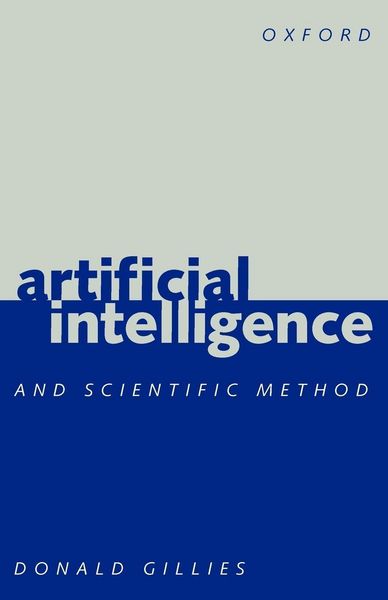
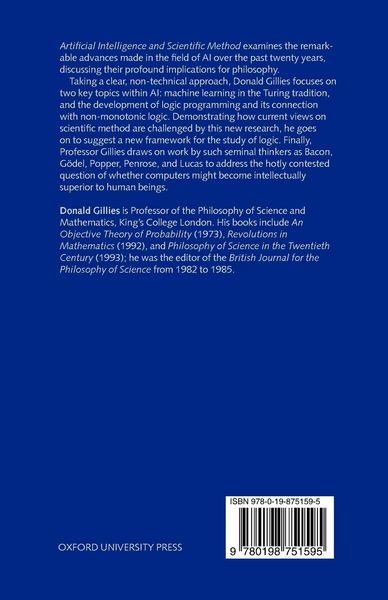
• Produktbild: Artificial Intelligence and Scientific Method
  • Produktbild: Artificial Intelligence and Scientific Method

Artificial Intelligence and Scientific Method

Fr. 54.90

inkl. gesetzl. MwSt., Versandkostenfrei


Beschreibung

Produktdetails

Einband

Taschenbuch

Erscheinungsdatum

05.09.1996

Abbildungen

line figures, tables

Verlag

Oxford University Press

Seitenzahl

192

Maße (L/B/H)

21.6/14/1.1 cm

Gewicht

249 g

Sprache

Englisch

ISBN

978-0-19-875159-5

Beschreibung

Produktdetails

Einband

Taschenbuch

Erscheinungsdatum

05.09.1996

Abbildungen

line figures, tables

Verlag

Oxford University Press

Seitenzahl

192

Maße (L/B/H)

21.6/14/1.1 cm

Gewicht

249 g

Sprache

Englisch

ISBN

978-0-19-875159-5

Herstelleradresse

Libri GmbH
Europaallee 1
36244 Bad Hersfeld
DE

Email: gpsr@libri.de

Noch keine Bewertungen vorhanden

Verfassen Sie die erste Bewertung zu diesem Artikel

Helfen Sie anderen Kundinnen und Kunden durch Ihre Meinung.

Kundinnen und Kunden meinen

Bewertungen (0)

  • Produktbild: Artificial Intelligence and Scientific Method
  • Produktbild: Artificial Intelligence and Scientific Method

    • Preface


    • Acknowledgements


    • Chapter 1: The Inductivist Controversy, or Bacon versus Popper


    • 1.1: Bacon's Inductivism


    • 1.2: Popper's Falsificationism


    • 1.3: Kepler's Discovery of the Laws of Planetary Motion


    • 1.4: The Discovery of the Sulphonamide Drugs


    • Chapter 2: Machine Learning in the Turing Tradition


    • 2.1: The Turing Tradition


    • 2.2: The Practical Problem: Expert Systems and Feigenbaum's Bottleneck


    • 2.3: Attribute-based Learning, Decision Trees, and Quinlan's ID3


    • 2.4: GOLEM as an example of Relational Learning


    • 2.5: Bratko's summary of the successes of Machine Learning in the Turing Tradition, 1992


    • 2.6: GOLEM's Discovery of a Law of Nature


    • Chapter 3: How Advances in Machine Learning affect the Inductivist Controversy


    • 3.1: Bacon's Example of Heat


    • 3.2: The Importance of Falsification


    • 3.3: Bacon's Method has only recently come to be used


    • 3.4: The Need for Background Knowledge


    • Chapter 4: Logic and Programming and a New Framework for Logic


    • 4.1: The Development of PROLOG


    • 4.2: PROLOG as a Non-Monotonic Logic


    • 4.3: Two Examples of Translations from One Logical System to Another


    • 4.4: Logic = Inference + Control


    • 4.5: PROLOG introduces Control into Deductive Logic


    • 4.6: PROLOG and Certainty. Is Logic a priori or empirical?


    • Chapter 5: Can there be an Inductive Logic?


    • 5.1: The Divergence between Deductive and Inductive Logic (up to the early 1970s)


    • 5.2: Inductive Logic as Inference + Control


    • 5.3: Confirmation Values as Control in a Deductive Logic


    • 5.4: The Empirical Testing of Rival Logics


    • Chapter 6: Do Gödel's Incompleteness Theorems place a Limit on Artificial Intelligence?


    • 6.1: Anxieties caused by Advances in AI


    • 6.2: Informal Exposition of Gödel's Incompleteness Theorems


    • 6.3: The Lucas Argument


    • 6.4: Objections to the Lucas Argument: i) Possible Limitations on Self-Knowledge


    • 6.5: Objections to the Lucas Argument: ii) Possible Additions of Learning Systems


    • 6.6: Why Advances in Computing are more likely to Stimulate Human Thinking than to Render it Superfluous


    • Notes References Index