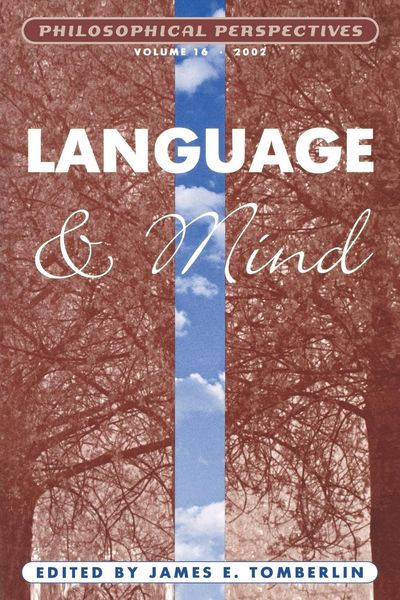
Produktbild: Tomberlin: Language and Mind

Tomberlin: Language and Mind Philosophical Perspectives

Fr. 68.90

inkl. gesetzl. MwSt., Versandkostenfrei


Beschreibung

Produktdetails

Einband

Taschenbuch

Erscheinungsdatum

04.11.2002

Herausgeber

James E. Tomberlin

Verlag

Wiley

Seitenzahl

472

Maße (L/B/H)

22.9/15.2/2.5 cm

Gewicht

626 g

Sprache

Englisch

ISBN

978-0-631-23409-8

Beschreibung

Produktdetails

Einband

Taschenbuch

Erscheinungsdatum

04.11.2002

Herausgeber

James E. Tomberlin

Verlag

Wiley

Seitenzahl

472

Maße (L/B/H)

22.9/15.2/2.5 cm

Gewicht

626 g

Sprache

Englisch

ISBN

978-0-631-23409-8

Noch keine Bewertungen vorhanden

Verfassen Sie die erste Bewertung zu diesem Artikel

Helfen Sie anderen Kundinnen und Kunden durch Ihre Meinung.

Kundinnen und Kunden meinen

Bewertungen (0)

  • Produktbild: Tomberlin: Language and Mind
  • Part I: Demonstratives and Anaphora:.

    1. Competence with Demonstratives: James Higginbotham (University of Southern California).

    2. Does Syntax Reveal Semantics? A Case Study of Complex Demonstratives: Kent Johnson (University of California, Irvine) and Ernie Lepore (Rutgers University).

    3. Reference and Anaphora: R.M. Sainsbury (King's College, London).

    Part II: Meaning and Naming:.

    4. Giorgione Was So-Called Because of His Name: Kent Bach (San Fransisco State University).

    5. Truth-Conditional Pragmatics: Anne L. Bezuidenhout (University of South Carolina).

    6. On Sense and Intention: David Chalmers (University of Arizona).

    7. Do Adjectives Conform to Compositionality?: Marga Reimer (University of Arizona).

    Part III: Belief and Privileged Access.

    8. Forms of Externalism and Privileged Access: Michael McKinsey (Wayne State University).

    9. De Re and De Dicto: Against the Conventional Wisdom: Kenneth A. Taylor (Stanford University).

    10. The Aim of Belief: Ralph Wedgwood (Merton College, Oxford).

    Part IV: Modality, Concepts, and Time:.

    11. The Source of Necessity: Robert Hale (University of Glasgow).

    12. Modality and What is Said: Jason Stanley (University of Michigan).

    13. The Emperor's New Concepts: Neil Tennant (Ohio State University).

    14. Time, Idealism, and the Identity of Indiscernibles: James Van Cleve (James Van Cleve).

    Part V: Paradox:.

    15. The Resolution of Russell's Paradox in Principia Mathematica: Bernard Linsky (University of Alberta).

    16. Vagueness and the Sorites Paradox: Kirk Ludwig and Greg Ray (Both University of Florida).