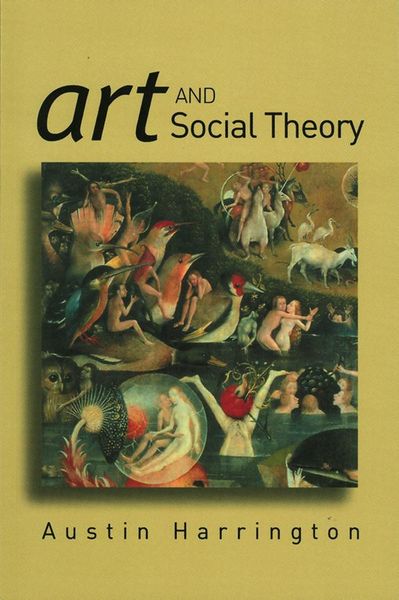
Produktbild: Art and Social Theory

Art and Social Theory Sociological Arguments in Aesthetics

Fr. 93.90

inkl. gesetzl. MwSt., Versandkostenfrei


Beschreibung

Produktdetails

Einband

Gebundene Ausgabe

Erscheinungsdatum

05.03.2004

Verlag

Wiley

Seitenzahl

248

Maße (L/B/H)

23.5/16.4/2.3 cm

Gewicht

490 g

Sprache

Englisch

ISBN

978-0-7456-3038-0

Beschreibung

Produktdetails

Einband

Gebundene Ausgabe

Erscheinungsdatum

05.03.2004

Verlag

Wiley

Seitenzahl

248

Maße (L/B/H)

23.5/16.4/2.3 cm

Gewicht

490 g

Sprache

Englisch

ISBN

978-0-7456-3038-0

Kundinnen und Kunden meinen

0 Bewertungen

Informationen zu Bewertungen

Zur Abgabe einer Bewertung ist eine Anmeldung im Konto notwendig. Die Authentizität der Bewertungen wird von uns nicht überprüft. Wir behalten uns vor, Bewertungstexte, die unseren Richtlinien widersprechen, entsprechend zu kürzen oder zu löschen.

Die Bewertungen sind nach Format, Anzahl Sterne und Datum sortiert.

Verfassen Sie die erste Bewertung zu diesem Artikel

Helfen Sie anderen Kund*innen durch Ihre Meinung

Kundinnen und Kunden meinen

0 Bewertungen filtern

  • Produktbild: Art and Social Theory
  • List of Illustrations.

    Acknowledgements.

    Introduction.

    1. Conceptions and Approaches.

    Metaphysical conceptions of art.

    Sociological conceptions of art.

    Humanistic art history.

    Marxist social history of art.

    Cultural studies, cultural materialism and postmodernism.

    Institutional theories of art in analytical philosophy.

    Anthropological studies of art.

    Empirical sociology of contemporary arts institutions.

    Conclusion.

    2. Aesthetic Value and Political Value.

    Value-relevance and value-neutrality.

    Liberal-humanistic art scholarship.

    Socialist criticism.

    Feminist criticism.

    Postcolonial criticism.

    Sociology, politics and aesthetics.

    Conclusion.

    3 Production and Socioeconomic Structure.

    Art and social class structure: Marxist theories.

    Art and social evolution: Pitirim Sorokin, Arnold Hauser and Robert Witkin.

    Patronage: the church, the monarchy and the nobility.

    Arts markets in early modern Europe.

    The state and the market in twentieth-century arts funding.

    Conclusion.

    4. Consumption and Aesthetic Autonomy.

    Kantian aesthetics.

    Leisure, gentility and aesthetic autonomy.

    Art and cultural capital: Pierre Bourdieu.

    Arts consumption in the US.

    Aesthetic validity versus the sociology of taste.

    Conclusion.

    5. Ideology and Utopia.

    Origins of the critique of mass culture.

    Art in German idealist philosophy.

    Marx, Bloch and Lukács.

    Art, myth and religion in nineteenth-century high culture.

    Richard Wagner and Friedrich Nietzsche.

    Sublimation and civilization: Sigmund Freud and Herbert Marcuse.

    Conclusion.

    6. Modernity and Modernism.

    Aesthetic modernity after Charles Baudelaire.

    Max Weber: rationalization and the aesthetic sphere.

    Georg Simmel: money, style and sociability.

    Walter Benjamin: mourning and the messianic.

    Siegfried Kracauer: the redemption of physical reality.

    Theodor Adorno and the Frankfurt School.

    The Frankfurt School reassessed.

    Conclusion.

    7. Postmodernism and After.

    German aesthetic thought since 1945: from Heidegger to Habermas.

    French aesthetic thought since 1945: literary thinking after the Marquis de Sade.

    Postmodernism.

    Beyond postmodernism: autonomy and reflexivity.

    Globalization and the arts.

    Conclusion.

    Further Reading.

    References.

    Index