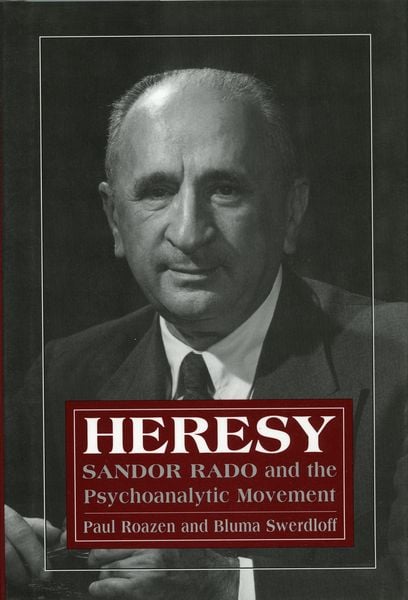
Roazen, P: Heresy Sandor Rado and the Psychoanalytic Movement
-
- Englisch ausgewählt
Fr. 134.00
inkl. gesetzl. MwSt.,
Beschreibung
Produktdetails
Einband
Gebundene Ausgabe
Erscheinungsdatum
07.07.1977
Verlag
Globe Pequot Publishing Group IncSeitenzahl
232
Maße (L/B/H)
21.7/14.8/2 cm
Gewicht
417 g
Sprache
Englisch
ISBN
978-1-56821-321-7
'My mother was the source of my brains and my father the mother of kindness,' said Sandor Rado, a Hungarian analyst whom Freud first embraced but with whom he was later displeased. In Heresy: Sandor Rado and the Psychoanalytic Movement, Paul Roazen and Bluma Swerdloff use interviews with Rado and his family to bring to life one of Freud's foremost followers, who later founded his own institute and psychodynamic orientation, one that focused on motivation rather than instinct. Based on interviews sponsored by the Columbia University Oral History Project, and including Freud's letters to Rado, this is a personal account of Rado and the life events that shaped him and his theories. Rado's life in late nineteenth-century Hungary, the enduring influence of his mother, his meetings with Freud (who made three slips of the tongue during their first encounter), his analysis with Karl Abraham, his affair with Helene Deutsch (she called it a 'companionship of suffering'), and Rank and Ferenczi's downfalls are vividly depicted. Rado's radical departure from Freudian theories of femininity, a reformulation daringly in keeping with today's gender debates, is also included. Rado freed himself from phallocentrism, abandoning the notions of universal castration fear and penis envy. He contended that men and woman are different, which does not mean that women are inferior. He saw women as having a greater emotional capacity based on their biological role as child bearers and nurturers. In 1963, as further evidence of his prescience, Rado prophesied the current crisis in psychotherapy, noting that 'the old-fashioned therapeutic practice will disappear for lack of money.' He anticipated that the influence of biochemical genetics was going to be 'so enormous that it would be bootless to try to outline it.' Dr. Swerdloff uses Rado's predictions and an analysis of the present debate to demonstrate the need to steer psychoanalysis toward a more scientific course.
Noch keine Bewertungen vorhanden
Verfassen Sie die erste Bewertung zu diesem Artikel
Helfen Sie anderen Kundinnen und Kunden durch Ihre Meinung.