
Beschreibung
Produktdetails
Einband
Gebundene Ausgabe
Erscheinungsdatum
23.04.2010
Abbildungen
XII, 185 p.
Verlag
Springer WienSeitenzahl
185
Maße (L/B/H)
24.1/16/1.7 cm
Gewicht
419 g
Auflage
2010
Sprache
Englisch
ISBN
978-3-211-92947-6
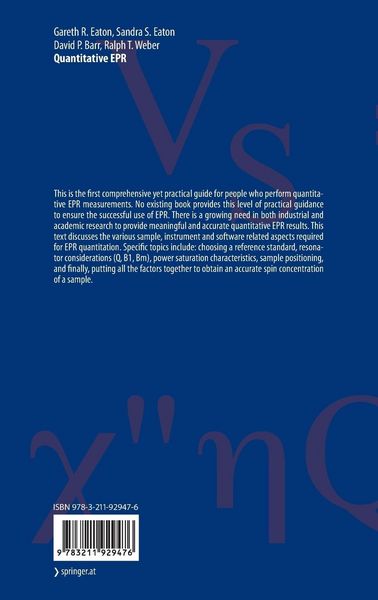
There is a growing need in both industrial and academic research to obtain accurate quantitative results from continuous wave (CW) electron paramagnetic resonance (EPR) experiments. This book describes various sample-related, instrument-related and software-related aspects of obtaining quantitative results from EPR expe- ments. Some speci?c items to be discussed include: selection of a reference standard, resonator considerations (Q, B ,B ), power saturation, sample position- 1 m ing, and ?nally, the blending of all the factors together to provide a calculation model for obtaining an accurate spin concentration of a sample. This book might, at ?rst glance, appear to be a step back from some of the more advanced pulsed methods discussed in recent EPR texts, but actually quantitative “routine CW EPR” is a challenging technique, and requires a thorough understa- ing of the spectrometer and the spin system. Quantitation of CW EPR can be subdivided into two main categories: (1) intensity and (2) magnetic ?eld/mic- wave frequency measurement. Intensity is important for spin counting. Both re- tive intensity quantitation of EPR samples and their absolute spin concentration of samples are often of interest. This information is important for kinetics, mechanism elucidation, and commercial applications where EPR serves as a detection system for free radicals produced in an industrial process. It is also important for the study of magnetic properties. Magnetic ?eld/microwave frequency is important for g and nuclear hyper?ne coupling measurements that re?ect the electronic structure of the radicals or metal ions.
Noch keine Bewertungen vorhanden
Verfassen Sie die erste Bewertung zu diesem Artikel
Helfen Sie anderen Kundinnen und Kunden durch Ihre Meinung.