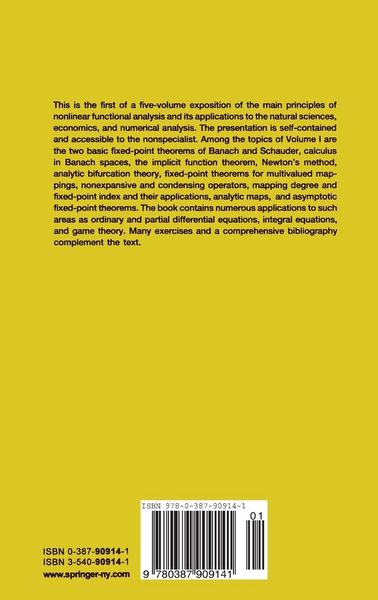

• Produktbild: Nonlinear Functional Analysis and its Applications
  • Produktbild: Nonlinear Functional Analysis and its Applications
  • Produktbild: Nonlinear Functional Analysis and its Applications

Nonlinear Functional Analysis and its Applications I: Fixed-Point Theorems

Fr. 300.00

inkl. gesetzl. MwSt., Versandkostenfrei


Beschreibung

Produktdetails

Einband

Gebundene Ausgabe

Erscheinungsdatum

13.12.1985

Verlag

Springer Us

Seitenzahl

909

Maße (L/B/H)

24.1/16/5.5 cm

Gewicht

1548 g

Auflage

1st ed. 1986. Corr. 3rd printing 1998

Übersetzt von

P.R. Wadsack

Sprache

Englisch

ISBN

978-0-387-90914-1

Beschreibung

Produktdetails

Einband

Gebundene Ausgabe

Erscheinungsdatum

13.12.1985

Verlag

Springer Us

Seitenzahl

909

Maße (L/B/H)

24.1/16/5.5 cm

Gewicht

1548 g

Auflage

1st ed. 1986. Corr. 3rd printing 1998

Übersetzt von

P.R. Wadsack

Sprache

Englisch

ISBN

978-0-387-90914-1

Herstelleradresse

Springer-Verlag KG
Sachsenplatz 4-6
1201 Wien
AT

Email: GPSR Kontakt

Noch keine Bewertungen vorhanden

Verfassen Sie die erste Bewertung zu diesem Artikel

Helfen Sie anderen Kundinnen und Kunden durch Ihre Meinung.

Kundinnen und Kunden meinen

Bewertungen (0)

  • Produktbild: Nonlinear Functional Analysis and its Applications
  • Produktbild: Nonlinear Functional Analysis and its Applications
  • Produktbild: Nonlinear Functional Analysis and its Applications
  • Fundamental Fixed-Point Principles.- 1 The Banach Fixed-Point Theorem and Iterative Methods.-
    1.1. The Banach Fixed-Point Theorem.-
    1.2. Continuous Dependence on a Parameter.-
    1.3. The Significance of the Banach Fixed-Point Theorem.-
    1.4. Applications to Nonlinear Equations.-
    1.5. Accelerated Convergence and Newton’s Method.-
    1.6. The Picard-Lindelof Theorem.-
    1.7. The Main Theorem for Iterative Methods for Linear Operator Equations.-
    1.8. Applications to Systems of Linear Equations.-
    1.9. Applications to Linear Integral Equations.- 2 The Schauder Fixed-Point Theorem and Compactness.-
    2.1. Extension Theorem.-
    2.2. Retracts.-
    2.3. The Brouwer Fixed-Point Theorem.-
    2.4. Existence Principle for Systems of Equations.-
    2.5. Compact Operators.-
    2.6. The Schauder Fixed-Point Theorem.-
    2.7. Peano’s Theorem.-
    2.8. Integral Equations with Small Parameters.-
    2.9. Systems of Integral Equations and Semilinear Differential Equations.-
    2.10. A General Strategy.-
    2.11. Existence Principle for Systems of Inequalities.- Applications of the Fundamental Fixed-Point Principles.- 3 Ordinary Differential Equations in B-spaces.-
    3.1. Integration of Vector Functions of One Real Variable t.-
    3.2. Differentiation of Vector Functions of One Real Variable t.-
    3.3. Generalized Picard-Lindelöf Theorem.-
    3.4. Generalized Peano Theorem.-
    3.5. Gronwall’s Lemma.-
    3.6. Stability of Solutions and Existence of Periodic Solutions.-
    3.7. Stability Theory and Plane Vector Fields, Electrical Circuits, Limit Cycles.-
    3.8. Perspectives.- 4 Differential Calculus and the Implicit Function Theorem.-
    4.1. Formal Differential Calculus.-
    4.2. The Derivatives of Fréchet and Gâteaux.-
    4.3. Sum Rule, Chain Rule, and Product Rule.-
    4.4. Partial Derivatives.-
    4.5. Higher Differentials and Higher Derivatives.-
    4.6. Generalized Taylor’s Theorem.-
    4.7. The Implicit Function Theorem.-
    4.8. Applications of the Implicit Function Theorem.-
    4.9. Attracting and Repelling Fixed Points and Stability.-
    4.10. Applications to Biological Equilibria.-
    4.11. The Continuously Differentiable Dependence of the Solutions of Ordinary Differential Equations in B-spaces on the Initial Values and on the Parameters.-
    4.12. The Generalized Frobenius Theorem and Total Differential Equations.-
    4.13. Diffeomorphisms and the Local Inverse Mapping Theorem.-
    4.14. Proper Maps and the Global Inverse Mapping Theorem.-
    4.15. The Suijective Implicit Function Theorem.-
    4.16. Nonlinear Systems of Equations, Subimmersions, and the Rank Theorem.-
    4.17. A Look at Manifolds.-
    4.18. Submersions and a Look at the Sard-Smale Theorem.-
    4.19. The Parametrized Sard Theorem and Constructive Fixed-Point Theory.- 5 Newton’s Method.-
    5.1. A Theorem on Local Convergence.-
    5.2. The Kantorovi? Semi-Local Convergence Theorem.- 6 Continuation with Respect to a Parameter.-
    6.1. The Continuation Method for Linear Operators.-
    6.2. B-spaces of Hölder Continuous Functions.-
    6.3. Applications to Linear Partial Differential Equations.-
    6.4. Functional-Analytic Interpretation of the Existence Theorem and its Generalizations.-
    6.5. Applications to Semi-linear Differential Equations.-
    6.6. The Implicit Function Theorem and the Continuation Method.-
    6.7. Ordinary Differential Equations in B-spaces and the Continuation Method.-
    6.8. The Leray—Schauder Principle.-
    6.9. Applications to Quasi-linear Elliptic Differential Equations.- 7 Positive Operators.-
    7.1. Ordered B-spaces.-
    7.2. Monotone Increasing Operators.-
    7.3. The Abstract Gronwall Lemma and its Applications to Integral Inequalities.-
    7.4. Supersolutions, Subsolutions, Iterative Methods, and Stability.-
    7.5. Applications.-
    7.6. Minorant Methods and Positive Eigensolutions.-
    7.7. Applications.-
    7.8. The Krein-Rutman Theorem and its Applications.-
    7.9. Asymptotic Linear Operators.-
    7.10. Main Theorem for Operators of Monotone Type.-
    7.11. Application to a Heat Conduction Problem.-
    7.12. Existence of Three Solutions.-
    7.13. Main Theorem for Abstract Hammerstein Equations in Ordered B-spaces.-
    7.14. Eigensolutions of Abstract Hammerstein Equations, Bifurcation, Stability, and the Nonlinear Krein-Rutman Theorem.-
    7.15. Applications to Hammerstein Integral Equations.-
    7.16. Applications to Semi-linear Elliptic Boundary-Value Problems.-
    7.17. Application to Elliptic Equations with Nonlinear Boundary Conditions.-
    7.18. Applications to Boundary Initial-Value Problems for Parabolic Differential Equations and Stability.- 8 Analytic Bifurcation Theory.-
    8.1. A Necessary Condition for Existence of a Bifurcation Point.-
    8.2. Analytic Operators.-
    8.3. An Analytic Majorant Method.-
    8.4. Fredholm Operators.-
    8.5. The Spectrum of Compact Linear Operators (Riesz—Schauder Theory).-
    8.6. The Branching Equations of Ljapunov—Schmidt.-
    8.7. The Main Theorem on the Generic Bifurcation From Simple Zeros.-
    8.8. Applications to Eigenvalue Problems.-
    8.9. Applications to Integral Equations.-
    8.10. Application to Differential Equations.-
    8.11. The Main Theorem on Generic Bifurcation for Multiparametric Operator Equations—The Bunch Theorem.-
    8.12. Main Theorem for Regular Semi-linear Equations.-
    8.13. Parameter-Induced Oscillation.-
    8.14. Self-Induced Oscillations and Limit Cycles.-
    8.15. Hopf Bifurcation.-
    8.16. The Main Theorem on Generic Bifurcation from Multiple Zeros.-
    8.17. Stability of Bifurcation Solutions.-
    8.18. Generic Point Bifurcation.- 9 Fixed Points of Multivalued Maps.-
    9.1. Generalized Banach Fixed-Point Theorem.-
    9.2. Upper and Lower Semi-continuity of Multivalued Maps.-
    9.3. Generalized Schauder Fixed-Point Theorem.-
    9.4. Variational Inequalities and the Browder Fixed-Point Theorem.-
    9.5. An Extremal Principle.-
    9.6. The Minimax Theorem and Saddle Points.-
    9.7. Applications in Game Theory.-
    9.8. Selections and the Marriage Theorem.-
    9.9. Michael’s Selection Theorem.-
    9.10. Application to the Generalized Peano Theorem for Differential Inclusions.- 10 Nonexpansive Operators and Iterative Methods.-
    10.1. Uniformly Convex B-spaces.-
    10.2. Demiclosed Operators.-
    10.3. The Fixed-Point Theorem of Browder, Göhde, and Kirk.-
    10.4. Demicompact Operators.-
    10.5. Convergence Principles in B-spaces.-
    10.6. Modified Successive Approximations.-
    10.7. Application to Periodic Solutions.- 11 Condensing Maps and the Bourbaki—Kneser Fixed-Point Theorem.-
    11.1. A Noncompactness Measure.-
    11.2. Applications to Generalized Interval Nesting.-
    11.3. Condensing Maps.-
    11.4. Operators with Closed Range and an Approximation Technique for Constructing Fixed Points.-
    11.5. Sadovskii’s Fixed-Point Theorem for Condensing Maps.-
    11.6. Fixed-Point Theorems for Perturbed Operators.-
    11.7. Application to Differential Equations in B-spaces.-
    11.8. The Bourbaki-Kneser Fixed-Point Theorem.-
    11.9. The Fixed-Point Theorems of Amann and Tarski.-
    11.10. Application to Interval Arithmetic.-
    11.11. Application to Formal Languages.- The Mapping Degree and the Fixed-Point Index.- 12 The Leray-Schauder Fixed-Point Index.-
    12.1. Intuitive Background and Basic Concepts.-
    12.2. Homotopy.-
    12.3. The System of Axioms.-
    12.4. An Approximation Theorem.-
    12.5. Existence and Uniqueness of the Fixed-Point Index in ?N.-
    12.6. Proof of Theorem 12.A..-
    12.7. Existence and Uniqueness of the Fixed-Point Index in B-spaces.-
    12.8. Product Theorem and Reduction Theorem.- 13 Applications of the Fixed-Point Index.-
    13.1. A General Fixed-Point Principle.-
    13.2. A General Eigenvalue Principle.-
    13.3. Existence of Multiple Solutions.-
    13.4. A Continuum of Fixed Points.-
    13.5. Applications to Differential Equations.-
    13.6. Properties of the Mapping Degree.-
    13.7. The Leray Product Theorem and Homeomorphisms.-
    13.8. The Jordan-Brouwer Separation Theorem and Brouwer’s Invariance of Dimension Theorem.-
    13.9. A Brief Glance at the History of Mathematics.-
    13.10. Topology and Intuition.-
    13.11. Generalization of the Mapping Degree.- 14 The Fixed-Point Index of Differentiable and Analytic Maps.-
    14.1. The Fixed-Point Index of Classical Analytic Functions.-
    14.2. The Leray—Schauder Index Theorem.-
    14.3. The Fixed-Point Index of Analytic Mappings on Complex B-spaces.-
    14.4. The Schauder Fixed-Point Theorem with Uniqueness.-
    14.5. Solution of Analytic Operator Equations.-
    14.6. The Global Continuation Principle of Leray—Schauder.-
    14.7. Unbounded Solution Components.-
    14.8. Applications to Systems of Equations.-
    14.9. Applications to Integral Equations.-
    14.10. Applications to Boundary-Value Problems.-
    14.11. Applications to Integral Power Series.- 15 Topological Bifurcation Theory.-
    15.1. The Index Jump Principle.-
    15.2. Applications to Systems of Equations.-
    15.3. Duality Between the Index Jump Principle and the Leray—Schauder Continuation Principle.-
    15.4. The Geometric Heart of the Continuation Method.-
    15.5. Stability Change and Bifurcation.-
    15.6. Local Bifurcation.-
    15.7. Global Bifurcation.-
    15.8. Application to Systems of Equations.-
    15.9. Application to Integral Equations.-
    15.10. Application to Differential Equations.-
    15.11. Application to Bifurcation at Infinity.-
    15.12. Proof of the Main Theorem.-
    15.13. Preventing Secondary Bifurcation.- 16 Essential Mappings and the Borsuk Antipodal Theorem.-
    16.1. Intuitive Introduction.-
    16.2. Essential Mappings and their Homotopy Invariance.-
    16.3. The Antipodal Theorem.-
    16.4. The Invariance of Domain Theorem and Global Homeomorphisms.-
    16.5. The Borsuk—Ulam Theorem and its Applications.-
    16.6. The Mapping Degree and Essential Maps.-
    16.7. The Hopf Theorem.-
    16.8. A Glance at Homotopy Theory.- 17 Asymptotic Fixed-Point Theorems.-
    17.1. The Generalized Banach Fixed-Point Theorem.-
    17.2. The Fixed-Point Index of Iterated Mappings.-
    17.3. The Generalized Schauder Fixed-Point Theorem.-
    17.4. Application to Dissipati ve Dynamical Systems.-
    17.5. Perspectives.- References.- Additional References to the Second Printing.- List of Symbols.- List of Theorems.- List of the Most Important Definitions.- Schematic Overviews.- General References to the Literature.- List of Important Principles.- of the Other Parts.