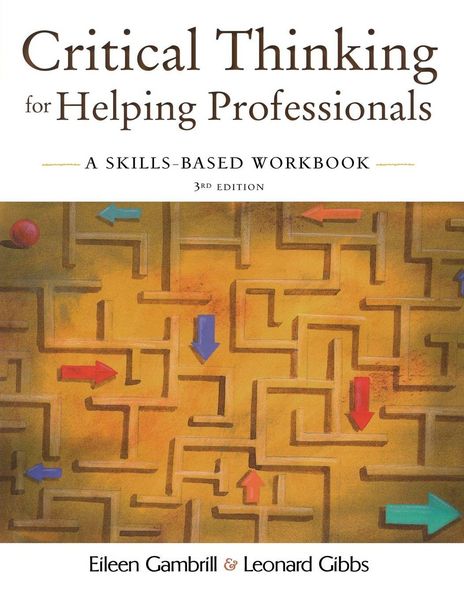
Produktbild: Critical Thinking for Helping Professionals

Critical Thinking for Helping Professionals A Skills-Based Workbook

Fr. 163.00

inkl. gesetzl. MwSt., Versandkostenfrei


Beschreibung

Produktdetails

Einband

Taschenbuch

Erscheinungsdatum

01.03.2009

Abbildungen

7 black and white line illustrations

Verlag

Oxford University Press

Seitenzahl

426

Maße (L/B/H)

28/21.6/2.3 cm

Gewicht

1066 g

Sprache

Englisch

ISBN

978-0-19-533095-3

Beschreibung

Produktdetails

Einband

Taschenbuch

Erscheinungsdatum

01.03.2009

Abbildungen

7 black and white line illustrations

Verlag

Oxford University Press

Seitenzahl

426

Maße (L/B/H)

28/21.6/2.3 cm

Gewicht

1066 g

Sprache

Englisch

ISBN

978-0-19-533095-3

Herstelleradresse

Libri GmbH
Europaallee 1
36244 Bad Hersfeld
DE

Email: gpsr@libri.de

Noch keine Bewertungen vorhanden

Verfassen Sie die erste Bewertung zu diesem Artikel

Helfen Sie anderen Kundinnen und Kunden durch Ihre Meinung.

Kundinnen und Kunden meinen

Bewertungen (0)

Die Leseprobe wird geladen.
  • Produktbild: Critical Thinking for Helping Professionals
    • PART 1 CRITICAL THINKING: WHAT IT IS AND WHY IT IS IMPORTANT

    • Introduction: The Role of Critical Thinking in the Helping Professions

    • Exercise 1 Making Decisions About Intervention

    • Exercise 2 Reviewing Your Beliefs About Knowledge

    • PART 2 RECOGNIZING PROPAGANDA IN HUMAN SERVICES ADVERTISING

    • Exercise 3 Evaluating Human-Services Advertisements

    • Exercise 4 Does Scaring Youth Help Them "Go Straight"?: Applying Principles of Reasoning, Inference, Decision Making, and Evaluation

    • PART 3 FALLACIES AND PITFALLS IN PROFESSIONAL DECISION MAKING

    • Exercise 5 Using the Professional Thinking Form

    • Exercise 6 Reasoning-in -Practice Game A: Reasoning-in -Practice Game A: Common Practice Fallacies

    • Exercise 7 Reasoning-in-Practice Game B: Group and Interpersonal Dynamics

    • Exercise 8 Reasoning-in-Practice Game C: Cognitive Biases in Practice

    • Exercise 9 Preparing a Fallacies Film Festival

    • Exercise 10 Fallacy Spotting in Professional Contexts

    • Exercise 11 Avoiding Group Think

    • PART 4 EVIDENCE-INFORMED DECISION MAKING

    • Exercise 12 Applying the Steps in Evidence-Based Practice

    • Exercise 13 Working in Interdisciplinary Evidence-Based Teams 1

    • Exercise 14 Working in Evidence-Based Teams 2

    • Exercise 15 Preparing Critically Appraisal Topics (CATs)

    • Exercise 16 Involving Clients as Informed Participants

    • Exercise 17 Asking Hard Questions

    • Exercise 18 Evaluating An Agency's Services

    • PART 5 CRITICALLY APPRAISING DIFFERENT KINDS OF RESEARCH REPORTS AND MEASURES

    • Exercise 19 Evaluating Effectiveness Studies

    • Exercise 20 Critically Appraising Research Reviews

    • Exercise 21 Critically Appraising Self-Report Measures

    • Exercise 22 Estimating Risk and Making Predictions

    • Exercise 23 Evaluating Diagnostic Tests

    • Exercise 24 Evaluating Classification Systems

    • Exercise 25 Evaluating Research Regarding Causes

    • PART 6 REVIEWING DECISIONS

    • Exercise 26 Reviewing Intervention Plans

    • Exercise 27 Critical Thinking as a Guide to making Ethical Decisions

    • Exercise 28 Critically Appraising Arguments

    • Exercise 29 Error as Process: Templating, Justification, and Ratcheting

    • Exercise 30 Thinking Critically About Case Records

    • Exercise 31 Critically Appraising Service Agreements

    • Exercise 32 Claim Buster: Spotting, Describing and Evaluating Claims

    • PART 7 IMPROVING EDUCATIONAL AND PRACTICE ENVIRONMENTS

    • Exercise 33 Encouraging a Culture of Thoughtfulness

    • Exercise 34 Evaluating the Teaching of Critical Thinking

    • Exercise 35 Forming a Journal Club

    • Exercise 36 Encouraging Continued Self-Development Regarding the Process of Evidence-Informed Practice

    • Exercise 37 Increasing Self-Awareness of Personal Obstacles to Critical Thinking