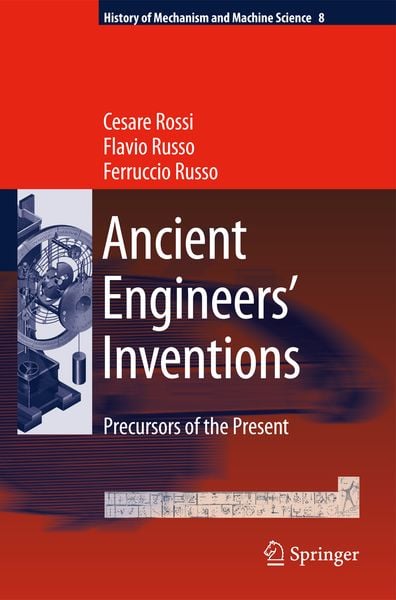
Produktbild: Ancient Engineers' Inventions
Band 8

Ancient Engineers' Inventions Precursors of the Present

Fr. 73.90

inkl. gesetzl. MwSt., Versandkostenfrei


Beschreibung

Produktdetails

Einband

Gebundene Ausgabe

Erscheinungsdatum

23.03.2009

Verlag

Springer Netherland

Seitenzahl

340

Maße (L/B/H)

24.1/16/2.5 cm

Gewicht

664 g

Auflage

2009

Sprache

Englisch

ISBN

978-90-481-2252-3

Beschreibung

Rezension

From the reviews:

“A lovingly compiled catalogue of engineering achievement, prepared most especially for young engineers, and dedicated to the appreciation of the works of pioneers. The reader is shown the problems and guided to their solutions, via all the technical detail needed to command attention. The target reader is thus served, under these terms of reference, well. … All in all, we have a collection of ingenious devices, well-described, frequently ‘reconstructed’ and lovingly commemorated.” (Michael A. B. Deakin, Metascience, Vol. 19, March, 2010)

Produktdetails

Einband

Gebundene Ausgabe

Erscheinungsdatum

23.03.2009

Verlag

Springer Netherland

Seitenzahl

340

Maße (L/B/H)

24.1/16/2.5 cm

Gewicht

664 g

Auflage

2009

Sprache

Englisch

ISBN

978-90-481-2252-3

Herstelleradresse

Springer Netherlands
Haberstr. 7
69126 Heidelberg
DE
buchhandel-buch@springer.com

Kundinnen und Kunden meinen

0 Bewertungen

Informationen zu Bewertungen

Zur Abgabe einer Bewertung ist eine Anmeldung im Konto notwendig. Die Authentizität der Bewertungen wird von uns nicht überprüft. Wir behalten uns vor, Bewertungstexte, die unseren Richtlinien widersprechen, entsprechend zu kürzen oder zu löschen.

Die Bewertungen sind nach Format, Anzahl Sterne und Datum sortiert.

Verfassen Sie die erste Bewertung zu diesem Artikel

Helfen Sie anderen Kund*innen durch Ihre Meinung

Kundinnen und Kunden meinen

0 Bewertungen filtern

  • Produktbild: Ancient Engineers' Inventions
  • Preface;
    PART I : MEASURING THE ENVIRONMENT: Introduction; Ancient Greek units; Length units; Area units; Volume units; Weight/mass units; Roman units; Length units; Area units; Volume units; Weight/mass units;
    Chap. 1 – MEASURING MASS: Introduction; 1.1 The balance scale; 1.2 The steelyard balance; Observations;
    Chap. 2 – MEASURING DISTANCE : Introduction; 2.1 Jacobs’ staff, Astrolabe; 2.2 Range finders; 2.2.1 Groma; 2.2.2 Surveyors’ cross; 2.2.3 Chorobate; 2.3 The dioptre by Heron; 2.4 The ancient odometer; 2.4.1 The odometer by Vitruvius; 2.4.2 The odometer by Heron; Observations;
    Chap. 3 - MEASURING TIME : Introduction; 3.1 The sundial; 3.1.1 Fixed sundials; 3.1.1.1 Equatorial sundials; 3.1.1.2 Horizontal sundials; 3.1.1.3 Vertical sundials; 3.1.1.4 Non-planar sundials; 3.1.2 Portable sundials; 3.2 Water clocks; 3.2.1 Early water clocks; 3.2.2 The water clock by Ctesibius; Observations;
    Chap. 4 – COMPUTATION DEVICES: Introduction; 4.1 The abacus; 4.2 The mesolabio; 4.2.1 The mesolabio of Heratostenes; 4.2.2 The solution by Hippocrates and the Mesolabio by Dürer; 4.3 The mechanism of Antikitera; 4.3.1 The history of the finding; 4.3.2 Description of the mechanism; 4.3.3 Technological aspects; 4.3.4 Planetariums in ancient literature; 4.3.5 A recent interesting finding; Observations;
    PART II – USING NATURAL ENERGY:
    Chap. 5 – WIND MOTORS: Introduction; 5.1 The wind mills; 5.1.1 TheAfghan mill; 5.1.2 The Cretan mill ; 5.2 Wings on the sea: the sails; 5.2.1 Evolution of the sail rig; 5.2.2 The Chinese junk; 5.2.3 The Flettner rotor; Observations;
    Chap. 6 – HYDRAULIC MOTORS: Introduction; 6.1 Water wheels with vertical axis; 6.1.1 The Greek mill; 6.1.2 Vertical axis rotor with oblique blades; 6.2 Water wheels with horizontal axis; 6.2.1 Undershot water wheels; 6.2.2 Overshot water wheels; 6.2.2.1 The wheel of Venafro; 6.3 The floating mill; 6.4 Water wheels in the Middle Ages and the Renaissance;Observations;
    PART III – USING WATER:
    Chap. 7 – LIFTING WATER: Introduction; 7.1 The early devices; 7.2 The Archimedes’ screw; 7.3 Norias; 7.3.1 Scoop wheel; 7.3.2 Chain norias; 7.4 Pumps; 7.4.1 Chain pumps; 7.4.2 Reciprocating pumps; Observations;
    Chap. 8 – ADDUCTION AND DISTRIBUTION OF WATER: Introduction; 8.1 Open ducts; 8.2 Penstocks; 8.3 The great cistern; 8.3.1 The Piscina Mirabilis at Miseno; 8.4 Water distribution systems ; 8.4.1 Piezometric turrets; 8.5 Pipes; 8.5.1 Dimensions of the lead pipes; 8.6 Valves; 8.6.1 Shut-off valves; 8.6.2 Single control mixers; 8.7 Hydraulic mining; 8.7.1 The technique 'Ruina Montium'; 8.7.2 Historical references; Observations;
    Chap. 9 – UNDERWATER ACTIVITIES: Introduction; 9.1 Scuba divers; 9.2 Diving bell;
    PART IV – COMMUNICATION AND TELECOMMUNICATION: Introduction; The capstan; Telecommunication devices;
    Chap. 10 – LIFT AND TRANSPORTS: Introduction; 10.1 Cranes and tackle; 10.2 Gravity driven elevators; 10.3 Roman charts; 10.4 Railed cargo; 10.5 The rails of Pompei; 10.6 Ancient self propelled vehicles; 10.7 Early ball bearings; 10.8 Transport on water; 10.8.1 Early paddle wheeled boats; 10.8.2 Pneumatic boats; 10.9 Cableways; 10.10 The dawn of flight in antiquity; 10.10.1 Legends and tales; 10.10.2 Ancient gliders; 10.10.3 Ancient rockets; Observations;
    Chap. 11 – TELECOMMUNICATIONS : Introduction; 11.1 Acoustic; 11.2 Carrier pigeons; 11.3 Optical telecommunication systems; 11.3.1 Systems based on image modification; 11.3.2 Systems based on brilliancy modification; 11.4 Lighthouses; 11.5 The water telegraph; Observations;
    PART V – TOWARDS THE MODERN AGE:
    Chap. 12 – SECONDARY MOTORS : Introduction; 12.1 Flexion elastic motors; 12.1.1 Metal spring flexion elastic motors, 12.2 Torsion elastic motors; 12.3 Pneumatic motors; 12.3.1 The air spring ballista; 12.4 Small spring motors; 12.4.1 Locks and padlocks; 12.5 Counterweight motors; 12.5.1 The trebuchet; 12.6 Ancient