• Produktbild: European Media in the Digital Age
  • Produktbild: European Media in the Digital Age

European Media in the Digital Age Analysis and Approaches

Fr. 79.90

inkl. gesetzl. MwSt., Versandkostenfrei


Beschreibung

Produktdetails

Einband

Taschenbuch

Erscheinungsdatum

02.04.2009

Verlag

Taylor and Francis

Seitenzahl

288

Maße (L/B/H)

24.6/18.9/1.6 cm

Gewicht

544 g

Sprache

Englisch

ISBN

978-1-4058-2197-1

Beschreibung

Produktdetails

Einband

Taschenbuch

Erscheinungsdatum

02.04.2009

Verlag

Taylor and Francis

Seitenzahl

288

Maße (L/B/H)

24.6/18.9/1.6 cm

Gewicht

544 g

Sprache

Englisch

ISBN

978-1-4058-2197-1

Herstelleradresse

Produktsicherheitsverantwortliche/r
Europaallee 1
36244 Bad Hersfeld
DE

Email: gpsr@libri.de

Kundinnen und Kunden meinen

0 Bewertungen

Informationen zu Bewertungen

Zur Abgabe einer Bewertung ist eine Anmeldung im Konto notwendig. Die Authentizität der Bewertungen wird von uns nicht überprüft. Wir behalten uns vor, Bewertungstexte, die unseren Richtlinien widersprechen, entsprechend zu kürzen oder zu löschen.

Die Bewertungen sind nach Format, Anzahl Sterne und Datum sortiert.

Verfassen Sie die erste Bewertung zu diesem Artikel

Helfen Sie anderen Kund*innen durch Ihre Meinung

Kundinnen und Kunden meinen

0 Bewertungen filtern

Die Leseprobe wird geladen.
  • Produktbild: European Media in the Digital Age
  • Produktbild: European Media in the Digital Age
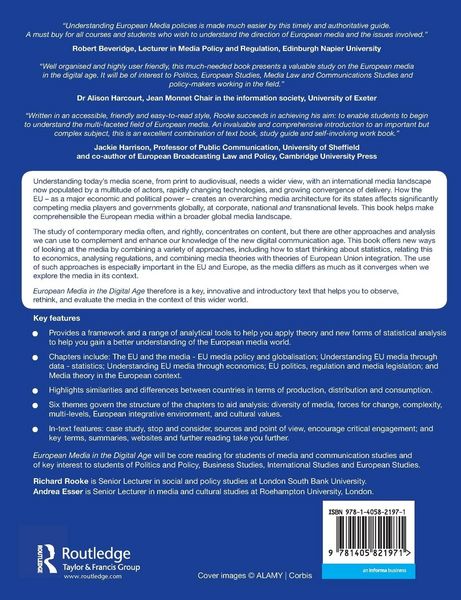
  • 1. The EU and the media - EU media policy and globalisation Inroduction: the EU and the media in the 21st century. The EU, globalisation and media. The EU and localisation. Glocalisation. The EU and ‘Europanisation’. Defining and understanding the EU. Europe and the EU: contexts for media policy. The EU institutions, policy-making and the media. The structure of the EU. Other direct and indirect pressures on the EU media. Chapter summary. Key terms. Discussion questions. Assignments. Further reading. Online resources. References. Appendix 2. Understanding EU media through data - statistics Introduction: The media and data. Sources. Statistics. Preliminary investigation: are newspapers and print products in decline in the EU? The context and the data questions: using qualitative methods. Linear and non-linear ways of looking at data. Chapter summary. Key terms. Discussion questions. Assigments. Further reading. Online resources. References 3. Understanding EU media through economics Introduction: economics and the media. The macro and the micro. Supply of and demand of goods. Price and costs (fixed and variable) and equilibrium. Market definitions. Chapter summary. Key terms. Discussion questions. Assignments. Further reading and references. Online resources 4. EU politics, regulation and media legislation Introduction: regulation and the regulators. The EU regulatory debate. The European regulatory context. Public vs private. International rules and the EU. EU regulatory development – key areas. Moving on into the 21st century. EU member state national regulation. Regulation, deregulation, self-regulation and co-regulation. Conclusions and more questions. Chapter summary. Key terms. Discussion questions. Assignments. Further reading. Online resources. References 5. Media theory in the European context Introduction: using theory. Media theory and European integration. Context: the theories of European integration and media development – some contexts. Debates on the EU theories of integration. Media and communication theory. Using theory with research methods. Critical review. Media theory milestones and contemporary debates. Chapter summary. Key terms. Discussion questions. Assignments. Further reading. Online resources. References 6. Production in the EU press and publishing industry Introduction: The European media landscape – analysing the market. History and precedents. The 20th century. The contemporary era: the 21st century. Publishing markets and production. The present scene: an indication. Comparative work: finding the variables (the comparators). Chapter summary. Key terms. Discussion questions. Assignments. Further reading. Online resources. References 7. The distribution of print and published material Introduction: the print industry. Distribution. Classic vs new distribution techniques. Distribution: European policy. Distribution: national policies – a comment. Chapter summary. Key terms. Discussion questions. Assignments. Further reading. Online resources. References 8. The consumption of print and published material Introduction: assessing the material available to researchers for the publishing industry - the data. Interpretation and judgement. European consumption and trends. Reflections. Chapter summary. Key terms. Discussion questions. Further reading. Online resources. References 9. Audio-visual content in the EU: Production and scheduling (by Andrea Esser) Introduction: analysing audiovisual programming in the EU. Sources. History and precedents. The 1980s. Changes in content production. Financing. Entertainment on our television screens: production, acquisition, scheduling. The rise of formats. Other programming trends in the new millennium: added-value, textual convergence and interactivity. Chapter summary. Key terms. Discussion questions. Assignments. Further reading. Online resources. References 10. The distribution network of the audio-visual in the EU Introduction: a period of change. Television and radio. Film. Classic vs new distribution techniques. Distribution: European policy. Distribution: national policies. The impact on public sector broadcasting. Chapter summary. Key terms. Discussion questions. Assignments. Further reading. Online resources. References 11. The consumption of audio-visual material in the EU: trends Introduction: assessing the material available to researchers for the audio-visual: industry - the data. Sources. Consumption: European trends. Consumption: national trends – an indication. EU National statistical agencies and the public-private divide. The future: a comment. Chapter summary. Key terms. Discussion questions. Assignments. Further reading. Online resources. References. Index