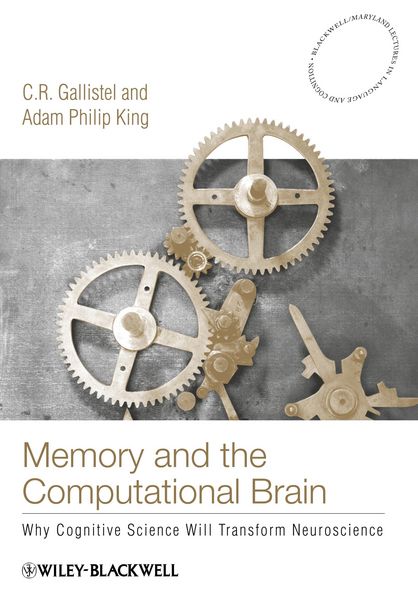
Produktbild: Memory and the Computational Brain

Memory and the Computational Brain Why Cognitive Science will Transform Neuroscience

Fr. 73.90

inkl. gesetzl. MwSt., Versandkostenfrei


Beschreibung

Produktdetails

Einband

Taschenbuch

Erscheinungsdatum

01.05.2009

Verlag

John Wiley & Sons

Seitenzahl

336

Maße (L/B/H)

24.4/17/1.9 cm

Gewicht

581 g

Auflage

1. Auflage

Sprache

Englisch

ISBN

978-1-4051-2288-7

Beschreibung

Rezension

"The book covers wide-ranging ground--indeed, it passes for a computer science or philosophy textbook in places--but it does so in a consistently lucid and engaging fashion." ( CHOICE , December 2009)

"The authors provide a cogent set of ideas regarding a kind of brain functional architecture that could serve as a thought-provoking alternative to that envisioned by current dogma. If one is seriously concerned with understanding and investigating the brain and how it operates, taking the time to absorb the ideas conveyed in this book is likely to be time well spent." ( PsycCRITIQUES , November 2009)
"Along with a light complement of fascinating psychological case studies of representations of space and time, and a heavy set of polemical sideswipes at neuroscientists and their hapless computational fellow travelers, this book has the simple goal of persuading us of the importance of a particular information processing mechanism that it claims does not currently occupy center stage." ( Nature Neuroscience , October 2009)

Produktdetails

Einband

Taschenbuch

Erscheinungsdatum

01.05.2009

Verlag

John Wiley & Sons

Seitenzahl

336

Maße (L/B/H)

24.4/17/1.9 cm

Gewicht

581 g

Auflage

1. Auflage

Sprache

Englisch

ISBN

978-1-4051-2288-7

Kundinnen und Kunden meinen

0 Bewertungen

Informationen zu Bewertungen

Zur Abgabe einer Bewertung ist eine Anmeldung im Konto notwendig. Die Authentizität der Bewertungen wird von uns nicht überprüft. Wir behalten uns vor, Bewertungstexte, die unseren Richtlinien widersprechen, entsprechend zu kürzen oder zu löschen.

Die Bewertungen sind nach Format, Anzahl Sterne und Datum sortiert.

Verfassen Sie die erste Bewertung zu diesem Artikel

Helfen Sie anderen Kund*innen durch Ihre Meinung

Kundinnen und Kunden meinen

0 Bewertungen filtern

Die Leseprobe wird geladen.
  • Produktbild: Memory and the Computational Brain
  • Preface viii

    1 Information 1

    Shannon's Theory of Communication 2

    Measuring Information 7

    Efficient Coding 16

    Information and the Brain 20

    Digital and Analog Signals 24

    Appendix: The Information Content of Rare Versus Common 25

    Events and Signals

    2 Bayesian Updating 27

    Bayes' Theorem and Our Intuitions about Evidence 30

    Using Bayes' Rule 32

    Summary 41

    3 Functions 43

    Functions of One Argument 43

    Composition and Decomposition of Functions 46

    Functions of More than One Argument 48

    The Limits to Functional Decomposition 49

    Functions Can Map to Multi-Part Outputs 49

    Mapping to Multiple-Element Outputs Does Not Increase Expressive Power 50

    Defining Particular Functions 51

    Summary: Physical/Neurobiological Implications of Facts about Functions 53

    4 Representations 55

    Some Simple Examples 56

    Notation 59

    The Algebraic Representation of Geometry 64

    5 Symbols 72

    Physical Properties of Good Symbols 72

    Symbol Taxonomy 79

    Summary 82

    6 Procedures 85

    Algorithms 85

    Procedures, Computation, and Symbols 87

    Coding and Procedures 89

    Two Senses of Knowing 100

    A Geometric Example 101

    7 Computation 104

    Formalizing Procedures 105

    The Turing Machine 107

    Turing Machine for the Successor Function 110

    Turing Machines for fis even 111

    Turing Machines for f+ 115

    Minimal Memory Structure 121

    General Purpose Computer 122

    Summary 124

    8 Architectures 126

    One-Dimensional Look-Up Tables (If-Then Implementation) 128

    Adding State Memory: Finite-State Machines 131

    Adding Register Memory 137

    Summary 144

    9 Data Structures 149

    Finding Information in Memory 151

    An Illustrative Example 160

    Procedures and the Coding of Data Structures 165

    The Structure of the Read-Only Biological Memory 167

    10 Computing with Neurons 170

    Transducers and Conductors 171

    Synapses and the Logic Gates 172

    The Slowness of It All 173

    The Time-Scale Problem 174

    Synaptic Plasticity 175

    Recurrent Loops in Which Activity Reverberates 183

    11 The Nature of Learning 187

    Learning As Rewiring 187

    Synaptic Plasticity and the Associative Theory of Learning 189

    Why Associations Are Not Symbols 191

    Distributed Coding 192

    Learning As the Extraction and Preservation of Useful Information 196

    Updating an Estimate of One's Location 198

    12 Learning Time and Space 207

    Computational Accessibility 207

    Learning the Time of Day 208

    Learning Durations 211

    Episodic Memory 213

    13 The Modularity of Learning 218

    Example 1: Path Integration 219

    Example 2: Learning the Solar Ephemeris 220

    Example 3: "Associative" Learning 226

    Summary 241

    14 Dead Reckoning in a Neural Network 242

    Reverberating Circuits as Read/Write Memory Mechanisms 245

    Implementing Combinatorial Operations by Table-Look-Up 250

    The Full Model 251

    The Ontogeny of the Connections? 252

    How Realistic Is the Model? 254

    Lessons to Be Drawn 258

    Summary 265

    15 Neural Models of Interval Timing 266

    Timing an Interval on First Encounter 266

    Dworkin's Paradox 268

    Neurally Inspired Models 269

    The Deeper Problems 276

    16 The Molecular Basis of Memory 278

    The Need to Separate Theory of Memory from Theory of Learning 278

    The Coding Question 279

    A Cautionary Tale 281

    Why Not Synaptic Conductance? 282

    A Molecular or Sub-Molecular Mechanism? 283

    Bringing the Data to the Computational Machinery 283

    Is It Universal? 286

    References 288

    Glossary 299

    Index 312