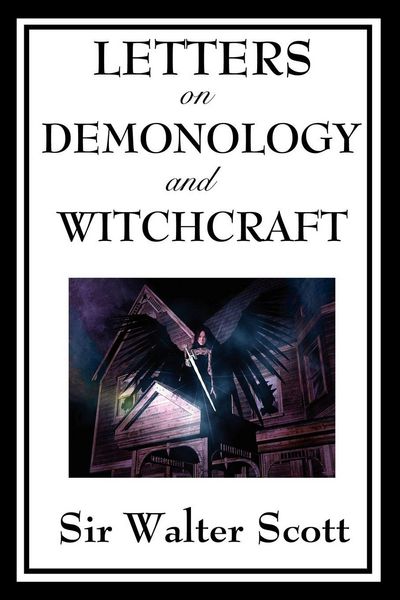
Letters on Demonology and Witchcraft Current subtitle not necessary unless you want stronger search positioning
-
- Hardcover
- Taschenbuch ausgewählt
- eBook
-
Sprache:Englisch
-
Verlag:Fantastic Books
- Cambridge Scholars Publishing Fr. 18.90
- Outlook Fr. 68.90
- Devoted Publishing Fr. 41.90
- Cambridge Academic Fr. 61.90
- Alpha Editions Fr. 34.90
- E-Kitap Projesi & Cheapest Books Fr. 37.90
- Tredition Fr. 23.90
- Fantastic Books Fr. 31.90 ausgewählt
- Aegypan Fr. 27.90
- External catalogues UK Fr. 35.90
- Bibliotech Pr Fr. 29.90
- Culturea Fr. 37.90
- Creative Media Partners, LLC Fr. 34.90
- Hansebooks Fr. 38.90
- Antigonos Verlag Fr. 68.90
Fr. 31.90
inkl. gesetzl. MwSt.,
Beschreibung
Produktdetails
Einband
Taschenbuch
Erscheinungsdatum
04.02.2009
Verlag
Fantastic BooksSeitenzahl
232
Maße (L/B/H)
22.9/15.2/1.4 cm
Gewicht
383 g
Sprache
Englisch
ISBN
978-1-60459-714-1
In ill health following a stroke, Sir Walter Scott wrote Letters on Demonology and Witchcraft at the behest of his son-in-law, J. G. Lockhart, who worked for a publishing firm. The book proved popular and Scott was paid six hundred pounds, which he desperately needed. (Despite his success as a novelist, Scott was almost ruined when the Ballantyne publishing firm, where he was a partner, went bankrupt in 1826.) Letters was written when educated society believed itself in enlightened times due to advances in modern science. Letters, however, revealed that all social classes still held beliefs in ghosts, witches, warlocks, fairies, elves, diabolism, the occult, and even werewolves. Sourcing from prior sixteenth- and seventeenth-century treatises on demonology along with contemporary accounts from England, Europe, and North America (Cotton Mather's Magnalia Christi, for one), Scott's discourses on the psychological, religious, physical, and preternatural explanations for these beliefs are essential reading for acolytes of the dark and macabre; the letters dealing with witch hunts, trials (Letters Eight and Nine), and torture are morbidly compelling. Scott was neither fully pro-rational modernity nor totally anti-superstitious past, as his skepticism of one of the "new" sciences (skullology, as he calls it) is made clear in a private letter to a friend. Thus, Letters is both a personal and intellectual examination of conflicting belief systems, when popular science began to challenge superstition in earnest.
Noch keine Bewertungen vorhanden
Verfassen Sie die erste Bewertung zu diesem Artikel
Helfen Sie anderen Kundinnen und Kunden durch Ihre Meinung.