• Produktbild: The Scientist's Atom and the Philosopher's Stone
  • Produktbild: The Scientist's Atom and the Philosopher's Stone
Band 279

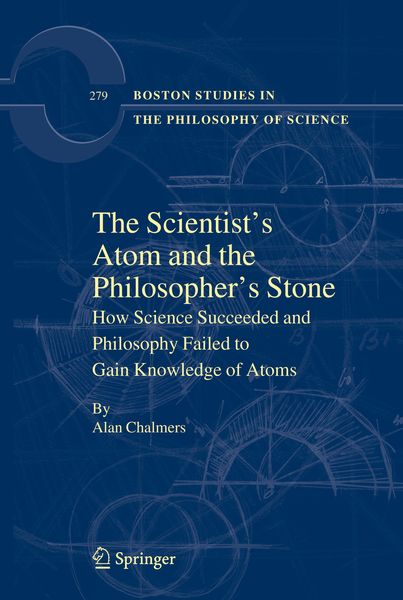
The Scientist's Atom and the Philosopher's Stone How Science Succeeded and Philosophy Failed to Gain Knowledge of Atoms

Fr. 138.00

inkl. gesetzl. MwSt., Versandkostenfrei


Beschreibung

Produktdetails

Einband

Gebundene Ausgabe

Erscheinungsdatum

17.06.2009

Verlag

Springer Netherland

Seitenzahl

288

Maße (L/B/H)

23.6/16/2.3 cm

Gewicht

584 g

Auflage

1. Auflage

Sprache

Englisch

ISBN

978-90-481-2361-2

Beschreibung

Rezension

From the reviews:

“Chalmers presents a comprehensive history of the atom, from antiquity to the early twentieth century. … Chalmers’s account draws on his distinction between philosophical and scientific versions of atomism. … His writing and exposition are clear, and the account is well documented and balanced and draws judiciously on primary and secondary sources. It should be of interest to historians and philosophers of science and to scientists more generally.” (Victor D. Boantza, ISIS, Vol. 103 (1), 2012)

“This book offers a conceptual history of atomism from the pre-Socratics to the end of the nineteenth century. … the first covers ancient Greek and medieval atomic and matter theories; the second deals with the scientific and chemical revolutions; and the third takes the story from Dalton through to the experimental discovery of the electron … . Chalmers makes his arguments clearly, powerfully and well. … inspire debates not only in those fields, but also in related fields within science studies.” (Seth Suman, British Journal for the History of Science, Vol. 44 (3), September, 2011)

“Alan Chalmers has strong views about what does and does not deserve to be considered ‘science’. In this book he examines a number of historical developments that are frequently cited in accounts of the origin of the outlook … . those generally used in introductory chemistry courses––and to take issue with specialized historians and philosophers. … historical stories widely used as background for introductory chemistry courses merits the serious attention of professional philosophers and historians, and also of science educators.” (Joseph E. Earley, Foundations of Chemistry, Vol. 13, 2011)

“Alan Chalmers has written by far the most important and incisive book of recent years on the fundamental and difficult notions of atoms and atomism. … In each chapter of his book Chalmers outlines modern lines of scholarship concerning the history of chemistry and physics … . Chalmers’ book is a masterpiece in the history and philosophy of science and on a neglected topic of great importance. It should be read by everyone with an interest in the field.” (Eric Scerri, Metascience, Vol. 19, August, 2010)

“The current book arose from Chalmers teaching of an advanced level HPS course … in the early 1990s. … a detailed scholarly work for graduate students, historians and philosophers. … Chalmers’ extensive research (about 250 references cited) his clarity of expression and well structured argument mean that both immodest realists and constructivists can benefit from a close and thoughtful reading of Atomism.” (Michael R. Matthews, Science & Education, March, 2010)

"It’s reasonable to see philosophy and science as natural partners, complementary in their application and intimately related. … Alan Chalmers textbook is an example of the healthy relationship that can, and often does, exist. It is therefore a welcome addition to the philosophyof science and should benefit students of philosophy and science … . it will help put the relationship between science and philosophy into the right perspective. … This serves to provide a comprehensive history of the relationship between philosophy and science." (Ken Perrott, Open Parachute, August, 2009)

Produktdetails

Einband

Gebundene Ausgabe

Erscheinungsdatum

17.06.2009

Verlag

Springer Netherland

Seitenzahl

288

Maße (L/B/H)

23.6/16/2.3 cm

Gewicht

584 g

Auflage

1. Auflage

Sprache

Englisch

ISBN

978-90-481-2361-2

Herstelleradresse

Libri GmbH
Europaallee 1
36244 Bad Hersfeld
DE

Email: gpsr@libri.de

Kundinnen und Kunden meinen

0 Bewertungen

Informationen zu Bewertungen

Zur Abgabe einer Bewertung ist eine Anmeldung im Konto notwendig. Die Authentizität der Bewertungen wird von uns nicht überprüft. Wir behalten uns vor, Bewertungstexte, die unseren Richtlinien widersprechen, entsprechend zu kürzen oder zu löschen.

Die Bewertungen sind nach Format, Anzahl Sterne und Datum sortiert.

Verfassen Sie die erste Bewertung zu diesem Artikel

Helfen Sie anderen Kund*innen durch Ihre Meinung

Kundinnen und Kunden meinen

0 Bewertungen filtern

  • Produktbild: The Scientist's Atom and the Philosopher's Stone
  • Produktbild: The Scientist's Atom and the Philosopher's Stone
  • Chapter 1. Atomism: Science or philosophy?
    1.1 Introduction
    1.2 Science and philosophy transcend the evidence for them
    1.3 How the claims of science are confirmed
    1.4 Inference to the best explanation
    1.5 Science involves experimental activity and conceptual innovation
    1.6 Reading the past in the light of the present
    1.7 Writing history of science backwards
    1.8 The structure of the book
    1.9 A note on terminology
    Chapter 2. Democritean atomism
    2.1 Philosophy as the refinement of common sense by reason
    2.2 Parmenides and the denial of change
    2.3 The atomism of Leucippus and Democritus: The basics
    2.4 Atomic explanations of properties
    2.5 Atomic explanations of specific phenomena
    2.6 Atomism as a response to Zeno’s paradoxes
    2.7 Aristotle’s critique of indivisible magnitudes
    2.8 Did Democritus propose indivisible magnitudes as a response to Zeno?
    2.9 Democritean atomism: an appraisal
    Chapter 3. How did Epicurus’s garden grow?
    3.1 Epicureanism
    3.2 Physical atoms in the void
    3.3 Atoms and indivisible magnitudes
    3.4 Atomic speeds and observable speeds
    3.5 Gravity
    3.6 Explaining the phenomena by appeal only to atoms and the void
    3.7 The status and role of the evidence of the senses
    3.8 Knowledge of atoms: Getting closer?
    Chapter 4. Atomism in its Ancient Greek perspective
    4.1 Philosophical atomism versus less ambitious projects
    4.2 The Aristotelian alternative
    4.3 Hints of a granular structure of matter in Aristotle
    4.4 Granular versus ultimate structures
    4.5 Greek ‘science’
    Chapter 5. From the Ancient Greeks to the dawn of science
    5.1 Introduction
    5.2 Natural minima
    5.3 Hardline vesus liberal interpretations of Aristotle
    5.4 Aristotelianism and alchemy
    5.5 Geber’s ‘atomism’
    5.6 Thestatis and fate of Geber’s integration of Aristotle and alchemy
    5.7 Currents of thought leading to Sennert’s atomism
    5.8 Sennert’s atomic theory
    5.9 The status of Sennert’s atomism
    Chapter 6. Atomism, experiment and the mechanical philosophy: The work of Robert Boyle
    6.1 What was scientific about the scientific revolution?
    6.2 Boyle’s version of the mechanical philosophy
    6.3 Boyle’s case for the mechanical philosophy
    6.4 Boyle’s use of the microscopic/microscopic analogy
    6.5 Boyle’s experimental science as distinct from the mechanical philosophy
    6.6 Empirical support for the mechanical philosophy
    6.7 The lack of fertility of the mechanical philosophy
    6.8 The various senses of ‘mechanical’
    6.9 Boyle’s mechanical philosophy and experimental support for atoms
    Chapter 7. Newton’s atomism and its fate
    7.1 Introduction
    7.2 Newton’s science
    7.3 Newton’s atomism
    7.4 The case for Newton’s atomism
    7.5 The fate of Newtonian atomism in the eighteenth century
    Chapter 8. The emergence of modern chemistry with no debt to atomism
    8.1 Introduction.
    8.2 Klein on Geoffroy and the concepts of chemical substance, compound and combination
    8.3 Reflections on Klein’s account of chemical combination
    8.4 Boyle’s chemistry: Some preliminaries
    8.5 Boyle’s mechanical rather than chemical construal of substances
    8.6 Boyle on the properties of chemical corpuscles
    8.7 Chemical properties and essential properties
    8.8 The mechanical philosophy versus the experimental philosophy
    8.9 Newtonian affinities
    8.10 Chemistry from Newton to Lavoisier
    Chapter 9. Dalton’s atomism and its creative modification via formulae
    9.1 Introduction
    9.2 Dalton’s atomism
    9.3 Dalton’s atomic chemistry
    9.4 The introduction of chemical