KI-Beratung Beta

Produktbild: Reliability Wearout Mechanisms in Advanced CMOS Technologies

Reliability Wearout Mechanisms in Advanced CMOS Technologies

Fr. 263.00

inkl. gesetzl. MwSt., Versandkostenfrei


Beschreibung

A comprehensive treatment of all aspects of CMOS reliability wearout mechanisms   This book covers everything students and professionals need to know about CMOS reliability wearout mechanisms, from basic concepts to the tools necessary to conduct reliability tests and analyze the results. It is the first...

Beschreibung

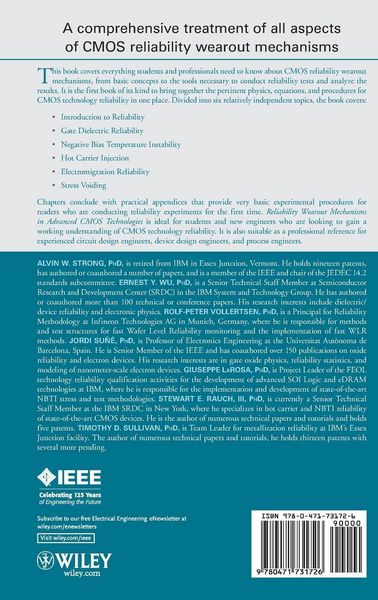
A comprehensive treatment of all aspects of CMOS reliability wearout mechanisms
 
This book covers everything students and professionals need to know about CMOS reliability wearout mechanisms, from basic concepts to the tools necessary to conduct reliability tests and analyze the results. It is the first book of its kind to bring together the pertinent physics, equations, and procedures for CMOS technology reliability in one place. Divided into six relatively independent topics, the book covers:
* Introduction to Reliability
* Gate Dielectric Reliability
* Negative Bias Temperature Instability
* Hot Carrier Injection
* Electromigration Reliability
* Stress Voiding
 
Chapters conclude with practical appendices that provide very basic experimental procedures for readers who are conducting reliability experiments for the first time. Reliability Wearout Mechanisms in Advanced CMOS Technologies is ideal for students and new engineers who are looking to gain a working understanding of CMOS technology reliability. It is also suitable as a professional reference for experienced circuit design engineers, device design engineers, and process engineers.

Produktdetails

Einband

Gebundene Ausgabe

Erscheinungsdatum

01.09.2009

Abbildungen

Photos: 25 B&W, 0 Color; Drawings: 475 B&W, 0 Color; Tables: 70 B&W, 0 Color

Verlag John Wiley & Sons

Produktdetails

Einband

Gebundene Ausgabe

Erscheinungsdatum

01.09.2009

Abbildungen

Photos: 25 B&W, 0 Color; Drawings: 475 B&W, 0 Color; Tables: 70 B&W, 0 Color

Verlag John Wiley & Sons
Seitenzahl

640

Maße (L/B/H)

24/16.1/3.9 cm

Gewicht

1120 g

Auflage

1. Auflage

Sprache

Englisch

ISBN

978-0-471-73172-6

Herstelleradresse

Libri GmbH
Europaallee 1
36244 Bad Hersfeld
DE

Email: gpsr@libri.de

Noch keine Bewertungen vorhanden

Verfassen Sie die erste Bewertung zu diesem Artikel

Helfen Sie anderen Kundinnen und Kunden durch Ihre Meinung.

Kundinnen und Kunden meinen

Bewertungen (0)

Die Leseprobe wird geladen.
  • Produktbild: Reliability Wearout Mechanisms in Advanced CMOS Technologies
  • Preface.
     
    1 INTRODUCTION (Alvin W. Strong).
     
    1.1 Book Philosophy.
     
    1.2 Lifetime and Acceleration Concepts.
     
    1.3 Mechanism Types.
     
    1.4 Reliability Statistics.
     
    1.5 Chi-Square and Student t Distributions.
     
    1.6 Application.
     
    2 DIELECTRIC CHARACTERIZATION AND RELIABILITY METHODOLOGY (Ernest Y. Wu, Rolf-Peter Vollertsen, and Jordi Sune).
     
    2.1 Introduction.
     
    2.2 Fundamentals of Insulator Physics and Characterization.
     
    2.3 Measurement of Dielectric Reliability.
     
    2.4 Fundamentals of Dielectric Breakdown Statistics.
     
    2.5 Summary and Future Trends.
     
    3 DIELECTRIC BREAKDOWN OF GATE OXIDES: PHYSICS AND EXPERIMENTS (Ernest Y. Wu, Rolf-Peter Vollertsen, and Jordi Sune).
     
    3.1 Introduction.
     
    3.2 Physics of Degradation and Breakdown.
     
    3.3 Physical Models for Oxide Degradation and Breakdown.
     
    3.4 Experimental Results of Oxide Breakdown.
     
    3.5 Post-Breakdown Phenomena.
     
    4 NEGATIVE BIAS TEMPERATURE INSTABILITIES IN pMOSFET DEVICES (Giuseppe LaRosa).
     
    4.1 Introduction.
     
    4.2 Considerations on NBTI Stress Configurations.
     
    4.3 Appropriate NBTI Stress Bias Dependence.
     
    4.4 Nature of the NBTI Damage.
     
    4.5 Impact of the NBTI Damage to Key pMOSFET Transistor Parameters.
     
    4.6 Physical Mechanisms Contributing to the NBTI Damage.
     
    4.7 Key Experimental Observations on the NBTI Damage.
     
    4.8 Nit Generation by Reaction-Diffusion (R-D) Processes.
     
    4.9 Hole Trapping Modeling.
     
    4.10 NBTI Dependence on CMOS Processes.
     
    4.11 NBTI Dependence on Area Scaling.
     
    4.12 Overview of Key NBTI Features.
     
    5 HOT CARRIERS (Stewart E. Rauch, III).
     
    5.1 Introduction.
     
    5.2 Hot Carriers: Physical Generation and Injection Mechanisms.
     
    5.3 Hot Carrier Damage Mechanisms.
     
    5.4 HC Impact to MOSFET Characteristics.
     
    5.5 Hot Carrier Shift Models.
     
    6 STRESS-INDUCED VOIDING (Timothy D. Sullivan).
     
    6.1 Introduction.
     
    6.2 Theory and Model.
     
    6.3 Role of the Overlying Dielectric.
     
    6.4 Summary of Voiding in Al Metallizations
     
    6.5 Stress Voiding in Cu Interconnects.
     
    6.6 Concluding Remarks.
     
    7 ELECTROMIGRATION (Timothy D. Sullivan).
     
    7.1 Introduction.
     
    7.2 Metallization Failure.
     
    7.3 Electromigration.
     
    7.4 General Approach to Electromigration Reliability.
     
    7.5 Thermal Considerations for Electromigration.
     
    7.6 Closing Remarks.
     
    Index.