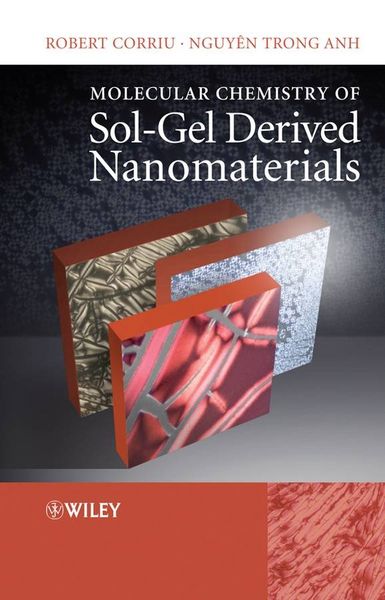
Produktbild: Molecular Chemistry of Sol-Gel Derived Nanomaterials

Molecular Chemistry of Sol-Gel Derived Nanomaterials

Fr. 219.00

inkl. gesetzl. MwSt., Versandkostenfrei


Beschreibung

Produktdetails

Einband

Gebundene Ausgabe

Erscheinungsdatum

01.04.2009

Verlag

John Wiley & Sons Inc

Seitenzahl

200

Maße (L/B/H)

23.7/15.9/1.7 cm

Gewicht

454 g

Auflage

1. Auflage

Sprache

Englisch

ISBN

978-0-470-72117-9

Beschreibung

Produktdetails

Einband

Gebundene Ausgabe

Erscheinungsdatum

01.04.2009

Verlag

John Wiley & Sons Inc

Seitenzahl

200

Maße (L/B/H)

23.7/15.9/1.7 cm

Gewicht

454 g

Auflage

1. Auflage

Sprache

Englisch

ISBN

978-0-470-72117-9

Noch keine Bewertungen vorhanden

Verfassen Sie die erste Bewertung zu diesem Artikel

Helfen Sie anderen Kundinnen und Kunden durch Ihre Meinung.

Kundinnen und Kunden meinen

Bewertungen (0)

  • Produktbild: Molecular Chemistry of Sol-Gel Derived Nanomaterials
  • Preface.

    About the Authors.

    1 Molecular Chemistry and Nanosciences.

    1.1 Introduction.

    1.2 Scope and Origin of Nanosciences: The 'Top-Down' and 'Bottom-Up' Approaches.

    1.3 Chemical Mutation: From an Exploratory to a Creative Science.

    1.4 Carbon and Ceramic Fibers: The Nanomaterial 'Ancestors'.

    1.5 Conclusions.

    References.

    2 Nano-Objects.

    2.1 Introduction.

    2.2 Presentation of Nano-Objects.

    2.3 Synthesis of Nano-Objects.

    2.4 The Nano-Object: Entry into Nanosciences.

    References.

    3 Introduction to Material Chemistry.

    3.1 General Remarks.

    3.2 Inorganic Materials: Crystals and Glasses.

    3.3 Thermodynamically Controlled Organic-Inorganic Hybrid Materials.

    3.4 Ceramic Materials Obtained from Organometallic Polymers: Ceramics with Interpenetrating Networks.

    3.5 Inorganic Polymer Materials (Sol-Gel Process).

    3.6 Inorganic Polymerization and Molecular Chemistry.

    3.7 Silica and Molecular Chemistry: A Dream Team.

    4 From Nano-Object to Nanomaterial.

    4.1 The Different Types of Nanomaterials.

    4.2 Inorganic Polymerization: A Major Route to Nanomaterials.

    4.3 Nanocomposite Materials.

    4.4 Grafted Materials.

    4.5 Selective Separation.

    4.6 Materials Obtained by Polycondensation of Monosubstituted Trialkoxysilanes.

    4.7 Multistage Syntheses - Cascade Reactions.

    References.

    5 Nanostructured Materials.

    5.1 General Remarks.

    5.2 Synthesis of Hybrid Nanomaterials.

    5.3 Nanostructured Hybrid Materials.

    5.4 Kinetic Control of the Texture of Nanostructured Hybrid Materials.

    5.5 Supramolecular Self-Organization Induced by Hydrogen Bonds.

    5.6 Supramolecular Self-Organization Induced by Weak van der Waals Type Bonds.

    5.7 Lamellar Materials.

    5.8 Prospects.

    5.9 Some Possible Developments.

    References.

    6 Chemistry Leading to Interactive Nanomaterials.

    6.1 Introduction.

    6.2 Smart Materials.

    6.3 The Route to Interactive Materials - Definitions.

    6.4 Mesoporous Materials.

    6.5 Functionalization of the Pores.

    6.6 Functionalization of the Framework.

    6.7 Importance of Functionalization and of Weight Analyses.

    6.8 On the Way to Interactive Nanomaterials.

    6.9 Preparation of New Matrices.

    6.10 On the Way to Biological Applications.

    6.11 Conclusions.

    References.

    7 Prospects and Stakes.

    7.1 General Remarks.

    7.2 Predictable Developments.

    References.

    Index.