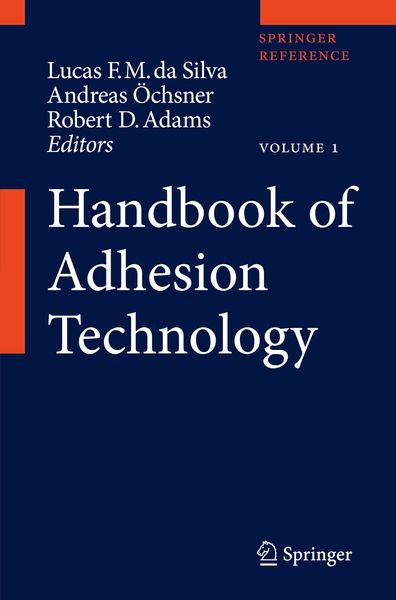
Handbook of Adhesion Technology
-
- Englisch ausgewählt
-
Verlag:Springer Berlin
- Springer Fr. 1’132.00
- Springer Berlin Fr. 895.00 ausgewählt
Fr. 895.00
inkl. gesetzl. MwSt.,
Beschreibung
Produktdetails
Einband
Set mit diversen Artikeln
Erscheinungsdatum
10.06.2011
Herausgeber
Lucas F. M. da Silva + weitereVerlag
Springer BerlinSeitenzahl
1554
Maße (L/B/H)
24.1/16/9.7 cm
Gewicht
2622 g
Auflage
1. Auflage
Sprache
Englisch
ISBN
978-3-642-01168-9
Adhesives have been used for thousands of years, but until 100 years ago, the vast majority was from natural products such as bones, skins, fish, milk, and plants. Since about 1900, adhesives based on synthetic polymers have been introduced, and today, there are many industrial uses of adhesives and sealants. It is difficult to imagine a product—in the home, in industry, in transportation, or anywhere else for that matter—that does not use adhesives or sealants in some manner.
The Handbook of Adhesion Technology is intended to be the definitive reference in the field of adhesion. Essential information is provided for all those concerned with the adhesion phenomenon. Adhesion is a phenomenon of interest in diverse scientific disciplines and of importance in a wide range of technologies. Therefore, this handbook includes the background science (physics, chemistry and materials science), engineering aspects of adhesion and industry specific applications. It is arranged in a user-friendly format with ten main sections: theory of adhesion, surface treatments, adhesive and sealant materials, testing of adhesive properties, joint design, durability, manufacture, quality control, applications and emerging areas. Each section contains about five chapters written by internationally renowned authors who are authorities in their fields.
This book is intended to be a reference for people needing a quick, but authoritative, description of topics in the field of adhesion and the practical use of adhesives and sealants. Scientists and engineers of many different backgrounds who need to have an understanding of various aspects of adhesion technology will find it highly valuable. These will include those working in research or design, as well as others involved with marketing services. Graduate students in materials, processes and manufacturing will also want to consult it.
Kundinnen und Kunden meinen
Verfassen Sie die erste Bewertung zu diesem Artikel
Helfen Sie anderen Kund*innen durch Ihre Meinung