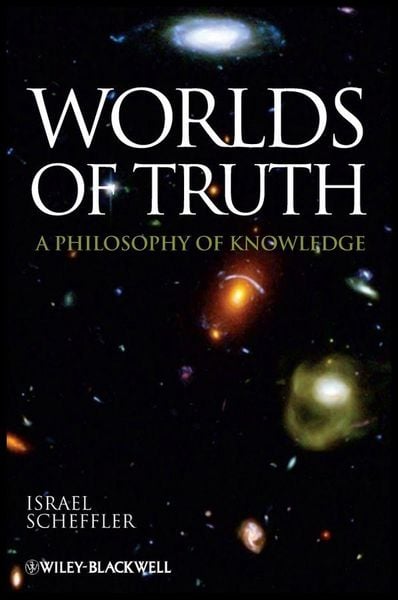
Produktbild: Worlds of Truth

Worlds of Truth A Philosophy of Knowledge

Fr. 51.90

inkl. gesetzl. MwSt., Versandkostenfrei


Beschreibung

Produktdetails

Einband

Gebundene Ausgabe

Erscheinungsdatum

01.05.2009

Verlag

John Wiley & Sons Inc

Seitenzahl

168

Maße (L/B/H)

23.4/15/1.8 cm

Gewicht

408 g

Sprache

Englisch

ISBN

978-1-4051-9170-8

Beschreibung

Produktdetails

Einband

Gebundene Ausgabe

Erscheinungsdatum

01.05.2009

Verlag

John Wiley & Sons Inc

Seitenzahl

168

Maße (L/B/H)

23.4/15/1.8 cm

Gewicht

408 g

Sprache

Englisch

ISBN

978-1-4051-9170-8

Herstelleradresse

Libri GmbH
Europaallee 1
36244 Bad Hersfeld
DE

Email: GPSR Kontakt

Noch keine Bewertungen vorhanden

Verfassen Sie die erste Bewertung zu diesem Artikel

Helfen Sie anderen Kundinnen und Kunden durch Ihre Meinung.

Kundinnen und Kunden meinen

Bewertungen (0)

  • Produktbild: Worlds of Truth
  • Preface viii

    Acknowledgments x

    Introduction 1

    Part I: Inquiry 5

    Chapter 1: Justification 7

    1. Beliefs 7

    2. Access to truth 8

    3. Cogito ergo sum 9

    4. Mathematical certainty 11

    5. Classical logic 12

    6. C. I. Lewis' empiricism 14

    7. Access as a metaphor 17

    8. J. F. Fries and K. Popper 18

    9. Voluntarism and linearity 19

    10. One-way justification 20

    11. Beginning in the middle 21

    12. Justification, contextual and comparative 22

    13. Justification in the empirical sciences 23

    14. Circularity versus linearity 25

    15. Democratic controls 25

    16. Interactionism 27

    Chapter 2: Truth 30

    1. Allergy to absolute truth 31

    2. Provisionality and truth 32

    3. Truth versus verification 34

    4. Truth and fixity 36

    5. Transparency, Tarski, and Carnap 38

    6. Truth and certainty 42

    7. Sentences as truth candidates 44

    8. Theoretical terms 44

    9. Varieties of instrumentalism 45

    10. Pragmatism and instrumentalism 45

    11. Systems, simplicity, reduction 46

    12. Crises in science 51

    13. Reduction and expansion 52

    Chapter 3: Worlds 55

    1. Philosophies of truth 55

    2. Operationism and truth 57

    3. Version-dependence 59

    4. Differences among scientifically oriented philosophers 61

    5. Monism, pluralism, plurealism 62

    6. Realism versus irrealism 66

    7. A theory of everything 72

    8. The status of ethics 75

    9. Emotive theories; Ayer and Stevenson 75

    10. Moore's ethical intuitionism 77

    11. Dewey and ethical naturalism 79

    12. Symbol, reference, and ritual 81

    Part II: Related Pragmatic Themes 93

    Chapter 4: Belief and Method 95

    Introduction 95

    1. Problems of pragmatism and pragmatic responses 98

    2. Peirce's theory of belief, doubt, and inquiry 102

    3. Peirce's comparison of methods 104

    4. Difficulties in Peirce's treatment 106

    5. An epistemological interpretation 108

    6. The primacy of method 109

    Chapter 5: Action and Commitment 114

    Chapter 6: Emotion and Cognition 125

    1. Emotions in the service of cognition 126

    2. Cognitive emotions 132

    Index 143