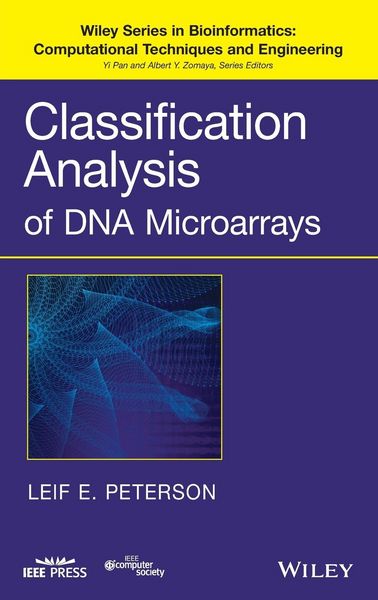
Analysis of DNA Microarrays
-
- Englisch ausgewählt
Fr. 147.00
inkl. gesetzl. MwSt.,
Beschreibung
Produktdetails
Einband
Taschenbuch
Erscheinungsdatum
22.04.2013
Herausgeber
Yi Pan + weitereVerlag
John Wiley & SonsSeitenzahl
736
Maße (L/B/H)
24/16.1/4.5 cm
Gewicht
1285 g
Auflage
1. Auflage
Sprache
Englisch
ISBN
978-0-470-17081-6
Wide coverage of traditional unsupervised and supervised methods and newer contemporary approaches that help researchers handle the rapid growth of classification methods in DNA microarray studies
Proliferating classification methods in DNA microarray studies have resulted in a body of information scattered throughout literature, conference proceedings, and elsewhere. This book unites many of these classification methods in a single volume. In addition to traditional statistical methods, it covers newer machine-learning approaches such as fuzzy methods, artificial neural networks, evolutionary-based genetic algorithms, support vector machines, swarm intelligence involving particle swarm optimization, and more.
Classification Analysis of DNA Microarrays provides highly detailed pseudo-code and rich, graphical programming features, plus ready-to-run source code. Along with primary methods that include traditional and contemporary classification, it offers supplementary tools and data preparation routines for standardization and fuzzification; dimensional reduction via crisp and fuzzy c-means, PCA, and non-linear manifold learning; and computational linguistics via text analytics and n-gram analysis, recursive feature extraction during ANN, kernel-based methods, ensemble classifier fusion.
This powerful new resource:
- Provides information on the use of classification analysis for DNA microarrays used for large-scale high-throughput transcriptional studies
- Serves as a historical repository of general use supervised classification methods as well as newer contemporary methods
- Brings the reader quickly up to speed on the various classification methods by implementing the programming pseudo-code and source code provided in the book
- Describes implementation methods that help shorten discovery times
Classification Analysis of DNA Microarrays is useful for professionals and graduate students in computer science, bioinformatics, biostatistics, systems biology, and many related fields.
Noch keine Bewertungen vorhanden
Verfassen Sie die erste Bewertung zu diesem Artikel
Helfen Sie anderen Kundinnen und Kunden durch Ihre Meinung.