KI-Beratung Beta

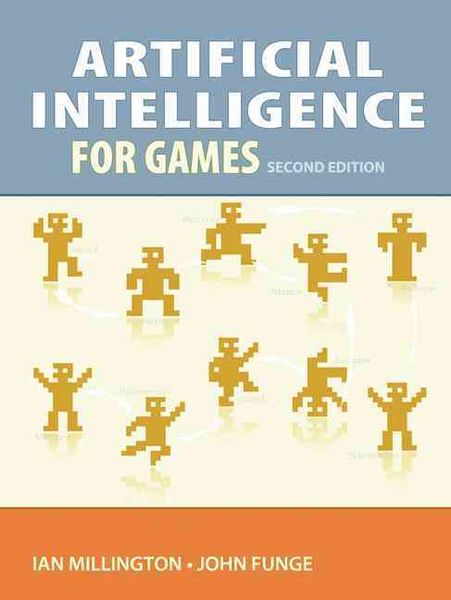
Produktbild: Millington, I: Artificial Intelligence for Games

Millington, I: Artificial Intelligence for Games

Fr. 109.00

inkl. gesetzl. MwSt., Versandkostenfrei


Beschreibung

Produktdetails

Einband

Gebundene Ausgabe

Erscheinungsdatum

06.08.2009

Abbildungen

Approx. 200 illustrations

Verlag

Taylor & Francis

Seitenzahl

888

Maße (L/B/H)

24.1/19.2/5.8 cm

Gewicht

1684 g

Auflage

2nd ed.

Sprache

Englisch

ISBN

978-0-12-374731-0

Beschreibung

Produktdetails

Einband

Gebundene Ausgabe

Erscheinungsdatum

06.08.2009

Abbildungen

Approx. 200 illustrations

Verlag

Taylor & Francis

Seitenzahl

888

Maße (L/B/H)

24.1/19.2/5.8 cm

Gewicht

1684 g

Auflage

2nd ed.

Sprache

Englisch

ISBN

978-0-12-374731-0

Noch keine Bewertungen vorhanden

Verfassen Sie die erste Bewertung zu diesem Artikel

Helfen Sie anderen Kundinnen und Kunden durch Ihre Meinung.

Kundinnen und Kunden meinen

Bewertungen (0)

  • Produktbild: Millington, I: Artificial Intelligence for Games
  • From the contents:
    Descriptions have been added to sections which will have significant changes in the 2nd edition.
    1 INTRODUCTION
    Will now make the code available exclusively online. This section would describe how to access the code and what it contains, in broad brush strokes. I have a completely new codebase for the second edition, with many more demos.
    2 GAME AI
    This chapter has been reorganised to include an additional section: AGENTS, PERCEPTS AND ACTIONS. This is a new section that looks at characters in a game in a more systemic way. It helps set up several of the later chapters that didn't have an organising principle.
    This section also includes updates on the current generation of hardware. In particular multi-core consoles.
    3 MOVEMENT
    Adding new section (ACTIONS AND MOVEMENT).
    Also, including more information on the representation of motion in a game engine, particularly a game engine with a physics core.
    There is additional material on COMBINING STEERING BEHAVIORS.
    4 PATHFINDING
    A short subsection on path finding in the presence of uncertainty will be added. This is an interesting new subfield.
    5 DECISION MAKING
    Adding a new section (BEHAVIOR TREES): a single technique set.
    A new section will be added to discuss goal oriented action planning outside the context of the Sims-like game from the 1st ed. Additional techniques will be discussed to allow readers to implement GOAP in other game genres.
    In particular two techniques: Hierarchical Task Planning and Partial Order Planning, will be introduced and applied at their most basic level.
    6 TACTICAL AND STRATEGIC AI
    Adding a new section (STRATEGY AND PERSONALITY) that discusses how to build strategic AI that follows distinct styles, without being too predictable and exploitable.
    7 LEARNING
    The examples in the section on REINFORCEMENT LEARNING will be modified. Readers found it difficult to understand why and how this technique should be used. The textual demo will be expanded to a graphic demo which will be walked through in detail.
    8 BOARD GAMES
    9 EXECUTION MANAGEMENT
    The section on ANYTIME ALGORITHMS will be expanded to include information on how to go about any-timing existing algorithms. Topics such as making recursion explicit, storing data between updates, and anytime algorithms on multi-core processors will be addressed.
    10 WORLD INTERFACING
    The section on GETTING KNOWLEDGE EFFICIENTLY will be expanded to bring in the idea of the percept introduced in chapter 2. In addition, there will be a new subsection on geometric queries to the game (where things are, what can be seen, etc).
    Adding a new section on INTELLIGENT CONTENT. Several games in the last few years have increased the AI sophistication by making the level more intelligent. Data and algorithms embedded into the level can mean that lots of characters can have correspondingly simpler AI and still appear very smart. This section describes how it can be done.
    11 TOOLS AND CONTENT CREATION
    There are minor tweaks to make here to bring the book up to date with current state of the art in commercial AI toolkits.
    The current hot-topic in game development is automating content creation. AI data is relatively easy to automate in some contexts - this section will be updated with this info.
    12 SCRIPTING
    NEW chapter on Scripting (pulling misc scripting sections from other parts of the book and going into more detail).
    Also, discussing visual scripting (the idea that programs can be represented visually). Also, covering node-based scripting systems in this new section.
    Coverage of declarative scripting, which doesn't give programs or scripts to be carried out, but states what should happen in response to conditions in the world. It is really a variation of rule-based decision making, but as a scripting technology is particularly powerful for gameplay development as well as agent-based AI. A couple of recent game projects I've seen use this approach....