KI-Beratung Beta

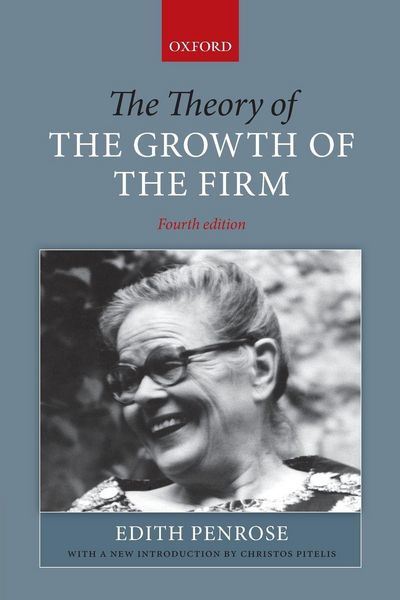
Produktbild: The Theory of the Growth of the Firm

The Theory of the Growth of the Firm

1

Fr. 39.90

inkl. gesetzl. MwSt., Versandkostenfrei


Beschreibung

There are not many books that are genuine classics, and only a handful in business and management whose insights and ideas last for 50 years and more. This book is one of the very few 'must reads' for anybody seriously interested in the role of management within the firm. Originally published in 1959,...

Beschreibung

There are not many books that are genuine classics, and only a handful in business and management whose insights and ideas last for 50 years and more. This book is one of the very few 'must reads' for anybody seriously interested in the role of management within the firm.
Originally published in 1959, The Theory of the Growth of the Firm has illuminated and inspired thinking in strategy, entrepreneurship, knowledge creation, and innovation. Edith Penrose's tightly-argued classic laid the foundations for the resource based view of the firm, now the dominant framework in business strategy. She analyses managerial activities and decisions, organizational routines, and also the factors that inevitably limit a firm's growth prospects.
For this new anniversary edition, Christos Pitelis has written a new introduction which both tells the story of Penrose's extraordinary life, and provides a balanced assessment of her key ideas and their continuing relevance and freshness.

Rezension

Review from previous edition A jewel of a volume. John Kay, Financial Times

Produktdetails

Einband

Taschenbuch

Erscheinungsdatum

03.07.2013

Verlag Oxford University Press
Seitenzahl

302

Produktdetails

Einband

Taschenbuch

Erscheinungsdatum

03.07.2013

Verlag Oxford University Press
Seitenzahl

302

Maße (L/B/H)

23.4/15.6/1.7 cm

Gewicht

462 g

Auflage

4. Auflage

Sprache

Englisch

ISBN

978-0-19-957384-4

Herstelleradresse

Libri GmbH
Europaallee 1
36244 Bad Hersfeld
DE

Email: gpsr@libri.de

Kundinnen und Kunden meinen

Informationen zu Bewertungen

Zur Abgabe einer Bewertung ist eine Anmeldung im Konto notwendig. Die Authentizität der Bewertungen wird von uns nicht überprüft. Wir behalten uns vor, Bewertungstexte, die unseren Richtlinien widersprechen, entsprechend zu kürzen oder zu löschen.

Die Bewertungen sind nach Format, Anzahl Sterne und Datum sortiert.

  • Hans-Peter Büttgenbach

    aus Langenfeld

    4/5

    15.01.2021

    Buch (Taschenbuch)

    Vorläufer der Strategieforschung

    Diese klassische Arbeit (1959) von Edith Penrose wird inzwischen als Ursprung des Ressourcenansatzes der Strategieforschung (Hamel, Prahalad u. a.) gesehen. Penrose greift auf Schumpeter, Babbage, Florence u. a. zurück und sieht in freien Ressourcen Chancen, das Portfolio zu erweitern und zu wachsen. Marktversagen führe letztlich dazu, dass Unternehmen diesen Weg gehen. Das neoklassische Modell der Firma wird ergänzt, manche sagen obsolet. Größe und Wachstum sind zentrale Kategorien. Grenzen werden in diesem Kontext nicht in der Größe von Unternehmen gesehen - Skalenökonomie existiert hauptsächlich bezüglich der Mindestgröße eines Unternehmens -, lediglich das Wachstum selbst hat Grenzen. Die Obergrenze der Größe kann durch Veränderung der Struktur (Holding) variert werden. Wachstum hängt an mehreren Faktoren, wesentlich an Managementressourcen. Breiten Raum nimmt die Ökonomie der Diversifizierung ein. Diese bewirke ein Hedging der Risiken - eine frühe Portfoliologik der Unternehmung. Obwohl prinzipiell jegliche Erweiterung der Breite möglich sei, wird das Risiko einer "messy product structure" gesehen. M. Porter konnte für die Diskussion um horizontale Integration Jahrzehnte später auf das Scheitern lateraler Diversifikationsmuster der Mischkonzerne (Konglomerate) zurückgreifen, er verwies auch darauf, dass horizonrale Strategie kein Portfoliokonzept ist. Vertikale Integration - backward/forward - wird ebenso thematisiert. Die einfache Weltenteilung - small firms/large firms - geschieht weitgehend ohne Branchen- und Technologiebezug wie bspw. in den Arbeiten von Bain (1956), Chandler (1962) oder Porter (1980), daher ist sie wenig hilfreich. "Big Business" lebt nicht unangreifbar auf einem Thron. Die Argumentation leidet generell unter einem Zuviel an Ideen, angesichts des Alters des Werks ist dies aber verzeihlich. Neben der Strategieforschung nutzt die VWL das Puzzle um freie Ressourcen in Unternehmen. P. Romer entwickelt Jahrzehnte später ähnliche Überlegungen ("rekombinante Innovation") zum endogenen Wachstum.

Kundinnen und Kunden meinen

5

0

4

1

3

0

2

0

1

0

Bewertungen (1)

Die Leseprobe wird geladen.
  • Produktbild: The Theory of the Growth of the Firm
    • Introduction
    • Preface
    • 1: Introduction
    • 2: The Firm in Theory
    • 3: The Productive Opportunity of the Firm and the 'Entrepreneur'
    • 4: Expansion Without Merger: The Receding Managerial Limit
    • 5: 'Inherited' Resources and the Direction of Expansion
    • 6: The Economies of Size and the Economies of Growth
    • 7: The Economics of Diversification
    • 8: Expansion Through Acquisition and Merger
    • 9: The Rate of Growth of Firms Through Time
    • 10: The Position of Large and Small Firms in a Growing Economy
    • 11: Growing Firms in a Growing Economy: The Process of Industrial Concentration and the Pattern of Dominance