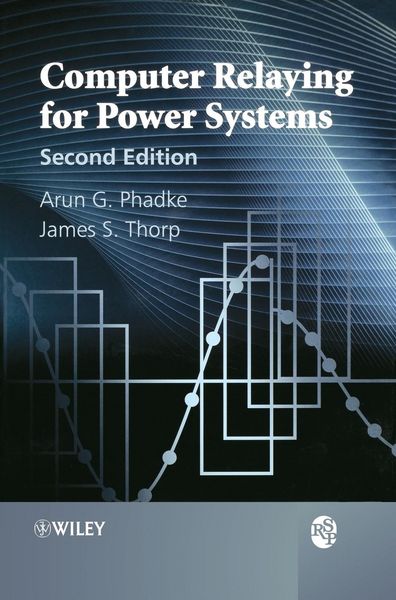
Computer Relaying for Power Systems
Fr. 183.00
inkl. gesetzl. MwSt.,
Beschreibung
Produktdetails
Einband
Gebundene Ausgabe
Erscheinungsdatum
07.08.2009
Verlag
John Wiley & SonsSeitenzahl
344
Maße (L/B/H)
25/17.5/2.3 cm
Gewicht
717 g
Auflage
2. Auflage
Sprache
Englisch
ISBN
978-0-470-05713-1
Since publication of the first edition of Computer Relaying for Power Systems in 1988, computer relays have been widely accepted by power engineers throughout the world and in many countries they are now the protective devices of choice.
The authors have updated this new edition with the latest developments in technology and applications such as adaptive relaying, wide area measurements, signal processing, new GPS-based measurement techniques and the application of artificial intelligence to digital relays. New material also includes sigma-delta and oversampling A/D converters, self-polarizing and cross-polarizing in transmission lines protection and optical current and voltage transformers.
Phadke and Thorp have been working together in power systems engineering for more than 30 years. Their impressive work in the field has been recognized by numerous awards, including the prestigious 2008 Benjamin Franklin Medal in Electrical Engineering for their pioneering contributions to the development and application of microprocessor controllers in electric power systems.
* Provides the student with an understanding of computer relaying
* Authored by international authorities in computer relaying
* Contents include relaying practices, mathematical basis for protective relaying algorithms, transmission line relaying, protection of transformers, machines and buses, hardware organization in integrated systems, system relaying and control, and developments in new relaying principles
* Features numerous solved examples to explain several of the more complex topics, as well as a problem at the end of each chapter
* Includes an updated list of references and a greatly expanded subject index.
The authors have updated this new edition with the latest developments in technology and applications such as adaptive relaying, wide area measurements, signal processing, new GPS-based measurement techniques and the application of artificial intelligence to digital relays. New material also includes sigma-delta and oversampling A/D converters, self-polarizing and cross-polarizing in transmission lines protection and optical current and voltage transformers.
Phadke and Thorp have been working together in power systems engineering for more than 30 years. Their impressive work in the field has been recognized by numerous awards, including the prestigious 2008 Benjamin Franklin Medal in Electrical Engineering for their pioneering contributions to the development and application of microprocessor controllers in electric power systems.
* Provides the student with an understanding of computer relaying
* Authored by international authorities in computer relaying
* Contents include relaying practices, mathematical basis for protective relaying algorithms, transmission line relaying, protection of transformers, machines and buses, hardware organization in integrated systems, system relaying and control, and developments in new relaying principles
* Features numerous solved examples to explain several of the more complex topics, as well as a problem at the end of each chapter
* Includes an updated list of references and a greatly expanded subject index.
Kundinnen und Kunden meinen
Verfassen Sie die erste Bewertung zu diesem Artikel
Helfen Sie anderen Kund*innen durch Ihre Meinung