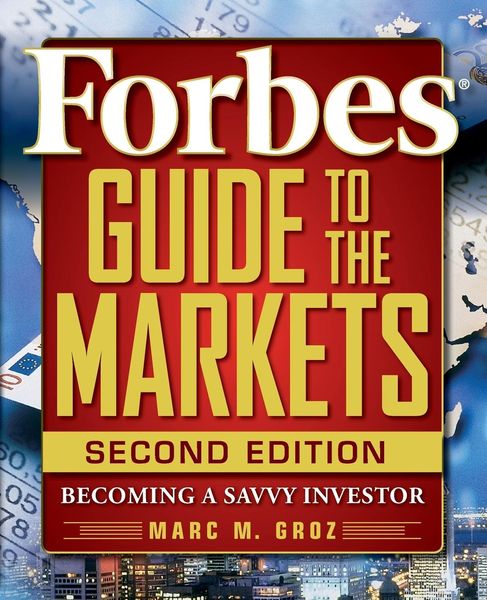
Produktbild: Forbes Guide to Markets 2e

Forbes Guide to Markets 2e Becoming a Savvy Investor

Fr. 35.90

inkl. gesetzl. MwSt., Versandkostenfrei


Beschreibung

Produktdetails

Einband

Taschenbuch

Erscheinungsdatum

01.09.2009

Verlag

John Wiley & Sons

Seitenzahl

320

Maße (L/B/H)

23.5/19.1/1.7 cm

Gewicht

590 g

Auflage

2nd edition

Sprache

Englisch

ISBN

978-0-470-46338-3

Beschreibung

Produktdetails

Einband

Taschenbuch

Erscheinungsdatum

01.09.2009

Verlag

John Wiley & Sons

Seitenzahl

320

Maße (L/B/H)

23.5/19.1/1.7 cm

Gewicht

590 g

Auflage

2nd edition

Sprache

Englisch

ISBN

978-0-470-46338-3

Herstelleradresse

Libri GmbH
Europaallee 1
36244 Bad Hersfeld
DE

Email: gpsr@libri.de

Kundinnen und Kunden meinen

0 Bewertungen

Informationen zu Bewertungen

Zur Abgabe einer Bewertung ist eine Anmeldung im Konto notwendig. Die Authentizität der Bewertungen wird von uns nicht überprüft. Wir behalten uns vor, Bewertungstexte, die unseren Richtlinien widersprechen, entsprechend zu kürzen oder zu löschen.

Die Bewertungen sind nach Format, Anzahl Sterne und Datum sortiert.

Verfassen Sie die erste Bewertung zu diesem Artikel

Helfen Sie anderen Kund*innen durch Ihre Meinung

Kundinnen und Kunden meinen

0 Bewertungen filtern

Die Leseprobe wird geladen.
  • Produktbild: Forbes Guide to Markets 2e
  • Acknowledgments xi

    Note to the Reader xiii

    About the Author xv

    Introduction: Becoming a Savvy Investor xvii

    Section I Establishing a Frame of Reference 1

    Chapter One From "Dumb" Barter to Intelligent Agents 3

    Chapter Two Point-Counterpoint 13

    Stocks 14

    Mutual Funds 14

    Bonds 15

    ETFs 15

    Options 15

    Futures 16

    Summary 16

    Chapter Three Confronting Information Overload 17

    Investor Constraints 18

    Investor Choices 19

    Investor Safety 21

    Section II Stocks and Equity Markets 23

    Chapter Four Varieties of Stocks 27

    Just What is a Security, Anyway? 27

    Issuers and Underwriters: Why Does a Corporation Sell Stock to the Public? 29

    Why Investors Buy Stock 34

    Summing Up Total Return: Dividends and Capital Gains 35

    A Letter to Our Shareholders: Annual and Quarterly Reports (and Filings) 41

    Making Sense of Types, Classes, and Other Stock Categories: A Map of the World of Stock 41

    Chapter Five Stock Markets 47

    The Big Board 48

    The Incredible Growth of Trading and Capital 58

    National Association of Securities Dealers Automated Quotation System (NASDAQ) 61

    Technology, Dark Pools, and the Evolution of a Unified Market 63

    Chapter Six Three Views of the Numbers 65

    Fundamental Analysis 66

    Technical Analysis 70

    Quantitative Analysis 80

    Chapter Seven Where to Find Information on Stocks and Financial Markets 87

    A Selection of Information Sources on the Financial Markets 91

    Chapter Eight How to Buy and Sell Stock 99

    Full-Service Brokers 100

    Discount Brokers 102

    Financial Intermediaries 103

    Direct Purchase 104

    If It Sounds Too Good to Be True . . . Protecting Yourself from Stock Scams 104

    A Note on Financial Planners 106

    Section III Mutual Funds and Investment Companies 109

    Chapter Nine A History and Overview of the Mutual Fund Business 113

    Open-End versus Closed-End Funds 117

    Index Funds 118

    Load versus No-Load Funds 119

    Chapter Ten Advantages of Mutual Funds 121

    Simplicity 121

    Diversification 122

    Access to New Issues 122

    Economies of Scale 123

    Professional Management 125

    Indexing 125

    Chapter Eleven Disadvantages of Mutual Funds 127

    Impact of One-Time Charges and Recurring Fees on Fund Performance 127

    Hidden Cost of Brokerage 130

    Some Hidden Risks of Fund Ownership 132

    Chapter Twelve Sources of Information on Mutual Funds 135

    Investment Company Institute Classification of Types of Funds 136

    Lipper Analytical Services 139

    Forbes 140

    Morningstar 140

    Chapter Thirteen Alternative Investments 141

    Hedge Funds 141

    Funds of Hedge Funds 144

    Other Alternatives 145

    Section IV Bonds and Other Fixed-Income Securities 147

    Chapter Fourteen Seven Characteristics of Bonds 151

    The Lifespan of Bonds 152

    Interest versus Discount 153

    Relationship of Price to Yield 154

    Four Important Yield Measures 154

    Credit Quality, Ratings, and Insurance 155

    Call and Related Features 155

    Fixed versus Floating Rates and Foreign Currencies 156

    Chapter Fifteen How the Other $30 Trillion is Invested 159

    Treasuries 160

    Corporates 170

    Mortgage-Backed Securities and Other Asset-Backed Securities 171

    Municipals 172

    Money Market 174

    Summary 175

    Section V Options, Futures, and Other Derivatives 177

    Chapter Sixteen Options 181

    Exchange-Traded Options 183

    Combination Strategies 185

    Determining the Value of an Option 187

    Chapter Seventeen Futures 193

    A Seller's Need to Hedge . . . 193

    Some Buyers Need to Hedge, Too 194

    Speculation or Insurance? Maybe a Little of Both 195

    Actuals versus Cash-Settled Contracts 195

    Margin and Collateral 196

    Chapter Eighteen Other Derivatives 199

    Section VI Summing Up Risk and Return 203

    Chapter Nineteen How Well Are My Investments Doing? 207

    The Basics of Return 208

    Annualized Returns: Arithmetic (Simple) or Geometric (Compound)? 211

    Time-Weighted Returns versus Money-Weighted Returns 216

    Complicating Factors 220

    Chapter Twenty Coming to Grips with the Many Dimensions of Risk 223

    A Definition of Investment Risk 223

    The Relativity of Risk 224

    What is Market Risk? 226

    "It Will Fluctuate" 227

    Other Kinds of Investment Risk: From the Quantifiable to the Subjective 228

    Balancing Risk and Return 232

    Chapter Twenty-One A Crescendo of Change 235

    Again, We Ask, What is a Market? 235

    Glossary 239

    Index 267