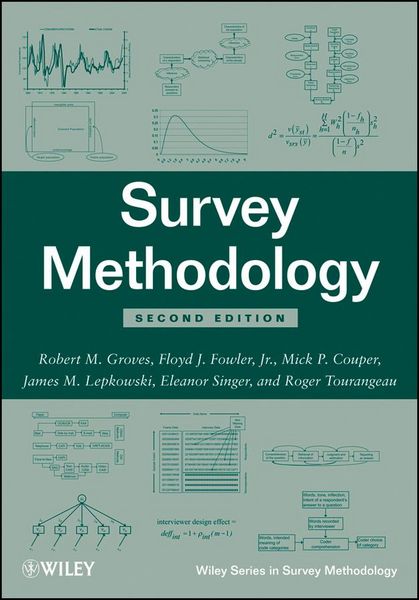
Survey Methodology
Aus der Reihe
Wiley Series in Survey Methodology
-
- Taschenbuch ausgewählt
- eBook
-
Sprache:Englisch
-
Auflage:2. Auflage
- 2. Auflage Fr. 109.00 ausgewählt
- 1. Auflage Fr. 87.90
Fr. 109.00
inkl. gesetzl. MwSt.,
Beschreibung
Produktdetails
Einband
Taschenbuch
Erscheinungsdatum
30.07.2009
Verlag
John Wiley & Sons IncSeitenzahl
496
Maße (L/B/H)
25.2/17.8/2.5 cm
Gewicht
882 g
Auflage
2. Auflage
Sprache
Englisch
ISBN
978-0-470-46546-2
Praise for the First Edition:
"The book makes a valuable contribution by synthesizing current research and identifying areas for future investigation for each aspect of the survey process."
--Journal of the American Statistical Association
"Overall, the high quality of the text material is matched by the quality of writing . . ."
--Public Opinion Quarterly
". . . it should find an audience everywhere surveys are being conducted." --Technometrics
This new edition of Survey Methodology continues to provide a state-of-the-science presentation of essential survey methodology topics and techniques. The volume's six world-renowned authors have updated this Second Edition to present newly emerging approaches to survey research and provide more comprehensive coverage of the major considerations in designing and conducting a sample survey.
Key topics in survey methodology are clearly explained in the book's chapters, with coverage including sampling frame evaluation, sample design, development of questionnaires, evaluation of questions, alternative modes of data collection, interviewing, nonresponse, post-collection processing of survey data, and practices for maintaining scientific integrity. Acknowledging the growing advances in research and technology, the Second Edition features:
* Updated explanations of sampling frame issues for mobile telephone and web surveys
* New scientific insight on the relationship between nonresponse rates and nonresponse errors
* Restructured discussion of ethical issues in survey research, emphasizing the growing research results on privacy, informed consent, and confidentiality issues
* The latest research findings on effective questionnaire development techniques
* The addition of 50% more exercises at the end of each chapter, illustrating basic principles of survey design
* An expanded FAQ chapter that addresses the concerns that accompany newly established methods
Providing valuable and informative perspectives on the most modern methods in the field, Survey Methodology, Second Edition is an ideal book for survey research courses at the upper-undergraduate and graduate levels. It is also an indispensable reference for practicing survey methodologists and any professional who employs survey research methods.
"The book makes a valuable contribution by synthesizing current research and identifying areas for future investigation for each aspect of the survey process."
--Journal of the American Statistical Association
"Overall, the high quality of the text material is matched by the quality of writing . . ."
--Public Opinion Quarterly
". . . it should find an audience everywhere surveys are being conducted." --Technometrics
This new edition of Survey Methodology continues to provide a state-of-the-science presentation of essential survey methodology topics and techniques. The volume's six world-renowned authors have updated this Second Edition to present newly emerging approaches to survey research and provide more comprehensive coverage of the major considerations in designing and conducting a sample survey.
Key topics in survey methodology are clearly explained in the book's chapters, with coverage including sampling frame evaluation, sample design, development of questionnaires, evaluation of questions, alternative modes of data collection, interviewing, nonresponse, post-collection processing of survey data, and practices for maintaining scientific integrity. Acknowledging the growing advances in research and technology, the Second Edition features:
* Updated explanations of sampling frame issues for mobile telephone and web surveys
* New scientific insight on the relationship between nonresponse rates and nonresponse errors
* Restructured discussion of ethical issues in survey research, emphasizing the growing research results on privacy, informed consent, and confidentiality issues
* The latest research findings on effective questionnaire development techniques
* The addition of 50% more exercises at the end of each chapter, illustrating basic principles of survey design
* An expanded FAQ chapter that addresses the concerns that accompany newly established methods
Providing valuable and informative perspectives on the most modern methods in the field, Survey Methodology, Second Edition is an ideal book for survey research courses at the upper-undergraduate and graduate levels. It is also an indispensable reference for practicing survey methodologists and any professional who employs survey research methods.
Kundinnen und Kunden meinen
Verfassen Sie die erste Bewertung zu diesem Artikel
Helfen Sie anderen Kund*innen durch Ihre Meinung