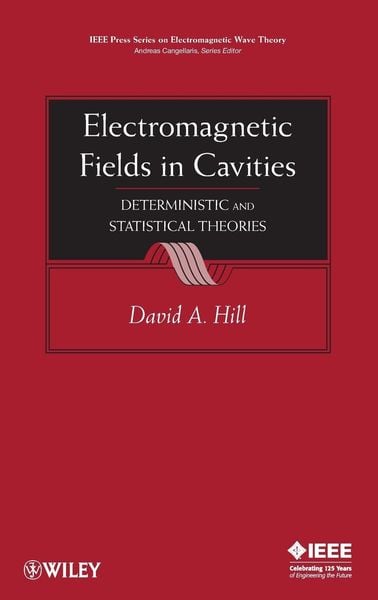
Produktbild: Electromagnetic Fields in Cavities

Electromagnetic Fields in Cavities Deterministic and Statistical Theories

Fr. 223.00

inkl. gesetzl. MwSt., Versandkostenfrei


Beschreibung

Produktdetails

Einband

Gebundene Ausgabe

Erscheinungsdatum

01.10.2009

Verlag

John Wiley & Sons

Seitenzahl

280

Maße (L/B/H)

24/16.1/2.1 cm

Gewicht

613 g

Auflage

1. Auflage

Sprache

Englisch

ISBN

978-0-470-46590-5

Beschreibung

Produktdetails

Einband

Gebundene Ausgabe

Erscheinungsdatum

01.10.2009

Verlag

John Wiley & Sons

Seitenzahl

280

Maße (L/B/H)

24/16.1/2.1 cm

Gewicht

613 g

Auflage

1. Auflage

Sprache

Englisch

ISBN

978-0-470-46590-5

Herstelleradresse

Libri GmbH
Europaallee 1
36244 Bad Hersfeld
DE

Email: gpsr@libri.de

Kundinnen und Kunden meinen

0 Bewertungen

Informationen zu Bewertungen

Zur Abgabe einer Bewertung ist eine Anmeldung im Konto notwendig. Die Authentizität der Bewertungen wird von uns nicht überprüft. Wir behalten uns vor, Bewertungstexte, die unseren Richtlinien widersprechen, entsprechend zu kürzen oder zu löschen.

Die Bewertungen sind nach Format, Anzahl Sterne und Datum sortiert.

Verfassen Sie die erste Bewertung zu diesem Artikel

Helfen Sie anderen Kund*innen durch Ihre Meinung

Kundinnen und Kunden meinen

0 Bewertungen filtern

Die Leseprobe wird geladen.
  • Produktbild: Electromagnetic Fields in Cavities
  • PREFACE.

    PART I. DETERMINISTIC THEORY.

    1. Introduction.

    1.1 Maxwell's Equations.

    1.2 Empty Cavity Modes.

    1.3 Wall Losses.

    1.4 Cavity Excitation.

    1.5 Perturbation Theories.

    Problems.

    2. Rectangular Cavity.

    2.1 Resonant Modes.

    2.2 Wall Losses and Cavity Q.

    2.3 Dyadic Green's Functions.

    Problems.

    3. Circular Cylindrical Cavity.

    3.1 Resonant Modes.

    3.2 Wall Losses and Cavity Q.

    3.3 Dyadic Green's Functions.

    Problems.

    4. Spherical Cavity.

    4.1 Resonant Modes.

    4.2 Wall Losses and Cavity Q.

    4.3 Dyadic Green's Functions.

    4.4 Schumann Resonances in the Earth-Ionosphere Cavity.

    Problems.

    PART II. STATISTICAL THEORIES FOR ELECTRICALLY LARGE CAVITIES.

    5. Motivation for Statistical Approaches.

    5.1 Lack of Detailed Information.

    5.2 Sensitivity of Fields to Cavity Geometry and Excitation.

    5.3 Interpretation of Results.

    Problems.

    6. Probability Fundamentals.

    6.1 Introduction.

    6.2 Probability Density Function.

    6.3 Common Probability Density Functions.

    6.4 Cumulative Distribution Function.

    6.5 Methods for Determining Probability Density Functions.

    Problems.

    7. Reverberation Chambers.

    7.1 Plane-Wave Integral Representation of Fields.

    7.2 Ideal Statistical Properties of Electric and Magnetic Fields.

    7.3 Probability Density Functions for the Fields.

    7.4 Spatial Correlation Functions of Fields and Energy Density.

    7.5 Antenna or Test-Object Response.

    7.6 Loss Mechanisms and Chamber Q.

    7.7 Reciprocity and Radiated Emissions.

    7.8 Boundary Fields.

    7.9 Enhanced Backscatter at the Transmitting Antenna.

    Problems.

    8. Aperture Excitation of Electrically Large, Lossy Cavities.

    8.1 Aperture Excitation.

    8.2 Power Balance.

    8.3 Experimental Results for SE.

    Problems.

    9. Extensions to the Uniform-Field Model.

    9.1 Frequency Stirring.

    9.2 Unstirred Energy.

    9.3 Alternative Probability Density Function.

    Problems.

    10. Further Applications of Reverberation Chambers.

    10.1 Nested Chambers for Shielding Effectiveness Measurements.

    10.2 Evaluation of Shielded Enclosures.

    10.3 Measurement of Antenna Efficiency.

    10.4 Measurement of Absorption Cross Section.

    Problems.

    11. Indoor Wireless Propagation.

    11.1 General Considerations.

    11.2 Path Loss Models.

    11.3 Temporal Characteristics.

    11.4 Angle of Arrival.

    11.5 Reverberation Chamber Simulation.

    Problems.

    APPENDIX A. VECTOR ANALYSIS.

    APPENDIX B. ASSOCIATED LEGENDRE FUNCTIONS.

    APPENDIX C. SPHERICAL BESSEL FUNCTIONS.

    APPENDIX D. THE ROLE OF CHAOS IN CAVITY FIELDS.

    APPENDIX E. SHORT ELECTRIC DIPOLE RESPONSE.

    APPENDIX F. SMALL LOOP ANTENNA RESPONSE.

    APPENDIX G. RAY THEORY FOR CHAMBER ANALYSIS.

    APPENDIX H. ABSORPTION BY A HOMOGENEOUS SPHERE.

    APPENDIX I. TRANSMISSION CROSS SECTION OF A SMALL CIRCULAR APERTURE.

    APPENDIX J. SCALING.

    REFERENCES.

    INDEX.