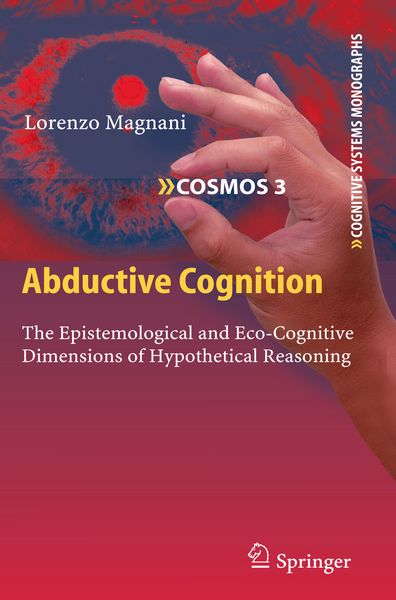
Produktbild: Abductive Cognition
Band 3

Abductive Cognition The Epistemological and Eco-Cognitive Dimensions of Hypothetical Reasoning

Fr. 191.00

inkl. gesetzl. MwSt., Versandkostenfrei


Beschreibung

Produktdetails

Einband

Gebundene Ausgabe

Erscheinungsdatum

09.10.2009

Verlag

Springer Berlin

Seitenzahl

535

Maße (L/B/H)

24.1/16.7/4.3 cm

Gewicht

956 g

Auflage

2010

Sprache

Englisch

ISBN

978-3-642-03630-9

Beschreibung

Rezension

From the reviews:

“Lorenzo Magnani has produced a magnum opus on abduction that brilliantly spans its philosophical, neuropsychological, computational, and ecological dimensions. In this review I will briefly highlight some of the substantial contributions of Abductive Cognition … . anyone interested in mind and society needs to pay attention to abductive cognition. There is no better place to jump off from than Lorenzo Magnani’s new book.” (Paul Thagard, Mind & Society, April, 2010)

“The aim of the monograph series is to record new developments in cognitive systems research. … The appearance of Abductive Cognition is a major event in cognitive science and the philosophy of science. In its reach, complexity and detail, it outpaces everything in the field. In its originality and daring, it is the freshest thing around and a tour de force. It is a book to be reckoned with.” (John Woods, Studies in History and Philosophy of Science, 2011)

“In Abductive Cognition Magnani pushes further his reflections on abduction … making of this concept as a key for understanding cognition. … To demonstrate the way the concept of abduction can be unfolded … in its many fields of application is the aim of the rest of the book. … Abductive Cognition does an impressive work in sketching some previously unexplored consequences of the concept of abduction in a cognitive framework … and in opening new ways of semiotically investigating cognitive phenomena.” (Riccardo Fusaroli, Versus, 2010)

“Lorenzo Magnani’s new book Abductive Cognition is an important addition … on the nature of abduction. … The book is full of ideas and approaches. … this is an essential reading for all who are interested in abduction, or (distributed) cognition, and especially those who are interested in both of them. Hopefully this is a growing group of people! There is also a large list of references as well as a short vocabulary on abductivecognition at the end of the book.” (Sami Paavola, Journal of General Philosophy of Science, March, 2011)

“Magnani’s book is an ambitious and ecumenical essay on that phenomenon, an attempt to collect and integrate research, old and new, regarding abductive thinking. … The audience of this volume is a readership already interested in the subject and acquainted with the basic issues surrounding it. … this review is to outline the thread of its development for the benefit of a broader audience, and to help readers perceive the overall thrust of the work in the midst of the many details recounted in it.” (Cameron Shelley, Minds and Machines, December, 2011)

Produktdetails

Einband

Gebundene Ausgabe

Erscheinungsdatum

09.10.2009

Verlag

Springer Berlin

Seitenzahl

535

Maße (L/B/H)

24.1/16.7/4.3 cm

Gewicht

956 g

Auflage

2010

Sprache

Englisch

ISBN

978-3-642-03630-9

Herstelleradresse

Springer-Verlag GmbH
Heidelberger Platz 3
14197 Berlin
Deutschland
Email: sdc-bookservice@springer.com
Url: www.springer.com
Telephone: +49 30 827870
Fax: +49 30 8214091

Kundinnen und Kunden meinen

0 Bewertungen

Informationen zu Bewertungen

Zur Abgabe einer Bewertung ist eine Anmeldung im Konto notwendig. Die Authentizität der Bewertungen wird von uns nicht überprüft. Wir behalten uns vor, Bewertungstexte, die unseren Richtlinien widersprechen, entsprechend zu kürzen oder zu löschen.

Die Bewertungen sind nach Format, Anzahl Sterne und Datum sortiert.

Verfassen Sie die erste Bewertung zu diesem Artikel

Helfen Sie anderen Kund*innen durch Ihre Meinung

Kundinnen und Kunden meinen

0 Bewertungen filtern

  • Produktbild: Abductive Cognition
  • Theoretical and Manipulative Abduction.- Non-explanatory and Instrumental Abduction.- Semiotic Brains and Artificial Minds.- Neuro-multimodal Abduction.- Animal Abduction.- Abduction, Affordances, and Cognitive Niches.- Abduction in Human and Logical Agents.- Morphodynamical Abduction.