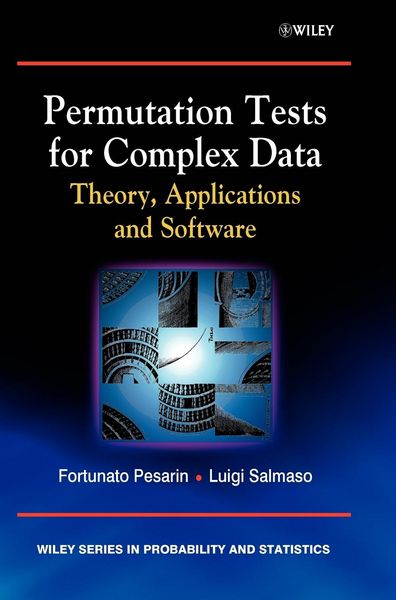
Permutation Tests for Complex Data Theory, Applications and Software
Aus der Reihe
Wiley Series in Probability and Statistics
-
Sprache:Englisch
-
Verlag:John Wiley & Sons Inc
- Wiley Fr. 173.00
- John Wiley & Sons Inc Fr. 179.00 ausgewählt
Fr. 179.00
inkl. gesetzl. MwSt.,
Beschreibung
Produktdetails
Einband
Gebundene Ausgabe
Erscheinungsdatum
19.03.2010
Verlag
John Wiley & Sons IncSeitenzahl
448
Maße (L/B/H)
22.9/15.2/2.9 cm
Gewicht
876 g
Auflage
1. Auflage
Sprache
Englisch
ISBN
978-0-470-51641-6
Complex multivariate testing problems are frequently encountered in many scientific disciplines, such as engineering, medicine and the social sciences. As a result, modern statistics needs permutation testing for complex data with low sample size and many variables, especially in observational studies.
The Authors give a general overview on permutation tests with a focus on recent theoretical advances within univariate and multivariate complex permutation testing problems, this book brings the reader completely up to date with today's current thinking.
Key Features:
* Examines the most up-to-date methodologies of univariate and multivariate permutation testing.
* Includes extensive software codes in MATLAB, R and SAS, featuring worked examples, and uses real case studies from both experimental and observational studies.
* Includes a standalone free software NPC Test Release 10 with a graphical interface which allows practitioners from every scientific field to easily implement almost all complex testing procedures included in the book.
* Presents and discusses solutions to the most important and frequently encountered real problems in multivariate analyses.
* A supplementary website containing all of the data sets examined in the book along with ready to use software codes.
Together with a wide set of application cases, the Authors present a thorough theory of permutation testing both with formal description and proofs, and analysing real case studies. Practitioners and researchers, working in different scientific fields such as engineering, biostatistics, psychology or medicine will benefit from this book.
The Authors give a general overview on permutation tests with a focus on recent theoretical advances within univariate and multivariate complex permutation testing problems, this book brings the reader completely up to date with today's current thinking.
Key Features:
* Examines the most up-to-date methodologies of univariate and multivariate permutation testing.
* Includes extensive software codes in MATLAB, R and SAS, featuring worked examples, and uses real case studies from both experimental and observational studies.
* Includes a standalone free software NPC Test Release 10 with a graphical interface which allows practitioners from every scientific field to easily implement almost all complex testing procedures included in the book.
* Presents and discusses solutions to the most important and frequently encountered real problems in multivariate analyses.
* A supplementary website containing all of the data sets examined in the book along with ready to use software codes.
Together with a wide set of application cases, the Authors present a thorough theory of permutation testing both with formal description and proofs, and analysing real case studies. Practitioners and researchers, working in different scientific fields such as engineering, biostatistics, psychology or medicine will benefit from this book.
Noch keine Bewertungen vorhanden
Verfassen Sie die erste Bewertung zu diesem Artikel
Helfen Sie anderen Kundinnen und Kunden durch Ihre Meinung.