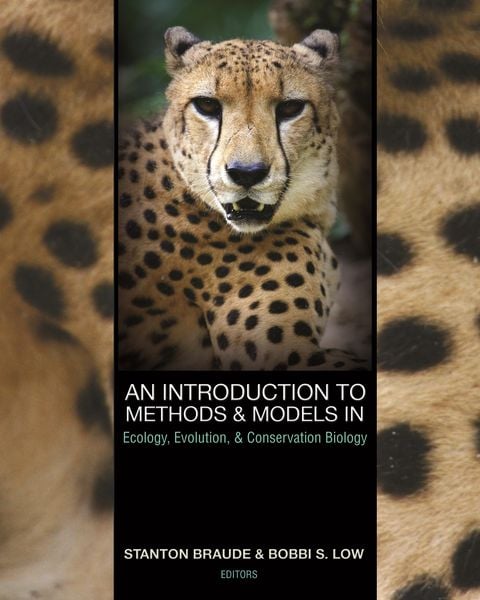
Produktbild: An Introduction to Methods & Models in Ecology, Evolution, & Conservation Biology

An Introduction to Methods & Models in Ecology, Evolution, & Conservation Biology Conservation Biolog

Fr. 89.90

inkl. gesetzl. MwSt., Versandkostenfrei


Beschreibung

Produktdetails

Einband

Taschenbuch

Erscheinungsdatum

24.01.2010

Herausgeber

Stanton Braude + weitere

Verlag

Princeton University Press

Seitenzahl

312

Maße (L/B/H)

25.7/20.5/2 cm

Gewicht

680 g

Sprache

Englisch

ISBN

978-0-691-12724-8

Beschreibung

Produktdetails

Einband

Taschenbuch

Erscheinungsdatum

24.01.2010

Herausgeber

Verlag

Princeton University Press

Seitenzahl

312

Maße (L/B/H)

25.7/20.5/2 cm

Gewicht

680 g

Sprache

Englisch

ISBN

978-0-691-12724-8

Herstelleradresse

Libri GmbH
Europaallee 1
36244 Bad Hersfeld
DE

Email: gpsr@libri.de

Kundinnen und Kunden meinen

0 Bewertungen

Informationen zu Bewertungen

Zur Abgabe einer Bewertung ist eine Anmeldung im Konto notwendig. Die Authentizität der Bewertungen wird von uns nicht überprüft. Wir behalten uns vor, Bewertungstexte, die unseren Richtlinien widersprechen, entsprechend zu kürzen oder zu löschen.

Die Bewertungen sind nach Format, Anzahl Sterne und Datum sortiert.

Verfassen Sie die erste Bewertung zu diesem Artikel

Helfen Sie anderen Kund*innen durch Ihre Meinung

Kundinnen und Kunden meinen

0 Bewertungen filtern

  • Produktbild: An Introduction to Methods & Models in Ecology, Evolution, & Conservation Biology
  • Figures vii Tables xi Preface xv Acknowledgments xvii Introduction xix Section I: E volutionary Biology Chapter 1: Evolution and Pesticide Resistance: Examining Quantitative Trends Visually by Stanton Braude and John Gaskin 3 Chapter 2: Lizard Ecomorphology: Generating and Testing Hypotheses of Adaptation by Kenneth H. Kozak 12 Chapter 3: Phylogenetic Inference: Examining Morphological and Molecular Datasets by James Beck 22 Chapter 4: Life History Tradeoffs in Avian Clutch Size: Interpreting Life History Data and Evaluating Alternative Hypotheses by Jon Hess 36 Chapter 5: Mimicry: Experimental Design and Scientific Logic by James Robertson 51 Section II: D emography and Population Ecology Chapter 6: Life Table Analysis by Stanton Braude 63 Chapter 7: Lotka-Volterra Competition Modeling by Stanton Braude, Tara Scherer, and Rebecca McGaha 69 Chapter 8: Explosive Population Growth and Invasive Exotic Species by Jon Hess and James Robertson 79 Chapter 9: Island Biogeography: Evaluating Correlational Data and Testing Alternative Hypotheses by James Robertson 91 Section III: Population Genetics Chapter 10: Hardy-Weinberg: Evaluating Disequilibrium Forces by Jason J. Kolbe 107 Chapter 11: Drift, Demographic Stochasticity, and Extinction in Woggles by James Robertson, Anton Weisstein, and Stanton Braude 117 Chapter 12: Conservation of Small Populations: Effective Population Sizes, Inbreeding, and the 50/500 Rule by Luke J. Harmon and Stanton Braude 125 Chapter 13: Dispersal and Metapopulation Structure by James Robertson 139 Section IV: Quantitative Ecological Tools Chapter 14: Understanding Descriptive Statistics by Beth Sparks-Jackson and Emily Silverman 155 Chapter 15: Understanding Statistical Inference by Emily Silverman and Beth Sparks-Jackson 179 Chapter 16: Sampling Wild Populations by Stanton Braude and James Robertson 189 Chapter 17: Quantifying Biodiversity by Cawas Behram Engineer and Stanton Braude 198 Chapter 18: Environmental Predictability and Life History by Bobbi S. Low and Stanton Braude 214 Chapter 19: Modeling Optimal Foraging by Stanton Braude and James Robertson 226 Section V: S ynthetic Exercises and Writing Assignments Chapter 20: Evaluating Competing Hypotheses of Regional Biodiversity by Stanton Braude 235 Chapter 21: Preparing and Evaluating Competitive Grant Proposals for Conservation Funding by Stanton Braude 239 Chapter 22: Tracing the History of Scientific Ideas: From Darwin, Connell, or Soule to the Present by Bobbi S. Low 245 Glossary 251 Contributors 263 Index 265