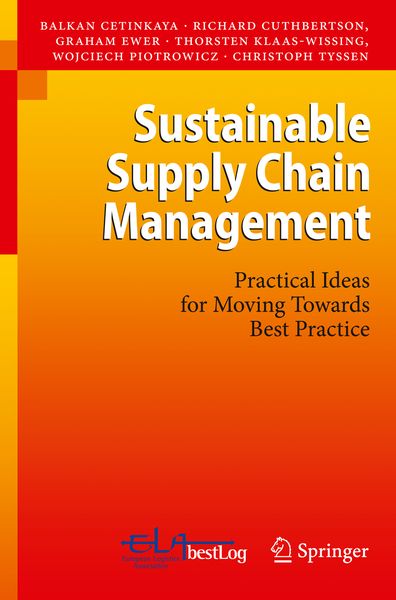
Produktbild: Sustainable Supply Chain Management

Sustainable Supply Chain Management Practical Ideas for Moving Towards Best Practice

Fr. 123.00

inkl. gesetzl. MwSt., Versandkostenfrei


Beschreibung

Produktdetails

Einband

Taschenbuch

Erscheinungsdatum

09.02.2011

Abbildungen

XVIII, 57 illus., 28 illus. in color., farbige Illustrationen, schwarz-weiss Illustrationen

Verlag

Springer Berlin

Seitenzahl

283

Maße (L/B/H)

23.8/15.6/2 cm

Gewicht

450 g

Auflage

2011

Sprache

Englisch

ISBN

978-3-642-12022-0

Beschreibung

Produktdetails

Einband

Taschenbuch

Erscheinungsdatum

09.02.2011

Abbildungen

XVIII, 57 illus., 28 illus. in color., farbige Illustrationen, schwarz-weiss Illustrationen

Verlag

Springer Berlin

Seitenzahl

283

Maße (L/B/H)

23.8/15.6/2 cm

Gewicht

450 g

Auflage

2011

Sprache

Englisch

ISBN

978-3-642-12022-0

Herstelleradresse

Springer Nature Customer Service Center GmbH
Europaplatz 3
69115 Heidelberg
DE
ProductSafety@springernature.com

Kundinnen und Kunden meinen

0 Bewertungen

Informationen zu Bewertungen

Zur Abgabe einer Bewertung ist eine Anmeldung im Konto notwendig. Die Authentizität der Bewertungen wird von uns nicht überprüft. Wir behalten uns vor, Bewertungstexte, die unseren Richtlinien widersprechen, entsprechend zu kürzen oder zu löschen.

Die Bewertungen sind nach Format, Anzahl Sterne und Datum sortiert.

Verfassen Sie die erste Bewertung zu diesem Artikel

Helfen Sie anderen Kund*innen durch Ihre Meinung

Kundinnen und Kunden meinen

0 Bewertungen filtern

  • Produktbild: Sustainable Supply Chain Management
  • Section A 11
    A.1 The need for sustainable supply chain management 12
    A.1.1. Sustainable Supply Chains 13
    A.1.2. Best practice in Supply Chain management 13
    A.1.3. The need for sustainable Supply Chains 14
    A.1.4. The implications of modern Supply Chain management 17
    A.1.5. Moving towards sustainable Supply Chains 20
    A.1.6. The structure of this book 22
    Section B 25
    Section Overview 25
    B. 27
    B.1 Developing a Sustainable Supply Chain Strategy 27
    B.1.1. Introduction – The starting point 27
    B.1.2. The Supply Chain Strategy – a critical success factor for sustainability 29
    B.1.3. Ingredients of a Sustainable Supply Chain Strategy 38
    B.1.4. An iterative approach to developing your Sustainable Supply Chain Strategy 46
    B.1.5. Principles into practice 71
    B.2 Managing Performance 73
    B.2.1. Introduction 74
    B.2.2. Measuring and monitoring sustainable Supply Chain 75
    B.2.3. Evaluating impact of your SC activities on sustainability 76
    B.2.4. Benefits of performance measurement 80
    B.2.5. Problems with measuring performance 81
    B.2.6. Stages of Supply Chain performance measurement 83
    B.2.7. Visible Supply Chain - Process, Product and Performance 85
    B.2.8. Product oriented monitoring 87
    B.2.9. Supply Chain performance measurement – methods and approaches 88
    B.2.10. Creating Supply Chain performance measurement system 89
    B.2.11. Conclusions 92
    B.3 Managing within your Organisation 95
    B.3.1. Under your managerial control 96
    B.3.2. Managing Processes 98
    B.3.3. Managing Products 104
    B.3.4. Managing Knowledge 106
    B.3.5. Managing Infrastructure 112
    B.3.6. Managing People & Teams 117
    B.3.7. Managerial Challenge: Find and Prioritize your Internal Sustainability Gap 121
    B.3.8. Summary and Conclusions 126
    B.4 Managing Outside your Organisation 133
    B.4.1. Introduction and structure of the chapter 134
    B.4.2. Supply Chain Stakeholders – Who has which impact on your supply chain? 135
    B.4.3. Action Fields for Supply Chain Stakeholder Management 143
    B.4.4. Determining the “right” Supply Chain Stakeholders 147
    B.4.5. Managing Supply Chain Stakeholders 156
    B.4.6. Conclusion 169
    B.5 Outside your control and influence - managing the unexpected 174
    B.5.1. What’s this all about? 175
    B.5.2. The Challenge – What is risk and why deal with it? 177
    B.5.3. Dealing with Risk - Principles 181
    B.5.4. Dealing with Risk – Getting Organised in Your Business 184
    B.5.5. Dealing with Risk from outside your business 190
    B.5.6. Uncontrollable Risks and how to handle them 194
    B.5.7. Solutions - What makes the best practice in risk avoidance? 197
    B.5.8. Managing Risk – the Principal Lessons from the bestLog Project 199
    B.5.9. Summary 201
    B.5.10. Definitions 203
    B.5.11. Questions for Teachers 206
    Section C 207
    Section Overview 207
    C. 208
    C.1 Future sustainable supply chains 208
    C.1.1. Understanding the future 208
    C.1.2. The central question for sustainable supply chains 209
    C.1.3. The driving forces that will influence sustainable supply chains 209
    C.1.4. Considering the critical uncertainties in supply chain management 211
    Section D 214
    Section Overview 214
    D. 215
    D.1 Section Structure 215
    D.2 Markets & Strategies Cases 216
    D.2.1. Strategic Environmental Plan 216
    D.3 Structure & Planning Cases 222
    D.3.1. Consolidation and consignment 222
    D.3.2. Supply network redesigning 227
    D.3.3. Full speed Supply Chain 233
    D.3.4. Collaborative Intermodal Transport with Supplier 238
    D.3.5. Pooling 243
    D.4 Processes & Operations Cases 248
    D.4.1. Increased transport efficiency 248
    D.4.2. Transportation of healthcare products by inland navigation 254
    D.4.3. Intermodal transport in Retail 259
    D.4.4. Intermodal less than truckload 264
    D.4.5. Collaborative Intermodal Transport with LSP 269
    D.4.6. e-Integration and Supplier Evaluation 273
    D.4.7. Optimization of goods collection 278
    D.4.8. Railway Transport 282
    D.4.9. Consolidation by DC 287
    D.4.10. Transport Marketplace 291
    D.4.11. Transport Exchange 297
    D.4.12. Influence of product design on warehousing and transport efficiency 301
    D.5 Enablers & Support Cases 306
    D.5.1. Telematics 306
    D.5.2. IT Integration 311
    D.5.3. Intermodal Terminal 316
    D.5.4. Cargo Securing 320