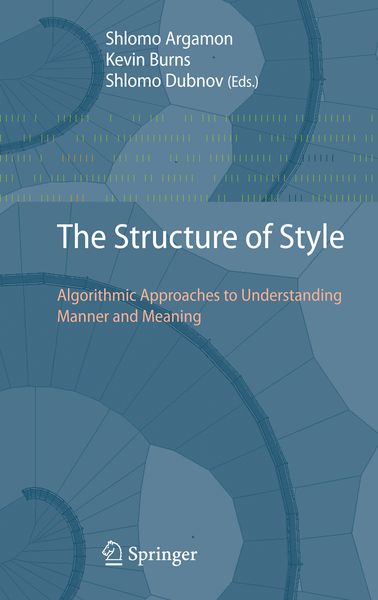
The Structure of Style Algorithmic Approaches to Understanding Manner and Meaning
-
- Hardcover ausgewählt
- Taschenbuch
-
Sprache:Englisch
Fr. 137.00
inkl. gesetzl. MwSt.,
Beschreibung
Produktdetails
Einband
Gebundene Ausgabe
Erscheinungsdatum
15.09.2010
Abbildungen
XVIII, 338 p.
Herausgeber
Shlomo Argamon + weitereVerlag
Springer BerlinSeitenzahl
338
Maße (L/B/H)
24.1/16/2.7 cm
Gewicht
765 g
Auflage
2010
Sprache
Englisch
ISBN
978-3-642-12336-8
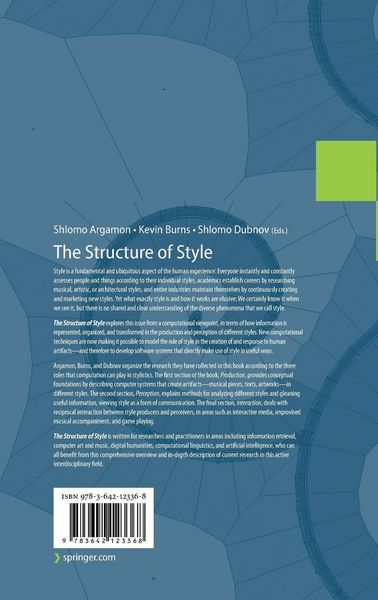
Style is a fundamental and ubiquitous aspect of the human experience: Everyone instantly and constantly assesses people and things according to their individual styles, academics establish careers by researching musical, artistic, or architectural styles, and entire industries maintain themselves by continuously creating and marketing new styles. Yet what exactly style is and how it works are elusive: We certainly know it when we see it, but there is no shared and clear understanding of the diverse phenomena that we call style.
The Structure of Style explores this issue from a computational viewpoint, in terms of how information is represented, organized, and transformed in the production and perception of different styles. New computational techniques are now making it possible to model the role of style in the creation of and response to human artifacts—and therefore to develop software systems that directly make use of style in useful ways.
Argamon, Burns, and Dubnov organize the research they have collected in this book according to the three roles that computation can play in stylistics. The first section of the book, Production, provides conceptual foundations by describing computer systems that create artifacts—musical pieces, texts, artworks—in different styles. The second section, Perception, explains methods for analyzing different styles and gleaning useful information, viewing style as a form of communication. The final section, Interaction, deals with reciprocal interaction between style producers and perceivers, in areas such as interactive media, improvised musical accompaniment, and game playing.
The Structure of Style is written for researchers and practitioners in areas including information retrieval, computer art and music, digital humanities, computational linguistics, and artificial intelligence, who can all benefit from this comprehensive overview and in-depth description of current research in this activeinterdisciplinary field.
Noch keine Bewertungen vorhanden
Verfassen Sie die erste Bewertung zu diesem Artikel
Helfen Sie anderen Kundinnen und Kunden durch Ihre Meinung.