Gutscheinbedingungen

*Gültig bis 20.07.2026 auf alle Bücher. Ausgeschlossen sind Zeitschriften, Prozentbücher und Abos | Einlösbar in allen Buchhandlungen von Orell Füssli, Barth Bücher, Buchladen Rapunzel, Papeterie Köhler, Schuler Orell Füssli, Stauffacher und ZAP unter Vorweisung des Gutscheins, auf www.orellfüssli.ch durch Eingabe des Gutscheincodes. Beim Service „eBooks verschenken“ und bei eBook-Käufen via eReader nicht einlösbar | Mindesteinkaufswert: Fr. 30.- | Nicht mit anderen Rabatten kumulierbar.

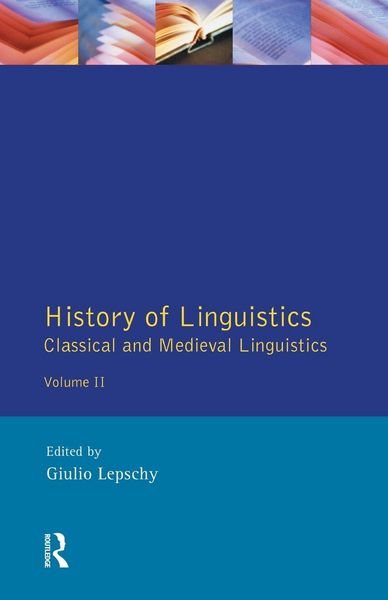
  • Produktbild: History of Linguistics Volume II
  • Produktbild: History of Linguistics Volume II

History of Linguistics Volume II Classical and Medieval Linguistics

Fr. 72.90

inkl. gesetzl. MwSt., Versandkostenfrei


Beschreibung

Produktdetails

Einband

Taschenbuch

Erscheinungsdatum

27.06.1994

Verlag

Taylor and Francis

Seitenzahl

400

Maße (L/B/H)

21.6/14/2.2 cm

Gewicht

740 g

Sprache

Englisch

ISBN

978-0-582-09491-8

Beschreibung

Produktdetails

Einband

Taschenbuch

Erscheinungsdatum

27.06.1994

Verlag

Taylor and Francis

Seitenzahl

400

Maße (L/B/H)

21.6/14/2.2 cm

Gewicht

740 g

Sprache

Englisch

ISBN

978-0-582-09491-8

Noch keine Bewertungen vorhanden

Verfassen Sie die erste Bewertung zu diesem Artikel

Helfen Sie anderen Kundinnen und Kunden durch Ihre Meinung.

Kundinnen und Kunden meinen

Bewertungen (0)

Die Leseprobe wird geladen.
  • Produktbild: History of Linguistics Volume II
  • Produktbild: History of Linguistics Volume II
  • Introduction
    Acknowledgements
    Notes on the contributors

    1. Greek and Latin linguistics, Peter Matthews
    1.1 Introduction
    1.2 Phonetics and phonology
    1.3 The status and origin of words
    1.4 Elements of the sentence
    1.5 The prehistory of grammar
    1.6 Grammars under the Empire

    2. Medieval linguistics, Edoardo Vineis and Alfonso Maierù
    2.1 Introduction, Edoardo Vineis
    2.2 Linguistics and grammar, Edoardo Vineis
    2.2.1 Schools and centres of culture from Late Antiquity to the Carolingian Renaissance
    2.2.2 Schools and centres of culture from the Carolingian Renaissance to the threshold of Humanism
    2.2.3 Knowledge of the Latin grammarians in the various areas of Europe
    2.2.4 Boethius, Cassiodorus, and Isidore of Seville
    2.2.5 Iulianus Toletanus and the beginnings of the early medieval grammatical tradition up to the works of Virgil the grammarian
    2.2.6 'Elementary grammarians' and 'exegetic grammars' up to the Carolingian Renaissance
    2.2.7 The tenth-twelfth century commentaries on Donatus and Priscian: first indications of the appearance of a speculative grammar
    2.2.8 Doctrinale and the Grecismus
    2.2.9 Lexiographic activity
    2.2.10 Grammars for the teaching of Latin written in other languages: the example of Aelfric
    2.2.11 The grammatical description of other languages other than Latin
    2.2.12 Elements of synchronic descriptions of the different local pronunciations of Latin inferable from medieval Latin grammars
    2.3 The philosophy of language, Alfonso Maierù
    2.3.1 Platonism in the early Middle Ages
    2.3.2 Aristotelianism in the eleventh and twelfth centuries
    2.3.3 The grammar of the Modistae
    2.3.4 Critics of the Modistae

    Notes
    Bibliographical references
    Index