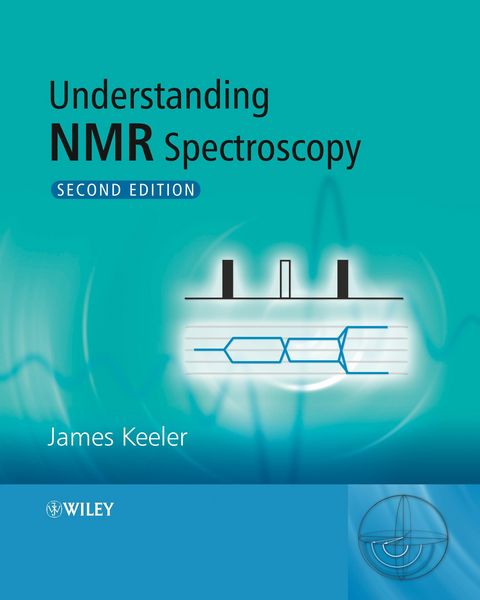
Understanding NMR Spectroscopy
-
- Hardcover ausgewählt
- Taschenbuch
- eBook
-
Sprache:Englisch
Fr. 239.00
inkl. gesetzl. MwSt.,
Beschreibung
Produktdetails
Einband
Gebundene Ausgabe
Erscheinungsdatum
29.09.2010
Verlag
John Wiley & SonsSeitenzahl
526
Maße (L/B/H)
3.1/18.9/24.6 cm
Gewicht
1426 g
Auflage
2. Auflage
Sprache
Englisch
ISBN
978-0-470-74609-7
This text is aimed at people who have some familiarity with high-resolution NMR and who wish to deepen their understanding of how NMR experiments actually 'work'. This revised and updated edition takes the same approach as the highly-acclaimed first edition. The text concentrates on the description of commonly-used experiments and explains in detail the theory behind how such experiments work. The quantum mechanical tools needed to analyse pulse sequences are introduced set by step, but the approach is relatively informal with the emphasis on obtaining a good understanding of how the experiments actually work. The use of two-colour printing and a new larger format improves the readability of the text. In addition, a number of new topics have been introduced:
* How product operators can be extended to describe experiments in AX2 and AX3 spin systems, thus making it possible to discuss the important APT, INEPT and DEPT experiments often used in carbon-13 NMR.
* Spin system analysis i.e. how shifts and couplings can be extracted from strongly-coupled (second-order) spectra.
* How the presence of chemically equivalent spins leads to spectral features which are somewhat unusual and possibly misleading, even at high magnetic fields.
* A discussion of chemical exchange effects has been introduced in order to help with the explanation of transverse relaxation.
* The double-quantum spectroscopy of a three-spin system is now considered in more detail.
Reviews of the First Edition
"For anyone wishing to know what really goes on in their NMR experiments, I would highly recommend this book" - Chemistry World
"...I warmly recommend for budding NMR spectroscopists, or others who wish to deepen their understanding of elementary NMR theory or theoretical tools" - Magnetic Resonance in Chemistry
* How product operators can be extended to describe experiments in AX2 and AX3 spin systems, thus making it possible to discuss the important APT, INEPT and DEPT experiments often used in carbon-13 NMR.
* Spin system analysis i.e. how shifts and couplings can be extracted from strongly-coupled (second-order) spectra.
* How the presence of chemically equivalent spins leads to spectral features which are somewhat unusual and possibly misleading, even at high magnetic fields.
* A discussion of chemical exchange effects has been introduced in order to help with the explanation of transverse relaxation.
* The double-quantum spectroscopy of a three-spin system is now considered in more detail.
Reviews of the First Edition
"For anyone wishing to know what really goes on in their NMR experiments, I would highly recommend this book" - Chemistry World
"...I warmly recommend for budding NMR spectroscopists, or others who wish to deepen their understanding of elementary NMR theory or theoretical tools" - Magnetic Resonance in Chemistry
Noch keine Bewertungen vorhanden
Verfassen Sie die erste Bewertung zu diesem Artikel
Helfen Sie anderen Kundinnen und Kunden durch Ihre Meinung.