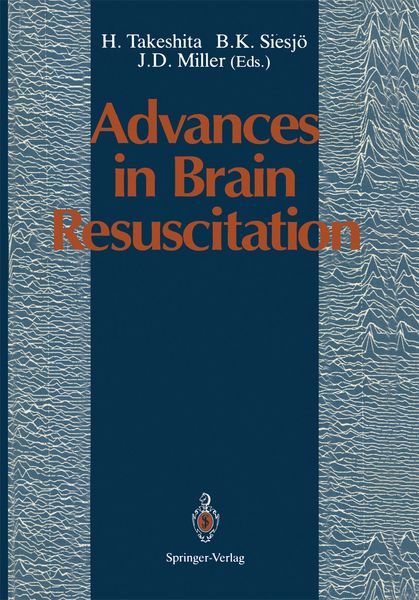
Advances in Brain Resuscitation
-
- Hardcover ausgewählt
- Taschenbuch
- eBook
-
Sprache:Englisch
Fr. 72.90
inkl. gesetzl. MwSt.,
Beschreibung
Produktdetails
Einband
Gebundene Ausgabe
Erscheinungsdatum
03.06.1991
Abbildungen
XI, 329 p.
Herausgeber
H. Takeshita + weitereVerlag
Springer TokyoSeitenzahl
329
Maße (L/B/H)
24.6/17.3/2.5 cm
Gewicht
697 g
Auflage
1. Auflage
Sprache
Englisch
ISBN
978-4-431-70067-8
Brain resuscitation is the therapeutic intervention for critically ill patients with severe brain damage, particularly the types caused by ischemia and hypoxia. The The objective of the International Symposium on Brain Resuscitation held in Ube, Yamaguchi Japan October 31 to November 2 1988, and sponsored by Yamaguchi University and the Japanese Ministry of Education, was to review our recent progress in brain resuscitation and to discuss controversies both basic and clinical. To my knowledge, this symposium was the first held in Japan. Our understanding of neuronal dysfunction due to ischemic/hypoxic insults at organ, cellular, and molecular levels has advanced significantly in the last two decades. We had therefore intended that this international symposium should broadly cover the topics which are of interest to both basic researchers and clinicians. Three hundred and twenty-five attendants, including twenty scientists from eight different countries, actively participated in discussion and exchange of new ideas and thoughts concerning brain resuscitation. This book comprises the re ports presented during the symposium which consisted of two main parts: basic and clinical. Although one single meeting can never be expected to solve any problems, meetings often highlight areas of ignorance and problems which are ripe for solving. It has been hard to review all the papers because of the multi plicity of the discussed topics, but the overview on brain resuscitation by Profes sor Bo K. Siesjo and the summary by Professor J.
Noch keine Bewertungen vorhanden
Verfassen Sie die erste Bewertung zu diesem Artikel
Helfen Sie anderen Kundinnen und Kunden durch Ihre Meinung.