KI-Beratung Beta

  • Produktbild: Making Competitive Cities
  • Produktbild: Making Competitive Cities

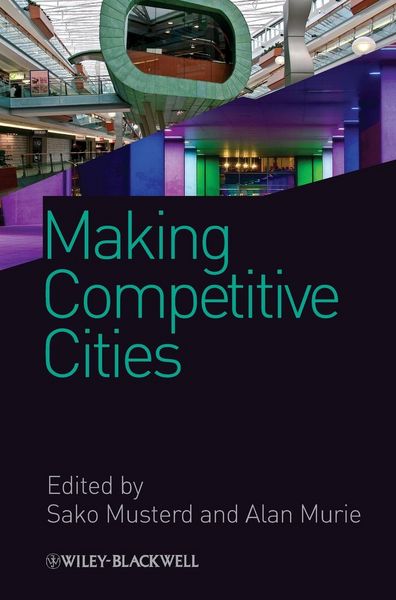
Making Competitive Cities

Fr. 183.00

inkl. gesetzl. MwSt., Versandkostenfrei


Beschreibung

The book investigates the impact on the competitiveness of cities developing creative industries (arts, media, entertainment, creative business services, architects, publishers, designers) and knowledge-intensive industries (ICT, R&D, finance, law). It provides significant new knowledge to the theoretical...

Beschreibung

The book investigates the impact on the competitiveness of cities developing creative industries (arts, media, entertainment, creative business services, architects, publishers, designers) and knowledge-intensive industries (ICT, R&D, finance, law). It provides significant new knowledge to the theoretical and practical understanding of the conditions necessary to stimulate "creative knowledge" cities.
 
The editors compare the socio-economic developments, experiences and strategies in 13 urban regions across Europe: Amsterdam, Barcelona, Birmingham, Budapest, Dublin, Helsinki, Leipzig, Milan, Munich, Poznan, Riga, Sofia and Toulouse. These have different histories and roles; include capital and non-capital cities of different sizes; represent cities with different economic structures; and different cultural, political and welfare state traditions.
 
Through this wide set of examples, Making Competitive Cities informs the debate about creative and knowledge-intensive industries, economic development, and competitiveness policies. It focuses on which metropolitan regions have a better chance to develop as "creative knowledge regions" and which do not, as well as investigating why this is so and what can policy do to influence change.
 
Chapter authors from thirteen European institutions rigorously evaluate, reformulate and empirically test assumptions about cities and their potential for attracting creative and knowledge-intensive industries. As well as a systematic empirical comparison of developments related to these industries, the book examines the pathways that cities have followed and surveys both the negative and positive impacts of different prevailing conditions.
 
Special Features:
* Analyses link between knowledge-intensive sectors and urban competitiveness
* Offers evidence from 13 European urban regions drawn from a major research project
* Establishes a new benchmark for academic and policy debates in a fast-moving field

Rezension

"Making Competitive Cities is therefore a stimulating read, persuasive and provocative in its lines of argument, and presenting an important challenge to urban political praxis the world over." (Journal of Economic Geography, 19 August 2011)
 
"The strength of Making Competitive Cities is its highly structured, data-driven research on thirteen diverse and widely scattered cities, which facilitates comparative study and the construction of useful generalizations. The informative individual chapters follow parallel structures and are all well prepared." (Association of American Geographers, 14 March 2011)
 
"This collection of essays utilizes comparative case studies to illustrate the challenges cities face from a shifting global economy and the very different ways cities can change. The essays offer insights into the theoretical and practical understanding of the environments required to develop competitive "creative knowledge" cities, cities that are successful, exciting, and enjoyable places to live." (Book News Inc, November 2010)
Produktdetails

Einband

Gebundene Ausgabe

Erscheinungsdatum

06.07.2010

Herausgeber Alan Murie + weitere
Verlag John Wiley & Sons Inc

Produktdetails

Einband

Gebundene Ausgabe

Erscheinungsdatum

06.07.2010

Herausgeber
Verlag John Wiley & Sons Inc
Seitenzahl

376

Maße (L/B/H)

25/17.5/2.5 cm

Gewicht

832 g

Auflage

1. Auflage

Sprache

Englisch

ISBN

978-1-4051-9415-0

Herstelleradresse

Libri GmbH
Europaallee 1
36244 Bad Hersfeld
DE

Email: gpsr@libri.de

Noch keine Bewertungen vorhanden

Verfassen Sie die erste Bewertung zu diesem Artikel

Helfen Sie anderen Kundinnen und Kunden durch Ihre Meinung.

Kundinnen und Kunden meinen

Bewertungen (0)

Die Leseprobe wird geladen.
  • Produktbild: Making Competitive Cities
  • Produktbild: Making Competitive Cities
  • Foreword by Professor Susan Fainstein, Harvard University
     
    Preface
     
    Contributors
     
    PART I INTRODUCTION
     
    1 Making Competitive Cities: Debates and Challenges
     
    Sako Musterd and Alan Murie
     
    Debates and challenges
     
    Sectors
     
    Questions and theories
     
    Regions and sources
     
    Pathways, actors and policies
     
    References
     
    2 The Idea of the Creative or Knowledge-Based City
     
    Sako Musterd and Alan Murie
     
    Essential conditions for competitive cities
     
    'Hard' conditions theory
     
    Cluster theory
     
    Personal networks
     
    'Soft' conditions theory
     
    Three parts
     
    References
     
    PART II PATHWAYS
     
    3 Pathways in Europe
     
    Denis Eckert, Alan Murie and Sako Musterd
     
    Path dependency
     
    Initial expectations and comparisons
     
    The chapters to come
     
    References
     
    4 Stable Trajectories Towards the Creative Knowledge City?
     
    Amsterdam, Munich and Milan
     
    Anne von Streit, Marco Bontje and Elena dell'Agnese
     
    Introduction
     
    The economic base and the creative knowledge economy
     
    Development path: roots and current conditions of the
     
    creative knowledge economy
     
    Development paths: a synthesis and conclusion
     
    References
     
    5 Reinventing the City: Barcelona, Birmingham and Dublin
     
    Veronica Crossa, Montserrat Pareja-Eastaway and
     
    Austin Barber
     
    Introduction
     
    Historical context
     
    The trajectory of industrial development
     
    The state and policy intervention
     
    The challenge of soft factors
     
    Conclusions
     
    References
     
    6 Institutional Change and New Development Paths:
     
    Budapest, Leipzig, Poznan, Riga and Sofia
     
    Tadeusz Stryjakiewicz, Joachim Burdack and
     
    Tamás Egedy
     
    Introduction
     
    Socio-economic characteristics of the study areas
     
    Development pathways shaping the city profiles and the role of the systemic change
     
    Determinants of development of the creative knowledge sector
     
    Conclusions
     
    Acknowledgements
     
    References
     
    7 Changing Specialisations and Single Sector Dominance:
     
    Helsinki and Toulouse
     
    Hélène Martin-Brelot and Kaisa Kepsu
     
    Introduction
     
    Setting the context - Helsinki and Toulouse
     
    Pathways to knowledge-driven economies
     
    Knowledge driving economic development: sciences, industries and policies
     
    Future challenges
     
    Conclusion and discussion
     
    References
     
    PART III ACTORS
     
    8 What Works for Managers and Highly Educated Workers
     
    in Creative Knowledge Industries?
     
    Sako Musterd and Alan Murie
     
    Introduction
     
    Three groups of actors and a range of conditions
     
    The following chapters
     
    References
     
    9 Managers and Entrepreneurs in Creative and Knowledge-
     
    Intensive Industries: What Determines Their Location?
     
    Toulouse, Helsinki, Budapest, Riga and Sofia
     
    Evgenii Dainov and Arnis Sauka
     
    Introduction: places matter
     
    Cities and the creative class: major conceptual challenges
     
    Characteristics of the cities: a brief overview
     
    Location decisions: 'individual trajectory' considerations and 'hard' factors
     
    Location decisions: the role of 'soft' factors
     
    In-city location decisions
     
    Capital city versus provincial city location decisions
     
    Policymaking: 'soft', 'hard' or 'other'?
     
    Conclusions and