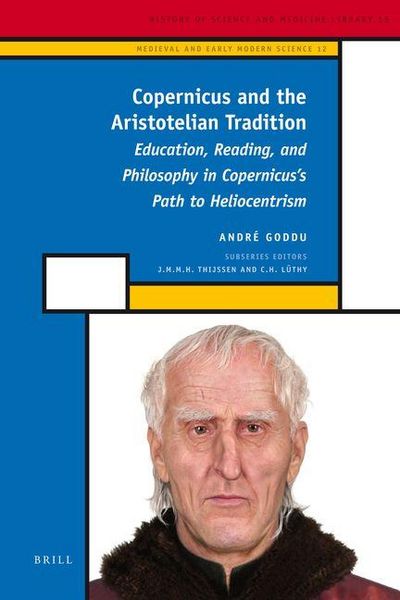
Produktbild: Copernicus and the Aristotelian Tradition
Band 12

Copernicus and the Aristotelian Tradition

Fr. 267.00

inkl. gesetzl. MwSt., Versandkostenfrei


Beschreibung

Produktdetails

Einband

Gebundene Ausgabe

Erscheinungsdatum

25.01.2010

Verlag

Koninklijke Brill Bv

Seitenzahl

578

Maße (L/B/H)

23.5/15.5/3.2 cm

Gewicht

980 g

Sprache

Englisch

ISBN

978-90-04-18107-6

Beschreibung

Produktdetails

Einband

Gebundene Ausgabe

Erscheinungsdatum

25.01.2010

Verlag

Koninklijke Brill Bv

Seitenzahl

578

Maße (L/B/H)

23.5/15.5/3.2 cm

Gewicht

980 g

Sprache

Englisch

ISBN

978-90-04-18107-6

Herstelleradresse

Libri GmbH
Europaallee 1
36244 Bad Hersfeld
DE

Email: gpsr@libri.de

Kundinnen und Kunden meinen

0 Bewertungen

Informationen zu Bewertungen

Zur Abgabe einer Bewertung ist eine Anmeldung im Konto notwendig. Die Authentizität der Bewertungen wird von uns nicht überprüft. Wir behalten uns vor, Bewertungstexte, die unseren Richtlinien widersprechen, entsprechend zu kürzen oder zu löschen.

Die Bewertungen sind nach Format, Anzahl Sterne und Datum sortiert.

Verfassen Sie die erste Bewertung zu diesem Artikel

Helfen Sie anderen Kund*innen durch Ihre Meinung

Kundinnen und Kunden meinen

0 Bewertungen filtern

  • Produktbild: Copernicus and the Aristotelian Tradition
  • List of Illustrations Preface Acknowledgements Introduction PART I: COPERNICUS'S EDUCATION IN POLAND 1. Poland, Torun, and Cracow in the Fifteenth Century 1. Early Education 2. Cracow University 3. Curriculum and Texts, 1475-1500 2. Two Masters and Students in the 1490s 3. Three The Teaching of Logic 1. Aristotelian Logic 2. Introductory Orientation 3. The Teaching of Logic at Cracow 4. Four Natural Philosophy 1. General Orientation 2. Markowski's Most Important and Relevant Conclusions- 3. Quaestiones cracovienses and John of Glogovia on the Physics of Aristotle 4. Aristotle's De caelo, De generatione, Meteorologica, and Metaphysics 5. Johannes Versoris 6. Albert of Saxony and John of Glogovia 5. Humanism and Astronomy 1. Introduction 2. The Curriculum at Cracow 3. The Criticisms of Ptolemaic Astronomy 4. Copernicus's Teachers at Cracow 5. Albert of Brudzewo's Commentariolum PART II: COPERNICUS'S EDUCATION IN ITALY, 1496-1503, AND RETURN TO POLAND 6. Copernicus in Italy 1. Introduction 2. Education in Canon and Civil Law 3. Novara 4. Study of Greek 5. Rome 6. Study of Medicine at Padua 7. Degree from Ferrara. 7. Copernicus's Reading and Progress towards his First Heliocentric Theory 1. Introduction 2. Regiomontanus 3. Bessarion 4. Ficino's Translation of Plato's Works 5. Plutarch, Pseudo-Plutarch, and Giorgio Valla 6. Pliny the Elder and other Ancient Authorities 7. Achillini 8. Commentariolus and the Transfer to Frombork PART III: COPERNICUS AS PHILOSOPHER 8. Copernicus as Logician 1. Introduction 2. The Sources of Dialectical Topics, 1490-1550 3. Mereology-Logic and Ontology 4. Logic in the Commentariolus 5. The Use of Topics in the Preface to De revolutionibus 6. The Rhetorical Framework of Book I 7. The Use of Topics in Book I 8. Hypotheses in Copernicus's Method 9. The Logical Issues in the Relation between Mathematics and Natural Philosophy 10. The Logical Issues in his Discovery of the Heliocentric Theory 11. Concluding Remarks on Copernicus's Relation to the Aristotelian Logical Tradition 9. Copernicus as Natural Philosopher 1. Introduction 2. Critique of Geocentrism 3. Motions of Celestial Bodies 4. Impetus and the Motions of Elemental Bodies 5. Infinity and the Finiteness of the Cosmos 6. Summary 10. Copernicus as Mathematical Cosmologist 1. Introduction 2. Hypotheses 3. Spheres and the Nature of Celestial Matter 4. Equants 5. Summary Conclusion and Epilog 1. Summary 2. Copernicus's Interpretation of Aristotle 3. Epilog: Reception of Copernicus's Interpretation Appendices Bibliography Index