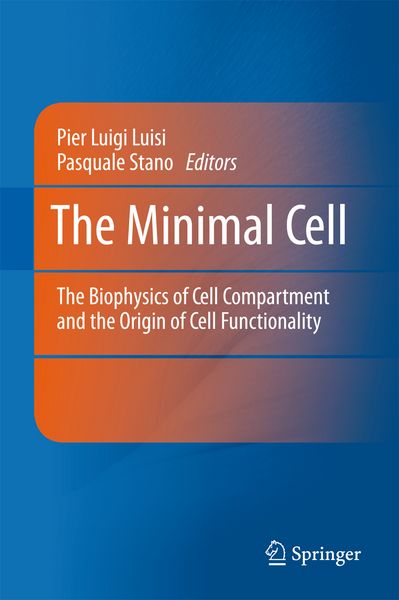
The Minimal Cell The Biophysics of Cell Compartment and the Origin of Cell Functionality
-
- Hardcover ausgewählt
- Taschenbuch
- eBook
-
Sprache:Englisch
Fr. 192.00
inkl. gesetzl. MwSt.,
Beschreibung
Produktdetails
Einband
Gebundene Ausgabe
Erscheinungsdatum
03.11.2010
Abbildungen
X, 298 p.
Herausgeber
Pier Luigi Luisi + weitereVerlag
Springer NetherlandSeitenzahl
298
Maße (L/B/H)
24.1/16/2.4 cm
Gewicht
686 g
Auflage
1. Auflage
Sprache
Englisch
ISBN
978-90-481-9943-3
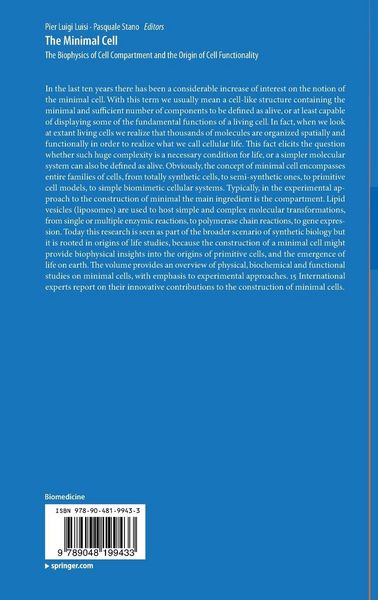
In the last ten years there has been a considerable increase of interest on the notion of the minimal cell. With this term we usually mean a cell-like structure containing the minimal and sufficient number of components to be defined as alive, or at least capable of displaying some of the fundamental functions of a living cell. In fact, when we look at extant living cells we realize that thousands of molecules are organized spatially and functionally in order to realize what we call cellular life. This fact elicits the question whether such huge complexity is a necessary condition for life, or a simpler molecular system can also be defined as alive. Obviously, the concept of minimal cell encompasses entire families of cells, from totally synthetic cells, to semi-synthetic ones, to primitive cell models, to simple biomimetic cellular systems. Typically, in the experimental approach to the construction of minimal the main ingredient is the compartment. Lipid vesicles (liposomes) are used to host simple and complex molecular transformations, from single or multiple enzymic reactions, to polymerase chain reactions, to gene expression. Today this research is seen as part of the broader scenario of synthetic biology but it is rooted in origins of life studies, because the construction of a minimal cell might provide biophysical insights into the origins of primitive cells, and the emergence of life on earth. The volume provides an overview of physical, biochemical and functional studies on minimal cells, with emphasis to experimental approaches. 15 International experts report on their innovative contributions to the construction of minimal cells.
Noch keine Bewertungen vorhanden
Verfassen Sie die erste Bewertung zu diesem Artikel
Helfen Sie anderen Kundinnen und Kunden durch Ihre Meinung.