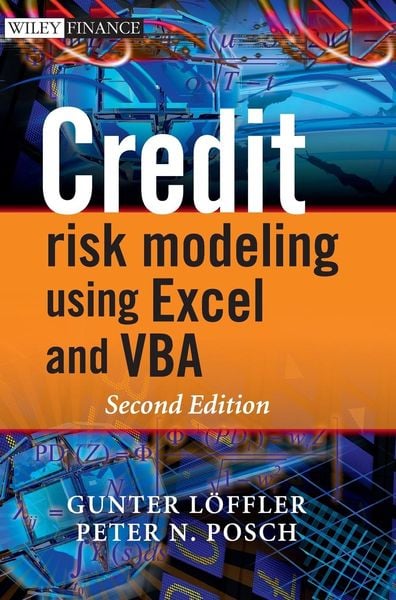
Produktbild: Credit Risk Modeling using Excel and VBA

Credit Risk Modeling using Excel and VBA

Aus der Reihe Wiley Finance Series

Fr. 135.00

inkl. gesetzl. MwSt., Versandkostenfrei


Beschreibung

Produktdetails

Einband

Gebundene Ausgabe

Erscheinungsdatum

17.12.2010

Verlag

John Wiley & Sons

Seitenzahl

368

Maße (L/B/H)

25/17.5/2.4 cm

Gewicht

802 g

Auflage

2nd edition

Sprache

Englisch

ISBN

978-0-470-66092-8

Beschreibung

Produktdetails

Einband

Gebundene Ausgabe

Erscheinungsdatum

17.12.2010

Verlag

John Wiley & Sons

Seitenzahl

368

Maße (L/B/H)

25/17.5/2.4 cm

Gewicht

802 g

Auflage

2nd edition

Sprache

Englisch

ISBN

978-0-470-66092-8

Herstelleradresse

Libri GmbH
Europaallee 1
36244 Bad Hersfeld
DE

Email: gpsr@libri.de

Noch keine Bewertungen vorhanden

Verfassen Sie die erste Bewertung zu diesem Artikel

Helfen Sie anderen Kundinnen und Kunden durch Ihre Meinung.

Kundinnen und Kunden meinen

Bewertungen (0)

Die Leseprobe wird geladen.
  • Produktbild: Credit Risk Modeling using Excel and VBA
  • Preface to the 2nd edition.
     
    Preface to the 1st edition.
     
    Some Hints for Troubleshooting.
     
    1 Estimating Credit Scores with Logit.
     
    Linking scores, default probabilities and observed default behavior.
     
    Estimating logit coefficients in Excel.
     
    Computing statistics after model estimation.
     
    Interpreting regression statistics.
     
    Prediction and scenario analysis.
     
    Treating outliers in input variables.
     
    Choosing the functional relationship between the score and explanatory variables.
     
    Concluding remarks.
     
    Appendix.
     
    Logit and probit.
     
    Marginal effects.
     
    Notes and literature.
     
    2 The Structural Approach to Default Prediction and Valuation.
     
    Default and valuation in a structural model.
     
    Implementing the Merton model with a one-year horizon.
     
    The iterative approach.
     
    A solution using equity values and equity volatilities.
     
    Implementing the Merton model with a T -year horizon.
     
    Credit spreads.
     
    CreditGrades.
     
    Appendix.
     
    Notes and literature.
     
    Assumptions.
     
    Literature.
     
    3 Transition Matrices.
     
    Cohort approach.
     
    Multi-period transitions.
     
    Hazard rate approach.
     
    Obtaining a generator matrix from a given transition matrix.
     
    Confidence intervals with the binomial distribution.
     
    Bootstrapped confidence intervals for the hazard approach.
     
    Notes and literature.
     
    Appendix.
     
    Matrix functions.
     
    4 Prediction of Default and Transition Rates.
     
    Candidate variables for prediction.
     
    Predicting investment-grade default rates with linear regression.
     
    Predicting investment-grade default rates with Poisson regression.
     
    Backtesting the prediction models.
     
    Predicting transition matrices.
     
    Adjusting transition matrices.
     
    Representing transition matrices with a single parameter.
     
    Shifting the transition matrix.
     
    Backtesting the transition forecasts.
     
    Scope of application.
     
    Notes and literature.
     
    Appendix.
     
    5 Prediction of Loss Given Default.
     
    Candidate variables for prediction.
     
    Instrument-related variables.
     
    Firm-specific variables.
     
    Macroeconomic variables.
     
    Industry variables.
     
    Creating a data set.
     
    Regression analysis of LGD.
     
    Backtesting predictions.
     
    Notes and literature.
     
    Appendix.
     
    6 Modeling and Estimating Default Correlations with the Asset Value Approach.
     
    Default correlation, joint default probabilities and the asset value approach.
     
    Calibrating the asset value approach to default experience: the method of moments.
     
    Estimating asset correlation with maximum likelihood.
     
    Exploring the reliability of estimators with a Monte Carlo study.
     
    Concluding remarks.
     
    Notes and literature.
     
    7 Measuring Credit Portfolio Risk with the Asset Value Approach.
     
    A default-mode model implemented in the spreadsheet.
     
    VBA implementation of a default-mode model.
     
    Importance sampling.
     
    Quasi Monte Carlo.
     
    Assessing Simulation Error.
     
    Exploiting portfolio structure in the VBA program.
     
    Dealing with parameter uncertainty.
     
    Extensions.
     
    First extension: Multi-factor model.
     
    Second extension: t-distributed asset values.
     
    Third extension: Random LGDs.
     
    Fourth extension: Other risk measures.
     
    Fifth extension: Multi-s