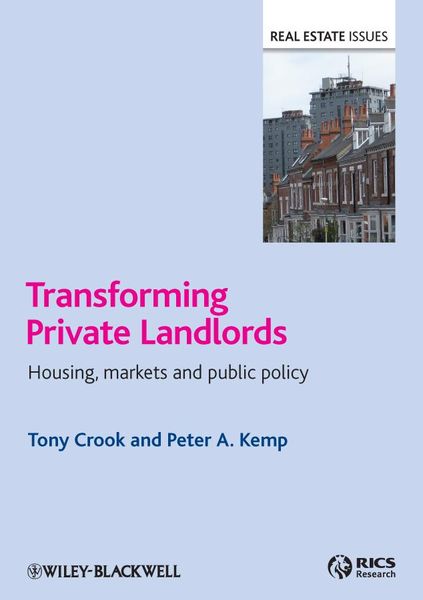
Produktbild: Transforming Private Landlords

Transforming Private Landlords Housing, Markets & Public Policy

Aus der Reihe Real Estate Issues

Fr. 159.00

inkl. gesetzl. MwSt., Versandkostenfrei


Beschreibung

Produktdetails

Einband

Gebundene Ausgabe

Erscheinungsdatum

13.12.2010

Verlag

John Wiley & Sons Inc

Seitenzahl

240

Maße (L/B/H)

24.6/17.5/1.8 cm

Gewicht

576 g

Auflage

1. Auflage

Sprache

Englisch

ISBN

978-1-4051-8415-1

Beschreibung

Rezension

"This is a fruitful read for anybody interested in housing and housing policy. With their well-informed and empirically grounded case study on British housing policy over the past three decades, Tony Cook and Peter Kemp highlight the transformation of landlord structure as a crucial field of governance in the field of housing." ( International Journal of Urban & Regional Research , 19 August 2013)

"Notwithstanding these observations, the book is a must for those of us with an interest in the PRS andI thoroughly recommend it." ( Housing Studies , 21 September 2012)

"This is an essential text for any housing academic - undergraduate, postgraduate and upwards - or policy practitioner seeking a basic understanding of the history and workings of the private rented sector (PRS) ... However, in its definitive summary of the authors research over the past three decades, the text constitutes a worthy full stop, and signals the prospect of a move forward into new questions, themes, data and analytical frameworks." (International Journal of Housing Policy, 1 December 2011)

Produktdetails

Einband

Gebundene Ausgabe

Erscheinungsdatum

13.12.2010

Verlag

John Wiley & Sons Inc

Seitenzahl

240

Maße (L/B/H)

24.6/17.5/1.8 cm

Gewicht

576 g

Auflage

1. Auflage

Sprache

Englisch

ISBN

978-1-4051-8415-1

Herstelleradresse

Libri GmbH
Europaallee 1
36244 Bad Hersfeld
DE

Email: GPSR Kontakt

Noch keine Bewertungen vorhanden

Verfassen Sie die erste Bewertung zu diesem Artikel

Helfen Sie anderen Kundinnen und Kunden durch Ihre Meinung.

Kundinnen und Kunden meinen

Bewertungen (0)

Die Leseprobe wird geladen.
  • Produktbild: Transforming Private Landlords
  • 1. Introduction.
     
    This chapter briefly sets the scene, describes the aims of the book, presents the analytical perspective that will be used and outlines the structure of the book..
     
    2. Private landlords in historical perspective.
     
    When the Conservative Government of Mrs Thatcher came to office in 1979 determined to roll back the state, the privately rented sector was a 'stagnant backwater of backwater of the market economy' and private landlords had a very poor reputation. The sector had been suffering from net disinvestment and declining in size since the early years of the twentieth century. This chapter presents the context within which the incoming Thatcher Government of 1979 sought to breath new life into private letting as an investment. It will describe the nature of private landlordism in its Victorian heyday and document the subsequent decline of landlordism up to the late 1970s..
     
    3. Government policy since 1979.
     
    The 1980s and 1990s witnessed a series of measures that were introduced in order to revive the privately rented housing market, a process that to some extent has continued into the new century. This chapter critically examines the development of government policy towards the privately rented sector, and especially the goal of reviving the private landlord, under the Conservative (1979-1997) and New Labour Governments (1997 to date)..
     
    4. Private landlordism in contemporary Britain.
     
    This chapter examines the contemporary nature of private landlordism in Britain. It also seeks to examine the extent to which private landlordism has changed over the period since 1979. It draws on a succession of surveys of private landlords conducted by the authors and subsequent surveys carried out by the Department for Communities and Local Government.
     
    5. The Business Expansion Scheme.
     
    In 1989, the Conservatives extended the Business Expansion Scheme - which provided tax relief to investors in new, small companies - to include companies letting residential property. This chapter presents an in-depth review of the experience of the BES, based on the authors' research into the scheme..
     
    6. Financial institutions.
     
    This chapter examines the success of recent government attempts to attract financial institutions back into the private lettings industry, such as the introduction of Housing Investment Trusts. The chapter draw on two qualitative studies of financial institutions and private renting conducted by the authors, as well as other research and scholarship. It will also discuss the implications of this experience in relation to residential lettings for the introduction of Real Estate Investment Trusts..
     
    7. Buy to let.
     
    Over the past decade, there has been a revival of interest in investment in rented housing by private individuals, a phenomenon widely referred to as 'buy to let'. Indeed, in contrast to much of the post-war period, such investment is now seen as a normal way for people to invest part of their savings, free of the stigma that was previously associated with private landlordism. This chapter reviews the evidence on the buy to let experience. It draws on research into buy to let in the context of the material about private landlordism presented in the previous chapters..
     
    8. Conclusions.
     
    This chapter brings together the key findings from the previous chapters to reflect on the nature of contemporary private landlordism in Britain. In particular, it assesses the extent to which, and the ways in which, it has been either revived or transformed since 1979 and the lessons for the future. It also discusses the lessons of this experience for housing policy.