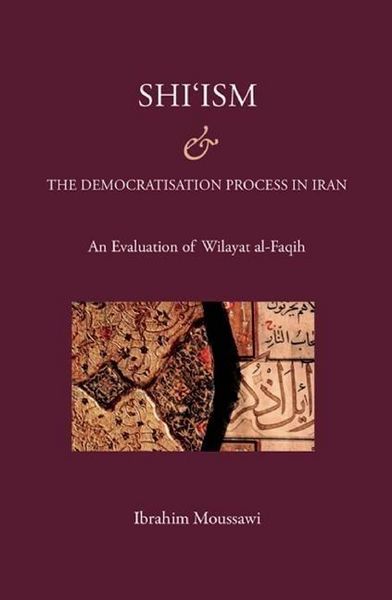
Produktbild: Moussawi, I: Shi'ism and the Democratisation Process in Iran

Moussawi, I: Shi'ism and the Democratisation Process in Iran With a Focus on Wilayat Al-Faqih

Fr. 76.90

inkl. gesetzl. MwSt., Versandkostenfrei


Beschreibung

Produktdetails

Einband

Gebundene Ausgabe

Erscheinungsdatum

17.04.2012

Verlag

Saqi Books

Seitenzahl

215

Maße (L/B/H)

23.7/15.5/1.9 cm

Gewicht

490 g

Sprache

Englisch

ISBN

978-0-86356-470-3

Beschreibung

Produktdetails

Einband

Gebundene Ausgabe

Erscheinungsdatum

17.04.2012

Verlag

Saqi Books

Seitenzahl

215

Maße (L/B/H)

23.7/15.5/1.9 cm

Gewicht

490 g

Sprache

Englisch

ISBN

978-0-86356-470-3

Noch keine Bewertungen vorhanden

Verfassen Sie die erste Bewertung zu diesem Artikel

Helfen Sie anderen Kundinnen und Kunden durch Ihre Meinung.

Kundinnen und Kunden meinen

Bewertungen (0)

Die Leseprobe wird geladen.
  • Produktbild: Moussawi, I: Shi'ism and the Democratisation Process in Iran
  • TABLE OF CONTENTS

    I. INTRODUCTION 1

    A. One View of Democratisation 2
    B. Another Perspective on Democratisation 4
    C. Methodology

    II. PRINCIPLES IN SHI'ITE ISLAM 8

    A. Introduction 8
    B. Four Sources of Islamic Law 8
    1. The Qur'an 9
    2. The Sunnah 10
    3. Ijma' 11
    4. Al-'Aql 13

    C. The Problem of Succession 15
    1. The Martyrdom of Imam Husayn 17
    2. The pre-Occultation (Ghayba) Period 19
    3. The Post-Ghayba Period 22

    D. Usuli and Akhbari Schools of Shi'ite Islam 27
    E. The Making and Choosing of a Marja' 29
    1. Qualities of the Marja' 30
    2. Choosing the Marja' 36
    3. Stages of Ijtihad as a Precursor to Becoming a Marja' 37

    III. BASIC PRINCIPLES: WILAYAT AL-FAQIH AND SHI'ITE JURISPRUDENCE 39

    A. Four Stages of Shi'ite Jurisprudence and Wilayat Al-Faqih 39
    B. Nine Theories of Wilayat al-Faqih and the Attempt to Reconcile It with Democracy 42

    C. Al-Faqih and Shura during the Greater Occultation Period 45
    D. Al-Na'ini and Constitutionalism 47
    1. Separation of Powers 48
    2. Al- Na'ini: Miscellaneous 49

    E. Religious and Political Legitimacy 54
    F. Wilayat al-Faqih and Wilayat al-Umma 55
    1. Legitimisation of Wilayat al-Faqih 58
    2. Dialectics on Imama in Wilayat al-Faqih 58
    3. Three Pillars of Wilayat al-Faqih 59
    a. The Need of Muslims for A Government 59
    b. The Meaning of the Wilayat al-Faqih and the Limitations of this Wilaya 62
    c. The Meaning of Islamic Government 62
    4. Evaluation of Wilayat al-Faqih 63
    5. Wilayat al-Faqih in the Islamic Republic 65
    6. Tabataba'i and Maghniyye's Views 70
    7. Debates on Wilayat al-Faqih 71
    8. Imam Khumayni's Theory and Implications 74
    a. Political Freedom 74
    b. Islamic Shura Council and the Council of Experts 75
    c. Taklif 75
    d. Islam Is More Sublime Than All Democracies 76
    e. There Is No Legitimacy without Islam 77
    f. The Salient Characteristics of Waliyat al-Faqih 77

    IV. DEMOCRATISATION PROCESSES IN THE ISLAMIC REPUBLIC OF IRAN: THE ROLE OF SHURA IN THE DEMOCRATISATION PROCESS 79

    A. Background on Shura 79
    1. Is Shura a Democratic Practice? 81
    2. Democracy Is Not Shura 83
    3. Shura in Islam: The Intellectual and Jurisprudential Stance of Shura 84
    4. Shura and Wilaya 86
    5. Qur'anic Legitisation of Shura 93
    6. Secularism and Democracy 97

    B. The Dilemma of Democracy in Contemporary Islamic Political Thought 100

    1. Sayyid Muhammad Baqir al-Sadr 103
    2. Shaykh Muhammad Mahdi Shamseddine on Shura 106
    3. Imam Khumayni on Shura 107

    C. The Concept of Shura and Its Positioning In the Islamic Order 109
    V. ISLAMIC PRINCIPLES APPLIED IN THE ISLAMIC REPUBLIC 110

    A. The Concept of Shura and its Positioning in the Islamic Order 110
    B. Shura Councils in the Islamic Republic of Iran 112
    D. The Role of the Umma in the Islamic System 116
    E. The Necessity of Ikhtilaf 121
    F. The Conception of Maslaha 124
    1. The Stance of Maslaha in Jurisprudence 125
    2. Wilayat and Maslaha 126
    4. The Expediency Council (Majlis Tashkhis Al-Maslaha) 127
    5. Practical Dimension of Maslaha 129
    6. Maslaha and Democratisation 134

    VI. DOES WILAYAT AL-FAQIH LEAD TO TYRANNY? 136

    A. Background 136
    B. Wilayat al-Faqih: The Problematic 137
    1. Discussions and Debates on Wilayat al-Faqih Vis-à-Vis Tyranny 139
    2. The Islamic System and the Stance from Despotism 143
    3. Constitutional Safeguards against Despotism 148
    4. Prerogatives of the Wali al-Faqih: A Comparison 154

    C. Populace and Islam 158
    D. The Democratic Nature of Islam 159
    E. Safety Valves and Constitutional Prohibitions against the Dictatorship of the Ruler 164

    F. The Imamate as a Continuation of Prophethood 172
    G. Conclusion 175
    VII. ISLAMISM AND REPUBLICANISM 176

    A. Background 176
    B. The Drafting of the Constitution 176
    C. The Establishment of the Constitution in its Own Right 179
    D. The Concepts of Republicanism and Islamism in the Islamic Republic 183

    1. The Background to the Formation of the Islamic Republic 186
    2. Is there Any Contradiction between the Two Concepts of "Republicanism" and "Islamism", or Is It Possible to Fuse them Together? 187
    3. Republicanism and Islamism in the Constitution of the Islamic Republic 190
    4. The Apparent Contradiction between Republicanism and Islamism 192
    5. Divergence between Wilayat al-Faqih and Republican Government 193
    6. The Concordance between Islamism and Republicanism 195
    7. How Can We Reconcile between Islamism and Republicanism? 199

    E. Conclusion 203
    F. Final Word: Practical Application 205
    VIII. DEMOCRATISATION IN THE ISLAMIC REPUBLIC OF IRAN: CASE STUDY 208

    A. The Dual Legitimacy of the Islamic Republic 209
    B. New Discourses on the State's Islamic Legitimacy 214
    C. New Discourses on Wilayat al Faqih 216
    D. New Discourses on the Council of Guardians 218
    E. New Discourses on Women's Rights in the Islamic Republic 220
    F. New Discourses on the Outlook of the Islamic Republic 223
    G. Battle Lines between Reformists and Conservatives 225
    H. The Limits Khatami's Reforms 228
    I. New Alliances, New Possibilities 232
    J. Is Democratisation Taking Place in Iran? 235
    IX. CONCLUSION 240

    BIBLIOGRAPHY 245