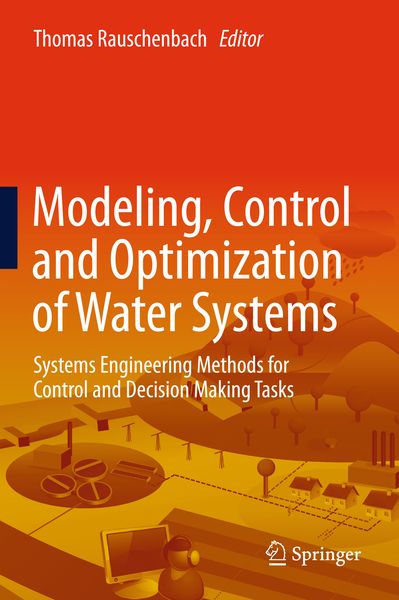
Modeling, Control and Optimization of Water Systems Systems Engineering Methods for Control and Decision Making Tasks
-
- Hardcover ausgewählt
- Taschenbuch
- eBook
-
Sprache:Englisch
Fr. 138.00
inkl. gesetzl. MwSt.,
Beschreibung
Produktdetails
Einband
Gebundene Ausgabe
Erscheinungsdatum
18.12.2015
Abbildungen
VII, 143 illus., 82 illus. in color., schwarz-weiss Illustrationen, farbige Illustrationen
Herausgeber
Thomas RauschenbachVerlag
Springer BerlinSeitenzahl
303
Maße (L/B/H)
24.1/16/2.3 cm
Gewicht
635 g
Auflage
1st edition 2016
Sprache
Englisch
ISBN
978-3-642-16025-7
This book provides essential background knowledge on the development of model-based real-world solutions in the field of control and decision making for water systems. It presents system engineering methods for modelling surface water and groundwater resources as well as water transportation systems (rivers, channels and pipelines). The models in turn provide information on both the water quantity (flow rates, water levels) of surface water and groundwater and on water quality. In addition, methods for modelling and predicting water demand are described. Sample applications of the models are presented, such as a water allocation decision support system for semi-arid regions, a multiple-criteria control model for run-of-river hydropower plants, and a supply network simulation for public services.
Noch keine Bewertungen vorhanden
Verfassen Sie die erste Bewertung zu diesem Artikel
Helfen Sie anderen Kundinnen und Kunden durch Ihre Meinung.