Produktbild: Federalism

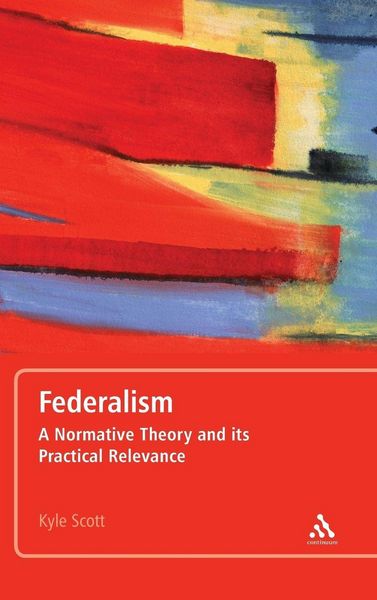
Federalism A Normative Theory and its Practical Relevance

Fr. 195.00

inkl. gesetzl. MwSt., Versandkostenfrei


Beschreibung

Produktdetails

Einband

Gebundene Ausgabe

Erscheinungsdatum

31.03.2011

Verlag

Bloomsbury USA

Seitenzahl

226

Maße (L/B/H)

22.9/15.2/1.4 cm

Gewicht

474 g

Sprache

Englisch

ISBN

978-1-4411-9764-1

Beschreibung

Zitat

Federalism: A Normative Theory and Its Practical Relevance is an innovative attempt to defend federalism as a desirable institutional form for contemporary democracies by means of a tightly argued, coherent normative theory, which is applied to case studies of conflict resolution around the world. Welding a communitarian theory of human teleology to commonly accepted empirical generalizations about democratic politics, author Kyle Scott makes a strong case that the decentralized governance characteristic of federalism can allow politics to operate at a "human scale" while facilitating constructive deliberation. Scott sees the polity as an organic whole, in sharp contrast to most contemporary liberals and libertarians. Unlike utilitarians, he does not defend federalism principally on its economic advantages. Instead, Scott argues that human flourishing is possible only when citizens participate actively in the governance of a community of shared customs and intimate familiarity, and that proper skepticism of the efficacy of uniform schemes for human improvement should lead us to appreciate the diverse experimentation characteristic of robust autonomy for a large number of political jurisdictions. The implications of these assumptions are truly radical, for the demanding kind of self-government that Scott - like Althusius, Aristotle, and Tocqueville - endorses requires very small jurisdictions and a very high degree of decentralization. Scott also argues in favor of a trinity of powers that local jurisdictions may use in extremis: nullification, veto, and secession. The reasoning is that these powers require the central government to deliberate with local governments on the most appropriate means to shared ends. Moreover, small scale allows deliberation to happen within local governments among citizens, who directly participate in making policy decisions.The federalism Scott defends is thus an ideal type to which no actual federal system, even the Swiss, currently con
Produktdetails

Einband

Gebundene Ausgabe

Erscheinungsdatum

31.03.2011

Verlag

Bloomsbury USA

Seitenzahl

226

Maße (L/B/H)

22.9/15.2/1.4 cm

Gewicht

474 g

Sprache

Englisch

ISBN

978-1-4411-9764-1

Noch keine Bewertungen vorhanden

Verfassen Sie die erste Bewertung zu diesem Artikel

Helfen Sie anderen Kundinnen und Kunden durch Ihre Meinung.

Kundinnen und Kunden meinen

Bewertungen (0)

  • Produktbild: Federalism
  • Preface
    Introduction

    1. Beginning a Theory of Federalism
    Drawing on Great Minds
    Modernity
    Deliberative Democracy
    Conclusion

    2. Saving Federalism from Relativism
    Plato
    Montesquieu
    Why this is not Relativism
    Conclusion

    3. Resituating Sovereignty
    Federalism and the State
    Sovereign Immunity
    Locke's Rejection of Sovereign Immunity
    Judicial Review
    Conclusion

    4. Nullification
    Examples of Nullification
    A Possible Framework
    Civil Society, Deliberative Democracy and Federalism
    Overcoming the Proceduralist vs. Substantivist Debate in Democratic Theory
    Conclusion

    5. Veto
    Defending and Defining Veto
    Deliberation through Veto
    General Outline for Veto
    On Religious Freedom in the U.S.: The Insufficiency of the Courts
    Sri Lanka: Veto and Conflict Resolution
    Conclusion

    6. Secession
    Legitimizing Secession with Locke
    Examples of Secession: The Former Soviet Union, Ethiopia, Belgium
    Secession: The Procedure
    Conclusion

    7. Exiting the Echo Chamber
    John C. Calhoun
    Polarization, Participation, Deliberation
    Israel and Iraq
    Conclusion

    Bibliography