• Produktbild: Generalized Musical Intervals and Transformations
  • Produktbild: Generalized Musical Intervals and Transformations

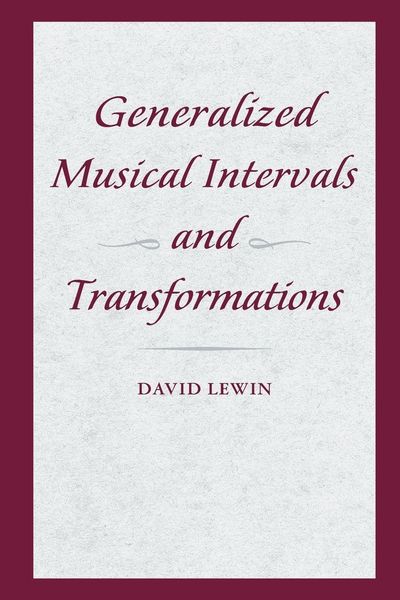
Generalized Musical Intervals and Transformations

Fr. 83.90

inkl. gesetzl. MwSt., Versandkostenfrei


Beschreibung

Produktdetails

Einband

Taschenbuch

Erscheinungsdatum

08.10.2010

Verlag

Oxford University Press

Seitenzahl

292

Maße (L/B/H)

22.9/15.2/1.8 cm

Gewicht

431 g

Sprache

Englisch

ISBN

978-0-19-975994-1

Beschreibung

Zitat

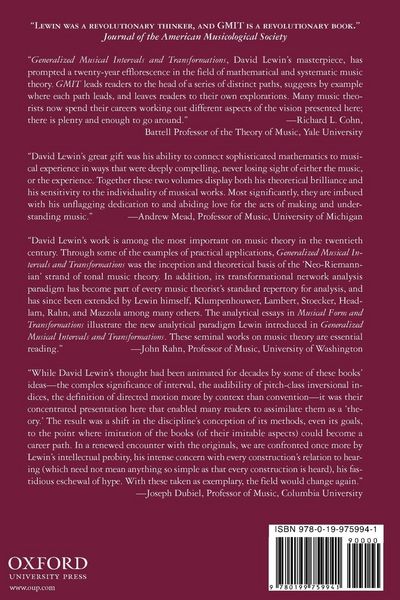
"Generalized Musical Intervals and Transformations, David Lewin's masterpiece, has prompted a twenty-year efflorescence in the field of mathematical and systematic music theory. GMIT leads readers to the head of a series of distinct paths, suggests by example where each path leads, and leaves readers to their own explorations. Many music theorists now spend their careers working out different aspects of the vision presented here; there is plenty and enough to go around."-Richard L. Cohn, Battell Professor of the Theory of Music, Yale University"David Lewin's great gift was his ability to connect sophisticated mathematics to musical experience in ways that were deeply compelling, never losing sight of either the music, or the experience. Together these two volumes display both his theoretical brilliance and his sensitivity to the individuality of musical works. Most significantly, they are imbued with his unflagging dedication to and abiding love for the acts of making and understanding music."--Andrew Mead, Professor of Music, University of Michigan"Lewin was a revolutionary thinker, and GMIT is a revolutionary book."--Journal of the American Musicological Society"David Lewin's work is among the most important on music theory in the twentieth century. Through some of the examples of practical applications, Generalized Musical Intervals and Transformations was the inception and theoretical basis of the 'Neo-Riemannian' strand of tonal music theory. In addition, its transformational network analysis paradigm has become part of every music theorist's standard repertory for analysis, and has since been extended by Lewin himself, Klumpenhouwer, Lambert, Stoecker, Headlam, Rahn, and Mazzola among many others. The analytical essays in Musical Form andTransformations illustrate the new analytical paradigm Lewin introduced in Generalized Musical Intervals and Transformations. These seminal works on music theory are essential reading."-John Rahn, Prof
Produktdetails

Einband

Taschenbuch

Erscheinungsdatum

08.10.2010

Verlag

Oxford University Press

Seitenzahl

292

Maße (L/B/H)

22.9/15.2/1.8 cm

Gewicht

431 g

Sprache

Englisch

ISBN

978-0-19-975994-1

Herstelleradresse

Libri GmbH
Europaallee 1
36244 Bad Hersfeld
DE

Email: gpsr@libri.de

Noch keine Bewertungen vorhanden

Verfassen Sie die erste Bewertung zu diesem Artikel

Helfen Sie anderen Kundinnen und Kunden durch Ihre Meinung.

Kundinnen und Kunden meinen

Bewertungen (0)

Die Leseprobe wird geladen.
  • Produktbild: Generalized Musical Intervals and Transformations
  • Produktbild: Generalized Musical Intervals and Transformations
    • Foreword by Edward Gollin

    • Preface

    • Acknowledgments

    • Introduction

    • 1.: Mathematical Preliminaries

    • 2.: Generalized Interval Systems (1): Preliminary Examples and Definition

    • 3.: Generalized Interval Systems (2): Formal Features

    • 4.: Generalized Interval Systems (3): A Non-Commutative GIS; Some Timbral GIS Models

    • 5.: Generalized Set Theory (1): Interval Functions; Canonical Groups and Canonical Equivalence; Embedding Functions

    • 6.: Generalized Set Theory (2): The Injection Function

    • 7.: Transformation Graphs and Networks (1): Intervals and Transpositions

    • 8.: Transformation Graphs and Networks (2): Non-Intervallic Transformations

    • 9.: Transformation Graphs and Networks (3): Formalities

    • 10.: Transformation Graphs and Networks (4): Some Further Analyses

    • Appendix A: Melodic and Harmonic GIS Structures; Some Notes on the History of Tonal Theory

    • Appendix B: Non-Commutative Octatonic GIS Structures; More on Simply Transitive Groups

    • Index