Zitat
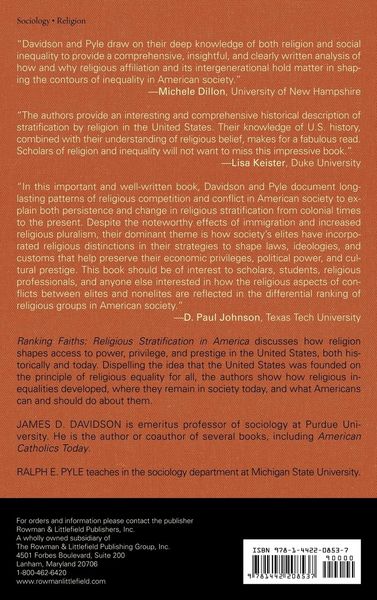
This work, in its introduction of religion as a formal category of stratification, should be regarded as an important contribution to the fields of religion and sociology. Publishers Weekly Davidson (emer., Purdue) and Pyle (Michigan State Univ.) have written a sociological study of religious stratification in the US, employing a conflict perspective on social inequality to identify religious in-groups and out-groups, prejudice, and competition for resources. They explore the origins, persistence, and change of religious inequality by identifying power relations, laws, ideologies, customs, and stratification from the colonial period to the present... Recommended. General and undergraduate libraries. CHOICE Religious 'stratification' reveals a lot about religious power blocs and the shifting political and cultural influences wielded by religious groups in the U.S. This fascinating book explores both the continuities and changes in religious stratification over the centuries and considers whether it is a good or bad thing for democracy... This book is outstanding... Voice of Reason 20110901 Professors Davidson and Pyle draw on their deep knowledge of both religion and social inequality to provide a comprehensive, insightful, and clearly written analysis of how and why religious affiliation and its inter-generational hold matter in shaping the contours of inequality in American society. -- Michele Dillon, professor and chair of sociology, University of New Hampshire and author of In the Course of a Lifetime: Tracing Religious Belief, Practice, and Change In this important and well-written book, Davidson and Pyle document long-lasting patterns of religious competition and conflict in American society to explain both persistence and change in religious stratification from colonial times to the present. Despite the noteworthy effects of immigration and increased religious pluralism, their dominant theme is how society's elites have incorporated religious distinctions in their strategies to shape laws, ideologies, and customs that help preserve their economic privileges, political power, and cultural prestige. The authors also argue, ironically, that the destabilizing effects of overt religious conflict may increase as non-elite groups eventually improve their position, thereby decreasing levels of religious inequality and the strength of traditional patterns of religious stratification. This book should be of interest to scholars, students, religious professionals, and anyone else interested in how the religious aspects of conflicts between elites and non-elites are reflected in the differential ranking of religious groups in American society. -- D. Paul Johnson, Texas Tech University Professors Davidson and Pyle provide an interesting and comprehensive historical description of stratification by religion in the U.S. Their knowledge of U.S. history combined with their understanding of religious belief make for a fabulous read. Scholars of religion and inequality will not want to miss this impressive book. -- Lisa Keister, professor, Duke University As someone who takes seriously the relationship between religion and social inequality, I thoroughly enjoyed this book. It contains a wealth of information that has continued relevance for our own day. These authors are to be commended for providing this excellent analysis of religious stratification. -- William A. Mirola, Marion College Journal for the Scientific Study of Religion "Ranking Faiths: Religious Stratification in America covers all the bases. Davidson and Pyle present a work that is, first, a solid piece of scholarship on the sociology of religion and social stratification. Second, it is a comprehensive teaching tool on religion, social class and the theory and methods used to study their interplay. Third, it calls forth continued research by setting up an agenda that advances scholarship linking the sociology of religion and social stratification. This book is innovative scholarship" Their work examines religion in ways that go far beyond how it has been used to exploit women and other minorities. They argue persuasively that religion has shaped American society and culture from its origins; religion continues to carry resources for those who already have them; religion has been, and remains, a force for social change. Ranking Faiths is good teaching. It would be a useful primary or secondary textbook for courses in the sociology of religion, and the study of social stratification. Davidson and Pyle use religion to teach stratification; they use stratification to teach the study of religion. And their triangulation of methods is a useful primer on the practice of research. Ranking Faiths is a gift to scholars and teachers. It is also a primer for politicians, business leaders and their constituents and customers. The book offers a greater understanding of how religion in society has shaped, and continues to shape, our values and serves our interests. Oxford Journals "Ranking Faiths: Religious Stratification in America covers all the bases. Davidson and Pyle present a work that is, first, a solid piece of scholarship on the sociology of religion and social stratification. Second, it is a comprehensive teaching tool on religion, social class and the theory and methods used to study their interplay. Third, it calls forth continued research by setting up an agenda that advances scholarship linking the sociology of religion and social stratification." "Ranking Faiths is good teaching. It would be a useful primary or secondary textbook for courses in the sociology of religion, and the study of social stratification." Social Forces