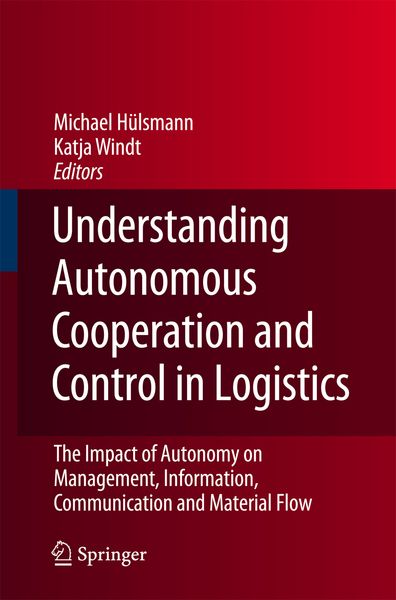
Understanding Autonomous Cooperation and Control in Logistics The Impact of Autonomy on Management, Information, Communication and Material Flow
-
- Hardcover
- Taschenbuch ausgewählt
-
Sprache:Englisch
Fr. 191.00
inkl. gesetzl. MwSt.,
Beschreibung
Produktdetails
Einband
Taschenbuch
Erscheinungsdatum
14.10.2010
Abbildungen
XXVIII, 417 p.
Herausgeber
Michael Hülsmann + weitereVerlag
Springer BerlinSeitenzahl
417
Maße (L/B/H)
23.5/15.5/2.5 cm
Gewicht
674 g
Auflage
Softcover reprint of hardcover 1st edition 2007
Sprache
Englisch
ISBN
978-3-642-07996-2
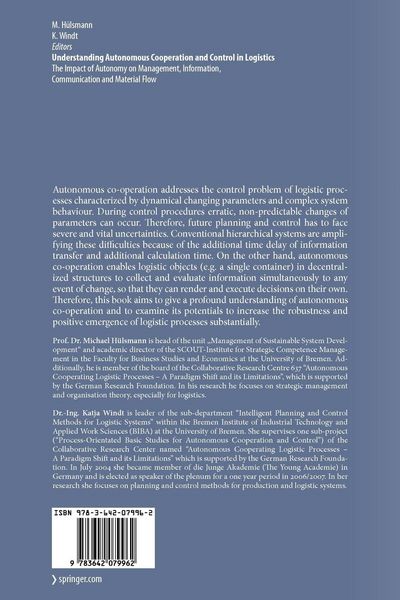
One of the great challenges in flexible production and supply chains is the availability of necessary information at any time and any place. As a result of increasing dynamical and structural complexity of structures and processes in production it is often impossible to make all necessary information available to a central instance in real time and to perform appropriate measures of control in terms of a defined target system. A fast and flexible adaptation to changing basic conditions ought to be achieved by establishing autonomous logistics processes.
In this context several fundamental questions concerning autonomous cooperating logistics processes were investigated:
The identification problem: What are autonomous logistics processes and how do they differ from conventionally managed processes?
The description problem: Which changes will autonomy cause in order processing?
One of the first results is a definition for the term autonomy for applications in engineering science. The constituent characteristics of this definition were considered within the development of the catalogue of criteria in order to describe autonomous logistic processes. Regarding the modelling of autonomous processes, first requirements for modelling methods were specified. To validate the research results, a production-logistic shop-floor scenario and a practical scenario based on the real business processes of an automobile terminal were developed. Simulation studies concerning autonomously controlled allocation of parking areas document comprehensive opportunities for improvement.
Noch keine Bewertungen vorhanden
Verfassen Sie die erste Bewertung zu diesem Artikel
Helfen Sie anderen Kundinnen und Kunden durch Ihre Meinung.