
KI-Beratung Beta

  • Produktbild: Analytical Mechanics
  • Produktbild: Analytical Mechanics
Band 191

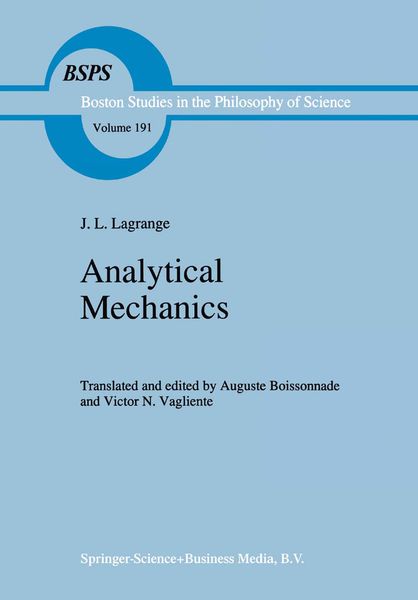
Analytical Mechanics

Fr. 395.00

inkl. gesetzl. MwSt., Versandkostenfrei


Beschreibung

to the English translation of Lagrange's Mecanique Analytique Lagrange's Mecanique Analytique appeared early in 1788 almost exactly one cen tury after the publication of Newton's Principia Mathematica. It marked the culmination of a line of research devoted to recasting Newton's synthetic, geomet ric...

Beschreibung

to the English translation of Lagrange's Mecanique Analytique Lagrange's Mecanique Analytique appeared early in 1788 almost exactly one cen tury after the publication of Newton's Principia Mathematica. It marked the culmination of a line of research devoted to recasting Newton's synthetic, geomet ric methods in the analytic style of the Leibnizian calculus. Its sources extended well beyond the physics of central forces set forth in the Principia. Continental au thors such as Jakob Bernoulli, Daniel Bernoulli, Leonhard Euler, Alexis Clairaut and Jean d'Alembert had developed new concepts and methods to investigate problems in constrained interaction, fluid flow, elasticity, strength of materials and the operation of machines. The Mecanique Analytique was a remarkable work of compilation that became a fundamental reference for subsequent research in exact science. During the eighteenth century there was a considerable emphasis on extending the domain of analysis and algorithmic calculation, on reducing the dependence of advanced mathematics on geometrical intuition and diagrammatic aids. The analytical style that characterizes the Mecanique Analytique was evident in La grange's original derivation in 1755 of the 8-algorithm in the calculus of variations. It was expressed in his consistent attempts during the 1770s to prove theorems of mathematics and mechanics that had previously been obtained synthetically. The scope and distinctiveness of his 1788 treatise are evident if one compares it with an earlier work of similar outlook, Euler's Mechanica sive Motus Scientia Analyt 1 ice Exposita of 1736.

Produktdetails

Einband

Taschenbuch

Erscheinungsdatum

03.12.2010

Abbildungen

XLV, 594 p.

Verlag Springer Netherland

Produktdetails

Einband

Taschenbuch

Erscheinungsdatum

03.12.2010

Abbildungen

XLV, 594 p.

Verlag Springer Netherland
Seitenzahl

594

Maße (L/B/H)

23.5/15.5/3.5 cm

Gewicht

961 g

Auflage

1. Auflage

Übersetzt von
  • A. Boissonnade
  • V.N. Vagliente
Sprache

Englisch

ISBN

978-90-481-4779-3

Herstelleradresse

Springer-Verlag KG
Sachsenplatz 4-6
1201 Wien
AT

Email: ProductSafety@springernature.com

Noch keine Bewertungen vorhanden

Verfassen Sie die erste Bewertung zu diesem Artikel

Helfen Sie anderen Kundinnen und Kunden durch Ihre Meinung.

Kundinnen und Kunden meinen

Bewertungen (0)

  • Produktbild: Analytical Mechanics
  • Produktbild: Analytical Mechanics
  • Section I — The Various Principles of Statics.- Section II — A General Formula of Statics and its Application to the Equilibrium of an Arbitrary System of Forces.- Section III — The General Properties of Equilibrium of a System of Bodies Deduced from the Preceding Formula.- Section IV. A More General and Simpler Way to Use the Formula of Equilibrium Presented in Section II.- Section V — The Solution of Various Problems of Statics.- Section VI. The Principles of Hydrostatics.- Section VII. The Equilibrium of Incompressible Fluids.- Section VIII. The Equilibrium of Compressible and Elastic Fluids.- Section I. The Various Principles of Dynamics.- Section II. A General Formula of Dynamics for the Motion of a System of Bodies Moved by Arbitrary Forces.- Section III. General Properties of Motion Deduced from the Preceding Formula.- Section IV. Differential Equations for the Solution of All Problems of Dynamics.- Section V. A General Method of Approximation for the Problems of Dynamics Based on the Variation of Arbitrary Constants.- Section VI. The Very Small Oscillations of an Arbitrary System of Bodies.- Section VII. The Motion of a System of Free Bodies Treated as Mass Points and Acted Upon by Forces of Attraction.- Section VIII. The Motion of Constrained Bodies Which Interact in an Arbitrary Fashion.- Section IX. Rotational Motion.- Section X. The Principles of Hydrodynamics.- Section XI. The Motion of Incompressible Fluids.- Section XII. The Motion of Compressible And Elastic Fluids.