• Produktbild: Modern Cryptography, Probabilistic Proofs and Pseudorandomness
  • Produktbild: Modern Cryptography, Probabilistic Proofs and Pseudorandomness
Band 17

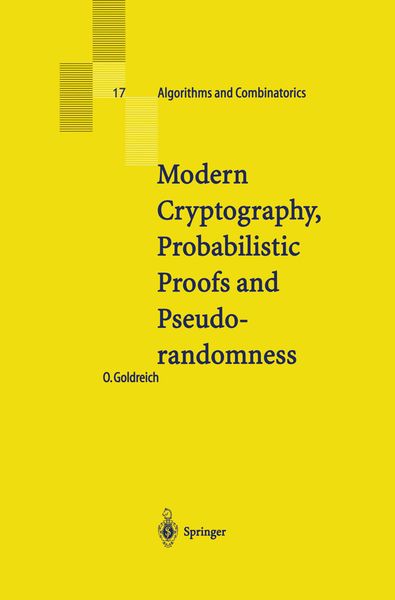
Modern Cryptography, Probabilistic Proofs and Pseudorandomness

Fr. 171.00

inkl. gesetzl. MwSt., Versandkostenfrei


Beschreibung

Produktdetails

Einband

Taschenbuch

Erscheinungsdatum

08.12.2010

Verlag

Springer Berlin

Seitenzahl

183

Maße (L/B/H)

23.5/15.5/1.2 cm

Gewicht

318 g

Auflage

Softcover reprint of hardcover 1st ed. 1999

Sprache

Englisch

ISBN

978-3-642-08432-4

Beschreibung

Rezension

From the reviews:


"This book is intended for a reader with some knowledge of the theory of computing. It is divided into three chapters, each a survey of one of the topics mentioned in the title. The chapters may be read independently, and are somewhat different in nature. ...The book ends with four appendices. The first summarises the probability theory, complexity theory and cryptography that is used in the body of the book. The second gives examples of randomisation in algorithmic problems, complexity theory and distributed computing. The third contains two proofs, not to be found in the literature, of well-known results. The last appendix lists other surveys by the author." (Simon R. Blackburn, Mathematical Reviews)


"Modern cryptography, probabilistic proofs and pseudorandomness are three areas in theoretical computer science that demonstrate the interplay between randomness and computations. … This book is informative and rich in content. … the most appealing feature of this book is that it leans toward the intuition and historical motivations around these topics. … it is an excellent resource for students and researchers … . this book will probably give you a good collection of background motivations and nice discussions as well." (Andrew C. Lee, SIGACT News, Vol. 34 (4), 2003)


Produktdetails

Einband

Taschenbuch

Erscheinungsdatum

08.12.2010

Verlag

Springer Berlin

Seitenzahl

183

Maße (L/B/H)

23.5/15.5/1.2 cm

Gewicht

318 g

Auflage

Softcover reprint of hardcover 1st ed. 1999

Sprache

Englisch

ISBN

978-3-642-08432-4

Herstelleradresse

Springer-Verlag KG
Sachsenplatz 4-6
1201 Wien
AT

Email: GPSR Kontakt

Noch keine Bewertungen vorhanden

Verfassen Sie die erste Bewertung zu diesem Artikel

Helfen Sie anderen Kundinnen und Kunden durch Ihre Meinung.

Kundinnen und Kunden meinen

Bewertungen (0)

  • Produktbild: Modern Cryptography, Probabilistic Proofs and Pseudorandomness
  • Produktbild: Modern Cryptography, Probabilistic Proofs and Pseudorandomness
  • Preface Chapter 1: The Foundations of Modern Cryptography 1.1 Introduction Part I: Basic Tools 1.2 Central Paradigms 1.2.1 Computational Difficulty 1.2.2 Computational Indistinguishability 1.2.3 The Simulation Paradigm 1.3 Pseudorandomness 1.3.1 The Basics 1.3.2 Pseudorandom Functions 1.4 Zero-Knowledge 1.4.1 The Basics 1.4.2 Some Variants Part II: Basic Utilities 1.5 Encryption 1.5.1 Definitions 1.5.2 Constructions 1.5.3 Beyond eavesdropping security 1.6 Signatures 1.6.1 Definitions 1.6.2 Constructions 1.6.3 Two variants 1.7 Cryptographic Protocols 1.7.1 Definitions 1.7.2 Constructions Part III: Concluding Comments 1.8 Some Notes 1.8.1 General notes 1.8.2 Specific notes 1.9 Historical Perspective 1.10 Two Suggestions for Future Research 1.11 Some Suggestions for Further Reading Chapter 2: Probabilistic Proof Systems 2.1 Introduction 2.2 Interactive Proof Systems 2.2.1 Definition 2.2.2 The Role of Randomness 2.2.3 The Power of Interactive Proofs 2.2.4 The Interactive Proof System Hierarchy 2.2.5 How Powerful Should the Prover be? 2.3 Zero-Knowledge Proof Systems 2.3.1 A Sample Definition 2.3.2 The Power of Zero-Knowledge 2.3.3 The Role of Randomness 2.4 Probabilistically Checkable Proof Systems 2.4.1 Definition 2.4.2 The Power of Probabilistically Checkable Proofs 2.4.3 PCP and Approximation 2.4.4 More on PCP itself 2.4.5 The Role of Randomness 2.5 Other Probabilistic Proof Systems 2.5.1 Restricting the Provers Strategy 2.5.2 Non-Interactive Probabilistic Proofs 2.5.3 Proofs of Knowledge 2.5.4 Refereed Games 2.6 Concluding Remarks 2.6.1 Comparison among the various systems 2.6.2 The Story 2.6.3 Open Problems Chapter 3: Pseudorandom Generators 3.1 Introduction 3.2 The General Paradigm 3.3 The Archetypical Case 3.3.1 A Short Discussion 3.3.2 Some Basic Observations 3.3.3 Constructions 3.3.4 Pseudorandom Functions 3.4 Derandomization of time-complexity classes 3.5 Space Pseudorandom Generators 3.6 Special Purpose Generators 3.6.1 Pairwise-Independence Generators 3.6.2Small-Bias Generators 3.6.3 Random Walks on Expanders 3.6.4 Samplers 3.6.5 Dispersers, Extractors and Weak Random Sources 3.7 Concluding Remarks 3.7.1 Discussion 3.7.2 Historical Perspective 3.7.3 Open Problems Appendix A: Background on Randomness and Computation A.1 Probability Theory -- Three Inequalities A.2 Computational Models and Complexity classes A.2.1 P, NP, and more A.2.2 Probabilistic Polynomial-Time A.2.3 Non-Uniform Polynomial-Time A.2.4 Oracle Machines A.2.5 Space Bounded Machines A.2.6 Average-Case Complexity A.3 Complexity classes -- Glossary A.4 Some Basic Cryptographic Settings A.4.1 Encryption Schemes A.4.2 Digital Signatures and Message Authentication A.4.3 The RSA and Rabin Functions Appendix B: Randomized Computations B.1 Randomized Algorithms B.1.1 Approx. Counting of DNF satisfying assignments B.1.2 Finding a perfect matching B.1.3 Testing whether polynomials are identical B.1.4 Randomized Rounding applied to MaxSAT B.1.5 Primality Testing B.1.6 Testing Graph Connectivity via a random walk B.1.7 Finding minimum cuts in graphs B.2 Randomness in Complexity Theory B.2.1 Reducing (Approximate) Counting to Deciding B.2.2 Two-sided error versus one-sided error B.2.3 The permanent: Worst-Case vs Average Case B.3 Randomness in Distributed Computing B.3.1 Testing String Equality B.3.2 Routing in networks B.3.3 Byzantine Agreement B.4 Bibliographic Notes Appendix C: Notes on two proofs C.1 Parallel repetition of interactive proofs C.2 A generic Hard-Core Predicate C.2.1 A motivating discussion C.2.2 Back to the formal argument C.2.3 Improved Implementation of Algorithm $A Appendix D: Related Surveys by the Author Bibliography (over 300 entries) '